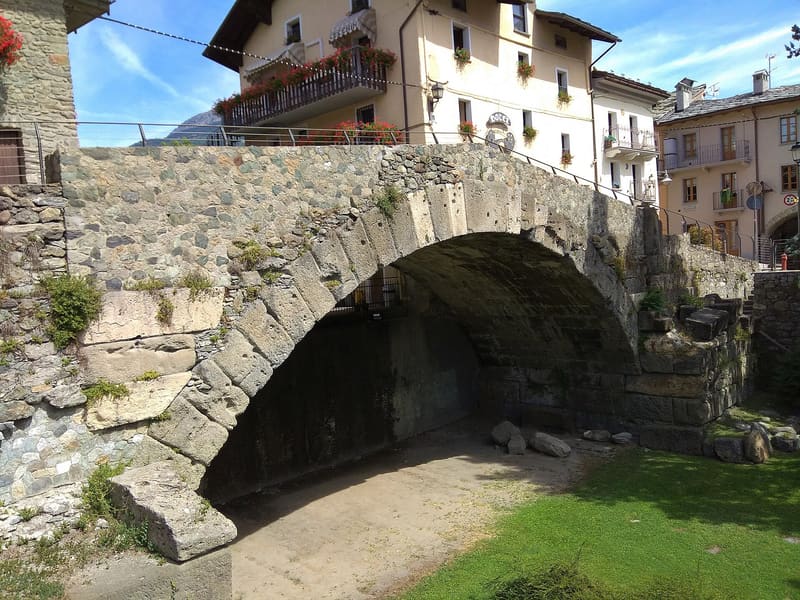
The bridge has a single humpback arch, that is, with its profile slightly raised in the centre, built of blocks of puddingstone (a conglomerate of river pebbles) bound with Roman concrete. It is incorporated into a small neighbourhood of houses, the Pont de Pierre district, and no water flows under the arch any more: you can only see a grassy bed.
Built in the Augustan period to span the Buthier stream, about 150 metres from the Arch of Augustus, it carried the road that left Augusta Praetoria towards the Great St Bernard and Little St Bernard passes. Between the eleventh and twelfth centuries a great flood buried it in sand and debris and, probably because of that very silting, the Buthier shifted its course further west, near the Arch of Augustus. The bridge remained buried until an excavation in about 1950, which brought it back to light.
If you go. The bridge is freely visible from the road, just before the present bridge over the Buthier coming from the east, near the Arch of Augustus; you can still walk across it. No opening hours or ticket: you can see it from outside at any time.
2
09:20 · 30 min
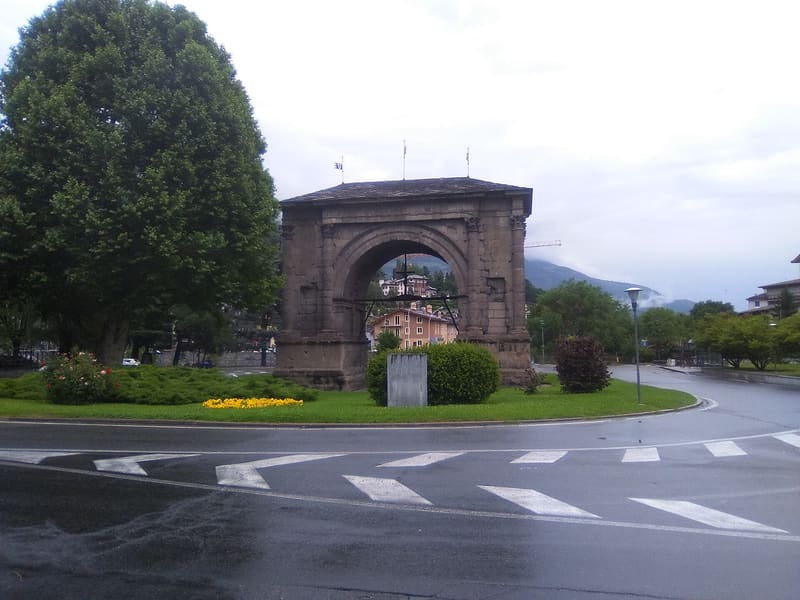
Single archway 11.40 metres high, now in the middle of a roundabout
The arch now stands in the middle of a roundabout with traffic running round it; to look at it at leisure you are best off crossing to the lawn on the west side, with benches and a hedge. Ten half-columns divide the façades and the sides and end in Corinthian capitals, but above them runs a Doric entablature with a band of triglyphs and metopes: a mixture of styles typical of the late Republican period. Next to it, towards the Buthier stream, there remains the base of the Roman bridge that once preceded it on the road to Porta Praetoria.
Erected in 25 BC after Rome's victory over the Salassi and the foundation of the colony of Augusta Praetoria, under the command of Aulus Terentius Varro Murena, the arch marked the eastern entrance to the city. In the Middle Ages it lost its original meaning: it took the name ‘Saint-Voût’ from a sacred image placed there, in the twelfth century a noble family settled in it as a dwelling, and in 1318 a fortified post for crossbowmen was built on it. In 1449 a votive wooden crucifix against the floods of the Buthier was hung on it (now in the cathedral treasury museum in Aosta); in 1716, because of water seepage, the lost attic was replaced by a slate roof. Its present appearance dates from the 1912 restoration directed by the superintendent Ernesto Schiaparelli; a new intervention, with the scaffolding removed at the end of 2025 and work on the lower part continued in spring–early summer 2026, has just freed the monument from its scaffolding.
If you go. Open-air monument, always accessible, with no ticket or opening hours; it stands on a road roundabout in the centre of Aosta.
3
10:00 · 60 min
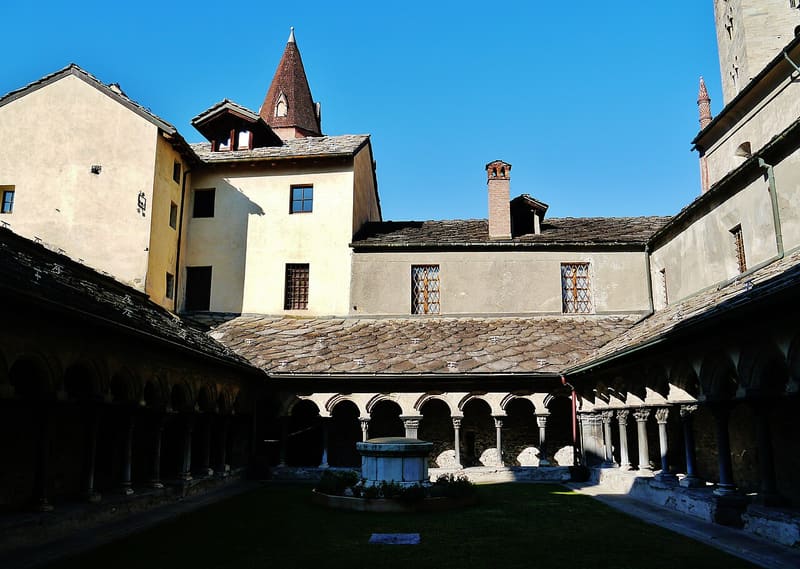
A capital in the cloister is dated 1133: the canons' communal life began here
The church lies in the Sant'Orso quarter, east of the Roman walls, in front of the 44-metre free-standing bell tower and the lime tree planted between 1530 and 1550. Giorgio di Challant's late Gothic façade, with its gable and pinnacles in terracotta, hides an eleventh-century three-aisled basilica. Inside you can see the fifteenth-century wooden choir, the five stained-glass windows of the apse, the Samson mosaic in the presbytery and the crypt with reused Roman columns; at the side, the cloister of 1132 with its historiated marble capitals, and the brick Priory with terracotta windows and the octagonal turret.
In the fifth century an Early Christian funerary complex was built on the site of a Roman necropolis; the church was rebuilt in the ninth century and then, under Bishop Anselmo (994–1025), remade with three aisles and frescoed. In 1132 the canons adopted the Rule of St Augustine and built the cloister. Prior Giorgio di Challant, from about 1468 to 1509, remade the façade, vaults, choir and stained-glass windows and built the Priory. Since 2019 the ticket office and guided tours have been entrusted to the Mirabilia association.
If you go. Admission to the church is free every day 9:00–18:00, crypt included; it cannot be visited during services. The cloister has a separate ticket (€2, €1 for under-18s, free for under-6s) and you go round it on your own with the sheet explaining the capitals: open every day, April–September 9:00–19:00, October and March 9:00–18:00, November–February 9:00–17:00, closed on 25 December. The frescoes in the roof space, the Priory chapel and the chapter house can only be seen on the guided tour, every day at 11:00 and 16:00 (at 15:00 from November to March): full price €10, concession €5 for minors and museum pass holders (a price list still online says €7: best to ask), free for under-6s; booking recommended on 329 5444625. Run by the Mirabilia cultural association. Guided tour times confirmed for 2026; the cloister opening hours are those published without a year by the operator and by the regional database, which agree with each other.
4
11:05 · 15 min
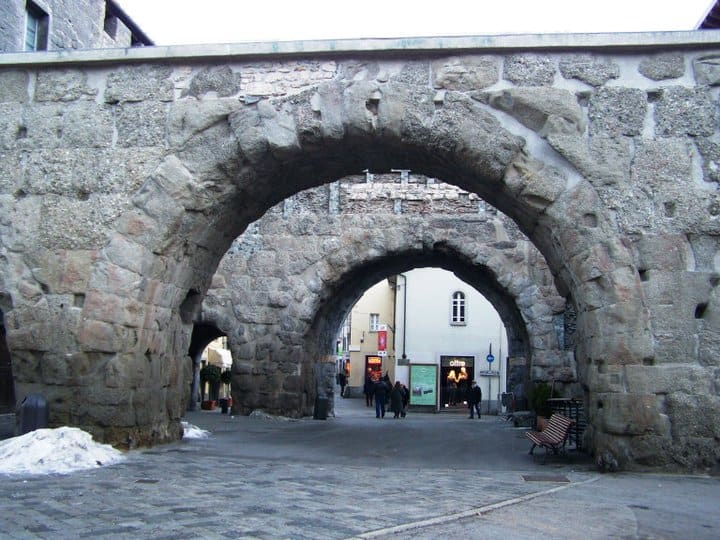
On the east side the marble facing added in the Claudian period (AD 41–54) survives
The gate has two parallel curtain walls, each with three archways: the central one, wider, was for carts, the two side ones for pedestrians. In the outer openings you can still see the groove where the portcullis ran, lowered at night. It is the only one of the four Roman gates of Aosta to have survived intact to the present day, aligned with the Arch of Augustus and the bridge over the Buthier.
It was built in 25 BC, immediately after the founding of the colony of Augusta Praetoria on the territory of the Salassi, who had just been defeated. Under the emperor Claudius (AD 41–54) the eastern façade received a facing of bardiglio and Luni marble, of which traces remain. In the twelfth century the Lords of Porta Sant'Orso built their residence on the north tower and collected tolls there, until in 1185 they moved to Quart Castle. The restorations of the 1920s removed the non-Roman additions and brought its present appearance back to light.
If you go. Free, open access at any time, in the historic centre of Aosta between Via Sant'Anselmo and Via Porta Praetoria; for any special openings or guided tours it is advisable to check beforehand.
5
11:30 · 60 min
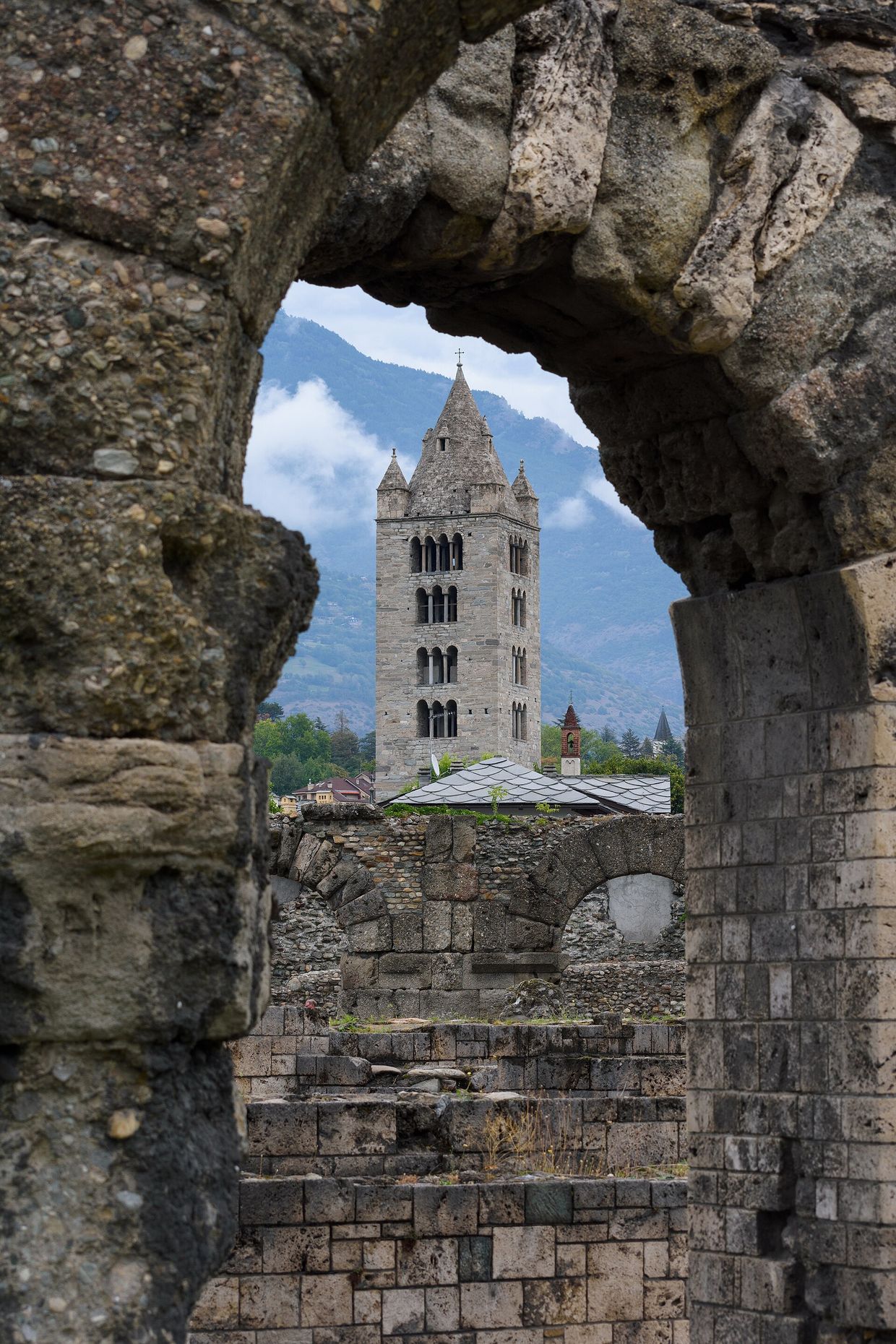
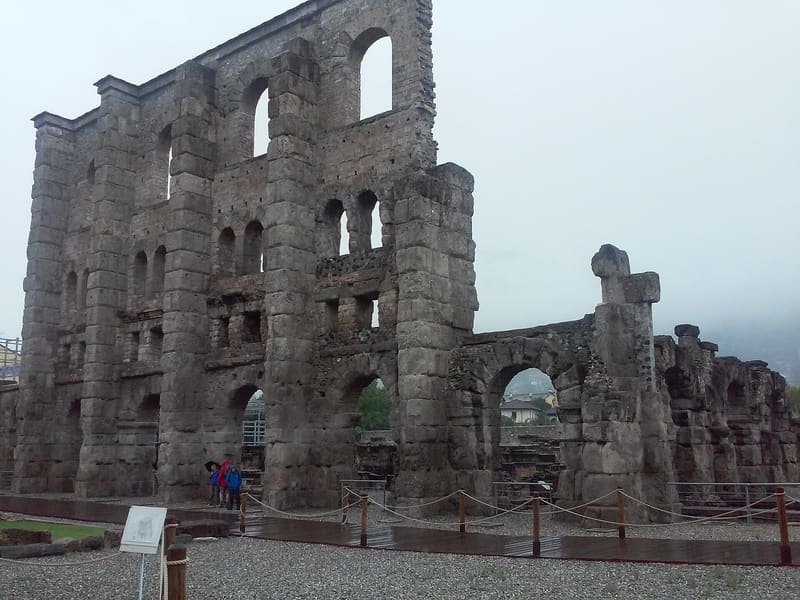
South façade 22 metres high, with three tiers of openings that get smaller towards the top
You enter from Via Charrey, no longer through the monumental entrance from Porta Praetoria, which is still being fitted out. New wooden walkways cross the building site, one of them passing between the stage and the orchestra, the semicircle with a 10-metre radius in front of the cavea. Four of the nine original arches of the south façade, which is supported by buttresses, remain, while of the others only the bases can be seen. Trilingual panels with QR codes explain the route, which still runs alongside the restoration site.
Built in the Augustan period, immediately after the founding of the colony of Augusta Praetoria in 25 BC, it probably held three to four thousand spectators. In the Middle Ages it lost its original function and farm buildings and houses were built up against it, demolished only between 1933 and 1941 during the systematic excavation and restoration of the monument; further studies between 1997 and 2000 clarified its construction phases, and the latest conservation work dates from 2009.
If you go. Partially reopened on 3 July 2026 after the closure for works that began in 2023: the redevelopment works in the Aosta east area are still under way, with completion expected on 30 June 2027, and the ticket office and the main entrance from Porta Praetoria have not yet been restored. It is included in the ‘Aosta Archeologica’ combined ticket (€10 full price, €8 concession, valid for the Roman Theatre, the Forum Cryptoporticus, the San Lorenzo Early Christian Church, the Regional Archaeological Museum and the Megalithic Area). Opening hours: April–September 9:00–19:00, October–March 10:00–13:00 and 14:00–17:00, last admission 30 minutes before closing; closed on 25 December and 1 January.
6
14:00 · 60 min
Fifth-century Latin-cross basilica, a few metres below the floor of the present church
You go down below the level of the deconsecrated church of San Lorenzo to the remains of the Early Christian funerary basilica with a cruciform plan, its arms ending in apses. Information panels accompany the route among liturgical structures, a platform with the tombs of three bishops of the fifth and sixth centuries and numerous burial chambers of the fifth to eighth centuries, above an older protohistoric funerary settlement.
The basilica was built at the beginning of the fifth century as a Latin-cross funerary church, on a Roman cemetery area that was itself laid over a protohistoric funerary settlement: local tradition calls it ‘Concilium Sanctorum’, the assembly of the saints, because it was built over the tombs of the first martyrs. The bishops Grato, Agnello and Gallo, who lived between the fifth and sixth centuries, were buried there. Destroyed by a fire and a flood in the eighth century, it was rebuilt in the ninth century on a smaller scale and lost its funerary function to become a church for worship; enlarged between the eleventh and twelfth centuries, it was substantially altered in the late Gothic period and rebuilt in 1642 with the apse moved from east to west. It remained a parish church until 1793. Excavations by the regional Superintendency brought the Early Christian basilica to light; today the building above ground, deconsecrated, hosts temporary exhibitions, while the underground archaeological area is open to the public.
If you go. It is included in the ‘Aosta Archeologica’ combined ticket (full price €10, concession €8, also valid for the Roman Theatre, Forum Cryptoporticus, Regional Archaeological Museum and Megalithic Area). Opening hours: April–September 9:00–19:00, October–March 10:00–13:00 and 14:00–17:00, last admission 30 minutes before closing; closed on 25 December and 1 January. Part of the route is wheelchair-accessible.
7
15:15 · 60 min
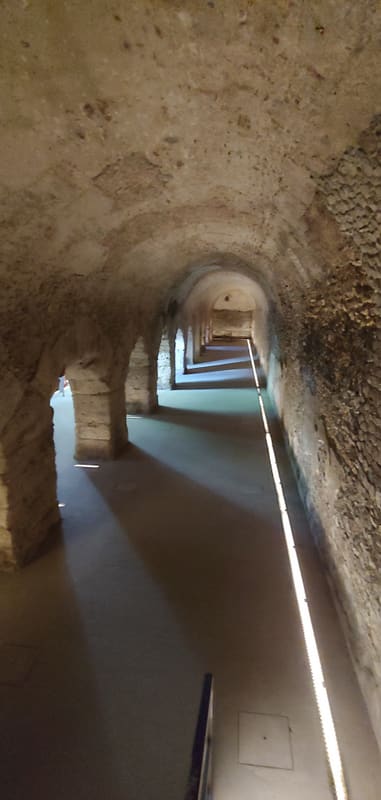
The horseshoe-shaped galleries measure 71.80 m along the sides and 87.10 m in the centre
You go down below the level of the square into a horseshoe-shaped gallery divided into two aisles covered by barrel vaults on pillars of tufa blocks. Light enters through small splayed openings known as ‘wolf's mouths’, which create a play of shadows along the whole route. It surrounded the sacred area of the Roman forum, of which the foundations of two twin temples remain visible in a garden next door.
It was built in the Augustan period to create a level terrace on which the sacred area of the forum stood, overcoming the difference in ground level. For decades it was thought to be a military warehouse, but recent studies have rejected this hypothesis in favour of a passageway between the sacred area and the public area of the forum, perhaps used by the city's elite and by the guilds. Works carried out in the early 2000s made it walkable and opened it to the public.
If you go. Opening hours: April–September 9:00–19:00, October–March 10:00–13:00 and 14:00–17:00, closed on 25 December and 1 January, last admission 30 minutes before closing. Maximum 50 people at a time, not accessible by wheelchair. Entrance from Piazza Giovanni XXIII, on the left side of the Cathedral. ‘Aosta archeologica’ combined ticket (with the Roman theatre, the regional archaeological museum, the church of San Lorenzo and the megalithic area): full price €10, concession €8.
8
16:20 · 90 min
In the basement lie the remains of the Roman Principalis Sinistra gate
The museum occupies the former Challant barracks, once the convent of the Visitandines founded in 1633. The route runs from Prehistory to the Middle Ages: anthropomorphic stelae from Saint-Martin-de-Corléans, Roman grave goods, the bronze balteus, a belt decorated with battle scenes, and an eighth-century ambo. In the basement lie the remains of the Roman Principalis Sinistra gate.
The museum was founded in 1929, with Canon Justin Boson as its first director. It is housed in the former Challant barracks, originally the convent of the Visitandines founded in 1633 by the Marquis Pierre-Philibert Roncas.
If you go. October–March 10:00–13:00 and 14:00–18:00 every day, April–September 9:00–19:00 every day; last admission 30 minutes before closing; closed on 25 December and 1 January. Entry with the ‘Aosta archeologica’ combined ticket (valid 6 months, 5 sites): full price €10, concession €8 (parties of at least 25 paying people, groups with a licensed tourist guide, Touring Club Italiano/FAI/Aosta Valley Card/Forte di Bard agreements), free for those up to and including age 25, for people with a certified disability and their companion, for school groups and for holders of the Abbonamento Musei card.
9
17:55 · 20 min
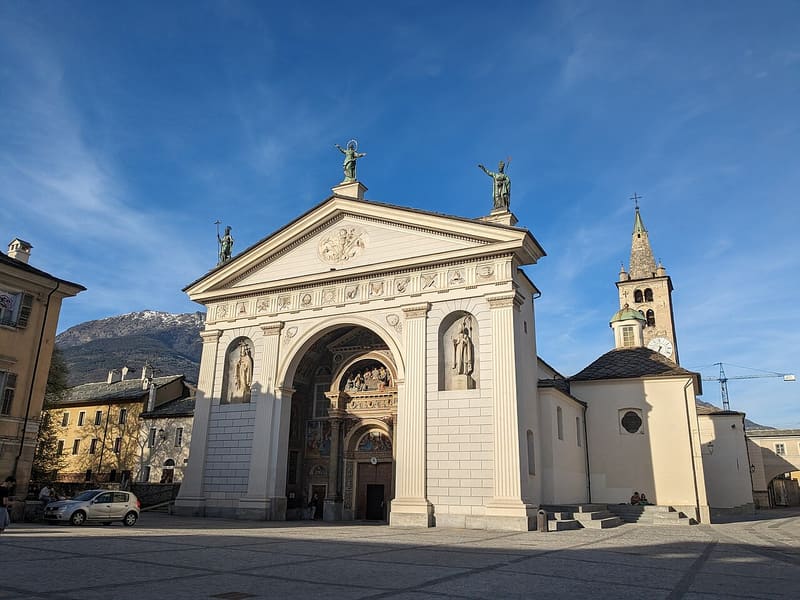
In the choir, two medieval mosaics: the twelve months and the four rivers of Paradise
From the square you see the Neoclassical façade of 1846–48, with its columns and statues; beneath its arch survives the atrium of 1522–26, frescoed and decorated in terracotta with the stories of the Virgin, the Assumption in the tympanum and the music-making angels in the vault. Behind it rise the two Romanesque bell towers with Gothic spires. Inside, three Gothic aisles: the raised choir with the fifteenth-century wooden stalls and the two floor mosaics, the late fifteenth-century stained-glass windows, the fourteenth-century wooden crucifix, the three-aisled crypt with reused Roman columns and, in a window in the floor, the Early Christian baptismal font. On the north side, the cloister of 1460.
At the end of the fourth century, in the area of the Roman forum, the first cathedral was built: a hall about forty metres long with two baptisteries. Bishop Anselmo, between 994 and 1025, remade it as a double church with three aisles and two bell towers, frescoed around the middle of the eleventh century. The thirteenth century added the Gothic ambulatory, the fifteenth the stalls, the cloister and the tombs by Stefano Mossettaz, the sixteenth the frescoed atrium; the Neoclassical façade dates from 1846–48. A national monument since 1940.
If you go. Free admission. In 2026 the church is open on Mondays, Tuesdays, Thursdays and Fridays 8:00–12:00 and 15:00–19:00, and on Wednesdays, Saturdays and Sundays 8:00–19:00; weekday Masses at 7:00, vigil Mass at 18:00, Sunday and public holiday Masses at 10:30 and 18:00. You can freely see the frescoed atrium, the nave and aisles, the choir with its stalls, the crypt (reached by the two staircases at the sides of the choir) and the Early Christian font beneath the floor of the nave. The eleventh-century frescoes in the roof space, the cloister of 1460 and the treasury are covered by the Treasury Museum ticket (€5 with the frescoes, €4 for the museum alone), with its own opening hours: see the museum's entry; the choir mosaics are also usually part of that route. The Early Christian excavations can be visited from 11 July to 6 September 2026, every day 15:00–17:30. Information on visits on 347 7346818, switchboard 0165 40251.
 1