 The Aosta Trip
Porta Praetoria
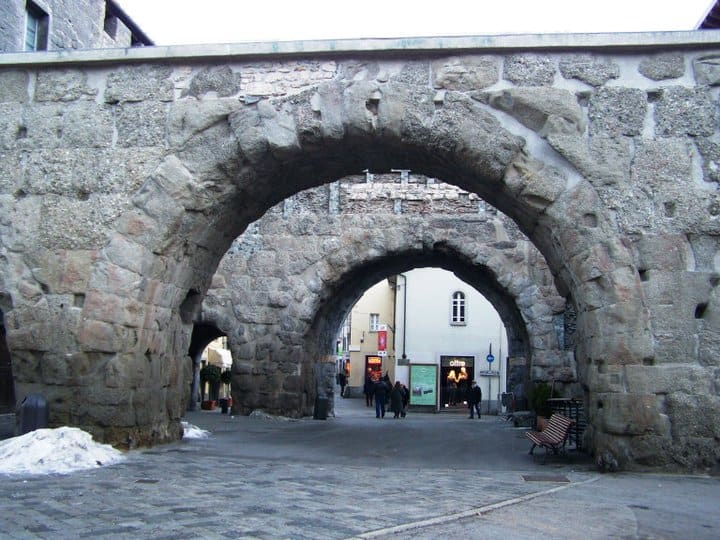
On the east side the marble facing added in the Claudian period (AD 41–54) survives
The gate has two parallel curtain walls, each with three archways: the central one, wider, was for carts, the two side ones for pedestrians. In the outer openings you can still see the groove where the portcullis ran, lowered at night. It is the only one of the four Roman gates of Aosta to have survived intact to the present day, aligned with the Arch of Augustus and the bridge over the Buthier.
 One-day guide · freeAugusta Praetoria in a DayA day's walk through Roman Aosta passes here: nine stops among gates, theatre and the forum's underground galleries.Open the guide →
Visiting
Free, open access at any time, in the historic centre of Aosta between Via Sant'Anselmo and Via Porta Praetoria; for any special openings or guided tours it is advisable to check beforehand.
History
The Porta Praetoria was built in 25 BC, just after the founding of Augusta Praetoria on the territory of the Salassi, defeated by the army of Terenzio Varrone. It stood on the eastern side of the walls, in line with the road to Eporedia (present-day Ivrea): two parallel curtain walls with three arches each, the central one for carts and the two side ones for pedestrians, which could be closed at night by portcullises whose grooves still remain.
Under the emperor Claudius (AD 41–54) the gate was embellished: a cladding of bardiglio and Luni marble, partly still visible, was applied to the eastern façade; it therefore did not belong to the original Augustan design but to a later intervention.
In the twelfth century the Lords of Porta Sant'Orso, a feudal family who collected tolls on those passing through, built their fortified residence in the north tower of the gate and added a chapel dedicated to the Trinity, with its apse facing the eastern sentry walk: from this chapel the gate took for centuries the name ‘Porta della Trinità’. The Lords left the residence in 1185 to move to Quart Castle.
The medieval structures were largely removed during the restoration carried out in the 1920s, which brought the Roman appearance of the monument back to light; the chapel was finally demolished in 1926 and a small oratory was built in its place on the east side.
Today the Porta Praetoria is the only one of the four Roman gates of Aosta to have survived almost intact, freely accessible and open to visitors in the historic centre of the city, between Via Sant'Anselmo and Via Porta Praetoria.
Nearby
 Roman TheatreSouth façade 22 metres high, with three tiers of openings that get smaller towards the top
 Tour FromageMentioned in a deed of 1191, from the fifteenth century it passed to the Vaudan by marriage
 San Lorenzo Early Christian Church Archaeological AreaFifth-century Latin-cross basilica, a few metres below the floor of the present church
 Roman AmphitheatreOf the sixty arches from the first century AD only eight remain, inside a convent
 Sant'Orso Collegiate ChurchA capital in the cloister is dated 1133: the canons' communal life began here
 AostaOn 30 and 31 January the Sant'Orso Fair brings over a thousand artisans to the centre