 The Aosta Trip
Aosta Roman Bridge
Pont de Pierre
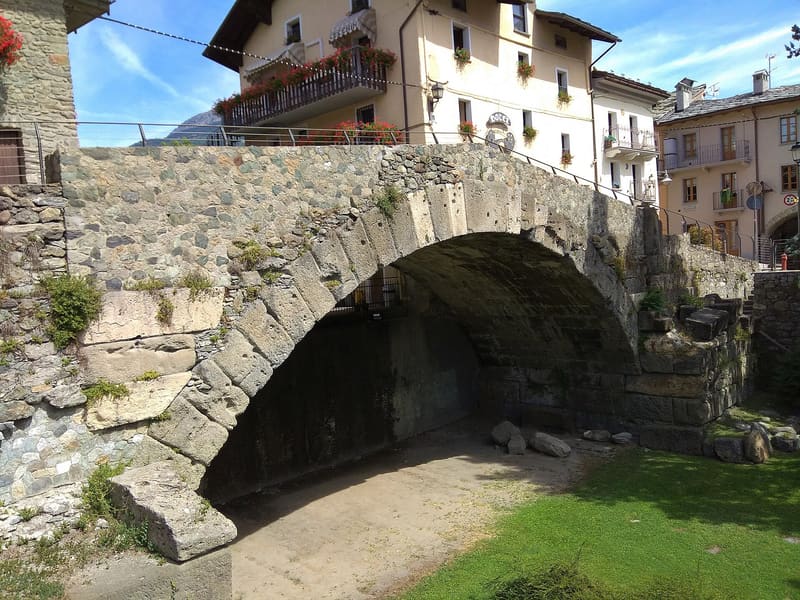
Its single arch, 17 metres wide, now spans a dry bed
The bridge has a single humpback arch, that is, with its profile slightly raised in the centre, built of blocks of puddingstone (a conglomerate of river pebbles) bound with Roman concrete. It is incorporated into a small neighbourhood of houses, the Pont de Pierre district, and no water flows under the arch any more: you can only see a grassy bed.
 One-day guide · freeAugusta Praetoria in a DayA day's walk through Roman Aosta passes here: nine stops among gates, theatre and the forum's underground galleries.Open the guide →
Visiting
The bridge is freely visible from the road, just before the present bridge over the Buthier coming from the east, near the Arch of Augustus; you can still walk across it. No opening hours or ticket: you can see it from outside at any time.
History
The bridge was built in the Augustan period, in the second half of the first century BC, to carry the Roman road over the Buthier stream just outside the walls of Augusta Praetoria, about 150 metres east of the Arch of Augustus. It consists of a single hump-backed arch, that is with the road surface slightly raised in the centre to reduce the gradient, 17.1 metres wide, built of blocks of puddingstone (a conglomerate of river pebbles quarried along the Dora Baltea) and filled with Roman concrete. The bridge carried the road which, a little further on in the city, divided towards the Great St Bernard and Little St Bernard passes.
For centuries the bridge remained exposed to the floods of the Buthier, until between the eleventh and the twelfth centuries an exceptional flood almost completely buried it under sand and debris. It is likely that this very burial pushed the stream to shift its course further west, towards the Arch of Augustus. The bridge was left dry and the houses that grew up around it gradually absorbed it: the district took the name Pont de Pierre.
Buried and forgotten for centuries beneath the street level of the neighbourhood, the bridge was brought fully back to light by an excavation carried out around 1950, which cleared its arch of the accumulated debris.
Today the Roman bridge can still be crossed on foot, wedged between the houses of the district, and it is the first ancient monument you come across when entering Aosta from the east: beneath the arch, instead of water, you see only the old grassy bed of the stream.
Nearby
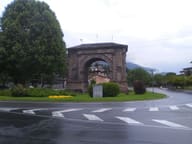 Honorary Arch of AugustusSingle archway 11.40 metres high, now in the middle of a roundabout
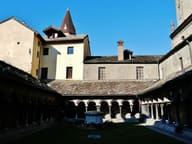 Sant'Orso Collegiate ChurchA capital in the cloister is dated 1133: the canons' communal life began here
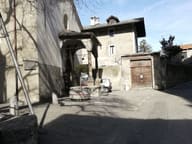 San Lorenzo Early Christian Church Archaeological AreaFifth-century Latin-cross basilica, a few metres below the floor of the present church
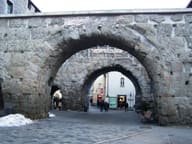 Porta PraetoriaOn the east side the marble facing added in the Claudian period (AD 41–54) survives
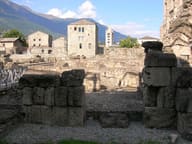 Tour FromageMentioned in a deed of 1191, from the fifteenth century it passed to the Vaudan by marriage
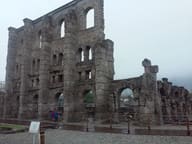 Roman TheatreSouth façade 22 metres high, with three tiers of openings that get smaller towards the top