 The Aosta Trip
Map › Churches and sanctuaries
Sant'Orso Collegiate Church
Collégiale Saint-Ours
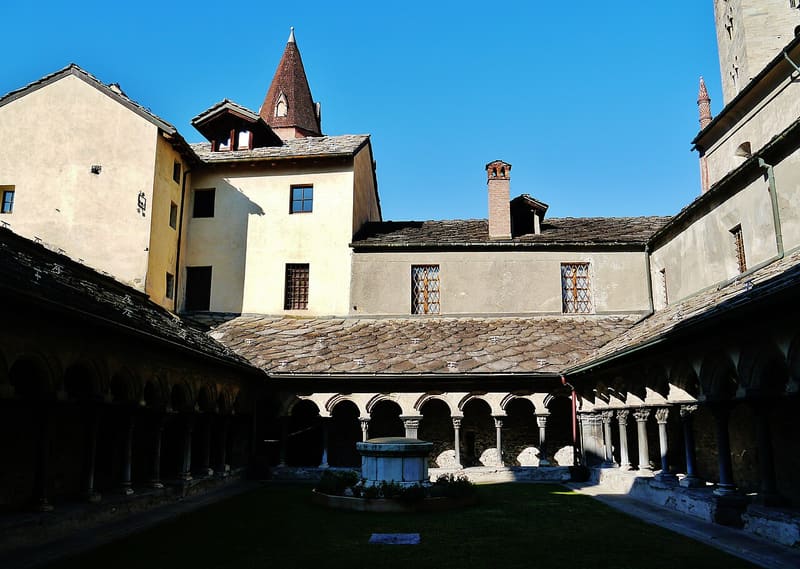
A capital in the cloister is dated 1133: the canons' communal life began here
The church lies in the Sant'Orso quarter, east of the Roman walls, in front of the 44-metre free-standing bell tower and the lime tree planted between 1530 and 1550. Giorgio di Challant's late Gothic façade, with its gable and pinnacles in terracotta, hides an eleventh-century three-aisled basilica. Inside you can see the fifteenth-century wooden choir, the five stained-glass windows of the apse, the Samson mosaic in the presbytery and the crypt with reused Roman columns; at the side, the cloister of 1132 with its historiated marble capitals, and the brick Priory with terracotta windows and the octagonal turret.
 One-day guide · freeAugusta Praetoria in a DayA day's walk through Roman Aosta passes here: nine stops among gates, theatre and the forum's underground galleries.Open the guide →
Visiting
Admission to the church is free every day 9:00–18:00, crypt included; it cannot be visited during services. The cloister has a separate ticket (€2, €1 for under-18s, free for under-6s) and you go round it on your own with the sheet explaining the capitals: open every day, April–September 9:00–19:00, October and March 9:00–18:00, November–February 9:00–17:00, closed on 25 December. The frescoes in the roof space, the Priory chapel and the chapter house can only be seen on the guided tour, every day at 11:00 and 16:00 (at 15:00 from November to March): full price €10, concession €5 for minors and museum pass holders (a price list still online says €7: best to ask), free for under-6s; booking recommended on 329 5444625. Run by the Mirabilia cultural association. Guided tour times confirmed for 2026; the cloister opening hours are those published without a year by the operator and by the regional database, which agree with each other.
History
The village of Sant'Orso grew up outside the Porta Praetoria, along the road from Ivrea that entered the city as an extension of the decumanus. Excavations have found a Roman necropolis beneath the church and, in the early fifth century, a Christian funerary complex made up of two churches: the cruciform basilica of San Lorenzo, where the first bishops of Aosta were buried, and a hall with an apse on the site of the present collegiate church. According to tradition Orso was a priest here, the saint who gives the village its name and whom iconography shows with a small bird on his shoulder; the sources place him between the sixth and eighth centuries, and his miracles, from the spring he made gush forth at Busseyaz to the prophecy against Bishop Ploceano, are carved on a capital in the cloister. The church was entirely rebuilt in the ninth century and in 989 received a bell tower on the façade, of which about 15 metres survive in the present wall.
Bishop Anselmo, who led the diocese from 994 to 1025 and whom the collegiate church's necrology remembers as the one who ‘built our church’, rebuilt it in Romanesque form: three aisles with a trussed roof, three apses, the choir raised above a crypt in two chambers, with reused Roman columns. The walls were covered with an eleventh-century fresco cycle, the work of the same Lombard workshop that was painting the cathedral: the Last Judgement, the Wedding at Cana, the Storm on the Lake, the martyrdoms of the apostles. The late fifteenth-century cross vaults cut off its lower band; the upper band survives in the roof space, reached by a walkway installed in 1965. The free-standing bell tower on the square, 44 metres high, dates from the twelfth century and was part of a defensive circuit: the base is made of large squared blocks perhaps taken from the Roman monuments, the upper part dates from the thirteenth century and the clock already existed in 1642.
In 1132 Bishop Eriberto, with the consent of Pope Innocent II, imposed the Rule of St Augustine on the canons: communal life, with meals and prayer together. This required a dormitory and a refectory around a cloister, and a capital bears the date: ‘in the year of the Incarnation 1133 the regular life began in this cloister’, that is, 1132 by the present calendar. Of the 52 original capitals about forty remain, in white marble on bardiglio columns, originally painted: scenes from the Old and New Testaments, the life of St Orso, the fable of the fox and the stork, and Eriberto himself with the first prior, Arnolfo d'Avise. The present arches and vaults come from rebuildings in the fifteenth and eighteenth centuries; after the obligation of communal life had lapsed in 1644, between the eighteenth and nineteenth centuries some capitals were dispersed and four ended up in the Turin Civic Museum.
The second phase is that of Giorgio di Challant, prior from about 1468 to 1509 and leading figure of the artistic renewal in the Aosta Valley, the same Giorgio di Challant as at Issogne Castle. He had the façade rebuilt (1492–94) with the terracotta gable and pinnacles, replaced the wooden ceiling with cross vaults, had the soffits of the arches painted around 1499 by the workshop of Master Colin, had the choir stalls made and commissioned the five stained-glass windows of the apse (1494–1503) from the master glaziers Jean Baudichon and Pietro Vaser, and a high altar, now lost, from the Burgundian Antoine de Lonhy; he was buried beneath the high altar. Next to the church he built the Priory, three brick wings with cross-mullioned windows framed in terracotta and an octagonal turret with a spiral staircase: at the top is the late fifteenth-century chapel, entirely frescoed, where the prior is portrayed praying before the Madonna, among the stories of St George.
The 1999 excavations in the choir uncovered a twelfth-century square mosaic, 3 metres per side, with Samson fighting the lion, surrounded by the palindromic inscription ‘Sator arepo tenet opera rotas’. In 2009 the Region commissioned a feasibility study for the restoration of the whole complex and provided by law for work on the church from 2010 to 2015, while the Superintendency had already begun, in 2008, the urgent restoration of the gable and the study of the paintings in the roof space. The complex remains the property of the Collegiate Church; since 14 October 2019 the ticket office and guided tours have been entrusted to the Mirabilia cultural association. In front of the church the lime tree planted between 1530 and 1550 is still alive, protected as a monumental tree.
Nearby
 San Lorenzo Early Christian Church Archaeological AreaFifth-century Latin-cross basilica, a few metres below the floor of the present church
 Tour FromageMentioned in a deed of 1191, from the fifteenth century it passed to the Vaudan by marriage
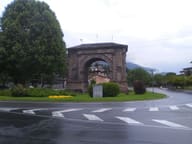 Honorary Arch of AugustusSingle archway 11.40 metres high, now in the middle of a roundabout
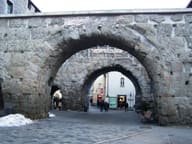 Porta PraetoriaOn the east side the marble facing added in the Claudian period (AD 41–54) survives
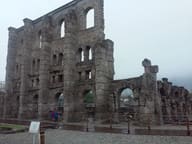 Roman TheatreSouth façade 22 metres high, with three tiers of openings that get smaller towards the top
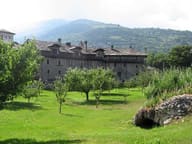 Roman AmphitheatreOf the sixty arches from the first century AD only eight remain, inside a convent