 The Aosta Trip
Map › Churches and sanctuaries
Aosta Cathedral
Cathédrale Notre-Dame-de-l'Assomption
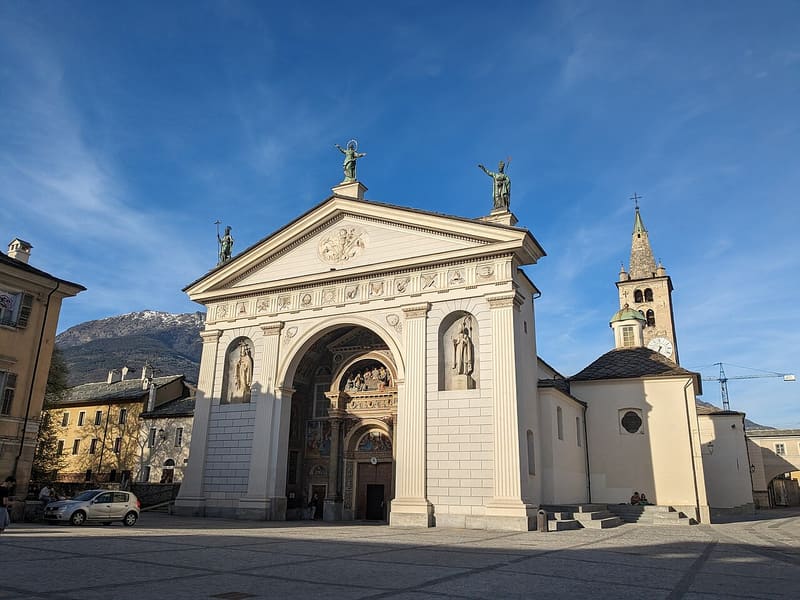
In the choir, two medieval mosaics: the twelve months and the four rivers of Paradise
From the square you see the Neoclassical façade of 1846–48, with its columns and statues; beneath its arch survives the atrium of 1522–26, frescoed and decorated in terracotta with the stories of the Virgin, the Assumption in the tympanum and the music-making angels in the vault. Behind it rise the two Romanesque bell towers with Gothic spires. Inside, three Gothic aisles: the raised choir with the fifteenth-century wooden stalls and the two floor mosaics, the late fifteenth-century stained-glass windows, the fourteenth-century wooden crucifix, the three-aisled crypt with reused Roman columns and, in a window in the floor, the Early Christian baptismal font. On the north side, the cloister of 1460.
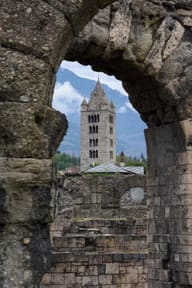 One-day guide · freeAugusta Praetoria in a DayA day's walk through Roman Aosta passes here: nine stops among gates, theatre and the forum's underground galleries.Open the guide →
Visiting
Free admission. In 2026 the church is open on Mondays, Tuesdays, Thursdays and Fridays 8:00–12:00 and 15:00–19:00, and on Wednesdays, Saturdays and Sundays 8:00–19:00; weekday Masses at 7:00, vigil Mass at 18:00, Sunday and public holiday Masses at 10:30 and 18:00. You can freely see the frescoed atrium, the nave and aisles, the choir with its stalls, the crypt (reached by the two staircases at the sides of the choir) and the Early Christian font beneath the floor of the nave. The eleventh-century frescoes in the roof space, the cloister of 1460 and the treasury are covered by the Treasury Museum ticket (€5 with the frescoes, €4 for the museum alone), with its own opening hours: see the museum's entry; the choir mosaics are also usually part of that route. The Early Christian excavations can be visited from 11 July to 6 September 2026, every day 15:00–17:30. Information on visits on 347 7346818, switchboard 0165 40251.
History
The cathedral stands on the south side of the sacred area of the forum of Augusta Praetoria, next to the cryptoporticus. Excavations have found a first-century AD building east of the cryptoporticus and, between the late third and the early fourth century, a large residence 30 metres per side with its rooms around a courtyard; around the middle of the fourth century some rooms were used by the Christian community and at the end of the century, within that complex, the cathedral was built: a single apsed hall about 40 metres long, with a baptistery to the west, a second baptistery and rooms for the clergy, partly created within the cryptoporticus. It is the oldest Christian building in the Aosta Valley. A window in the floor of the central nave still shows the large immersion font.
Bishop Anselmo (994–1025) rebuilt it on the model of the German episcopal complexes of the Ottonian period: two churches in line, San Giovanni Battista to the west and Santa Maria to the east, a three-aisled basilica of 54 by 32 metres, with the central nave more than 15 metres high, a trussed roof, the choir raised above the crypt and two bell towers on either side of the apse; to the west there was no true façade, because the building rested against the Roman cryptoporticus. Around the middle of the eleventh century the nave was entirely frescoed by painters from the Lombard area, the same ones as at Sant'Orso: the stories of St Eustace, Moses and the plagues of Egypt, the angels, an arcaded frieze with portraits of the bishops. Hidden by the fifteenth-century vaults, the fragments were rediscovered in the roof space in 1979 and, together with Sant'Orso, make Aosta one of the main centres of Ottonian painting in Europe. The three-aisled crypt, with small medieval columns and reused Roman columns, long served as the burial place of the bishops.
Between the twelfth and fourteenth centuries the choir received its two floor mosaics: the first, from the twelfth century, with Christ between the sun and the moon, the twelve months and the four rivers of Paradise; the second, from the thirteenth or fourteenth century, with real and fantastic animals and the rivers Tigris and Euphrates. From the same period comes a first cycle of painted glass windows, of which two roundels survive in the Treasury. At the end of the thirteenth century the Romanesque apses were demolished to build the Gothic ambulatory with three radiating chapels and the apse with five tall windows, and a French-style rood screen separated the choir from the nave. The large wooden crucifix hanging in the nave dates from the fourteenth century.
The fifteenth century was the golden age. The sculptor and architect Stefano Mossettaz fitted out the funerary chapels and carved a new tomb for Thomas II of Savoy, buried in the cathedral more than a century earlier: the figure lies in armour with a lion at his feet, in the idiom of Franco-Flemish International Gothic. The Flemish goldsmith Jean de Malines completed the reliquary chest of St Grato in 1458; the Savoyard architect Pierre Berger built, on the site of the Romanesque cloister, the trapezoidal cloister completed in 1460, with bardiglio pillars and gypsum capitals bearing the names of canons and donors; the woodcarvers Jean Vion de Samoëns and Jean de Chetro carved the choir stalls around 1460–1470, with apostles and prophets on the backs and grotesque figures on the misericords. Between the late fifteenth and the early sixteenth century the old church of San Giovanni was partly demolished, the nave was extended westwards by two bays and covered with cross vaults, and the windows were filled with stained glass; between 1522 and 1526 the façade was built, with the porch frescoed in the Lombard style and decorated in terracotta with the stories of the Virgin.
The following centuries brought the frescoes of the first chapel on the right (1570–80), the Mannerist reliquary by the goldsmith and priest Joseph Javin (1613), the marble high altar by Francesco Albertolli (1758) and, between 1846 and 1848, the Neoclassical façade by the architect Gayo, which enclosed the Renaissance porch within its arch. Around 1860 the Neo-Gothic Rosary chapel cost a large part of the south wing of the cloister. The cathedral has been a national monument since 1940; the Treasury Museum has been open in the ambulatory since 1984; in 2007 Bishop Anfossi had the chapel for the bishops' burials created at the base of the south bell tower, and in 2012 the restoration of the Rosary chapel, now the weekday chapel, was completed.
Nearby
 Aosta Cathedral Treasury MuseumThe ivory diptych of 406: the consul Probus had the emperor Honorius carved on it
 Forum CryptoporticusThe horseshoe-shaped galleries measure 71.80 m along the sides and 87.10 m in the centre
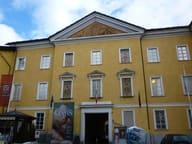 MAR - Regional Archaeological MuseumIn the basement lie the remains of the Roman Principalis Sinistra gate
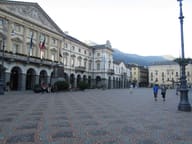 AostaOn 30 and 31 January the Sant'Orso Fair brings over a thousand artisans to the centre
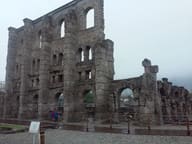 Roman TheatreSouth façade 22 metres high, with three tiers of openings that get smaller towards the top
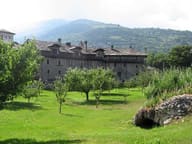 Roman AmphitheatreOf the sixty arches from the first century AD only eight remain, inside a convent