 The Aosta Trip
MAR - Regional Archaeological Museum
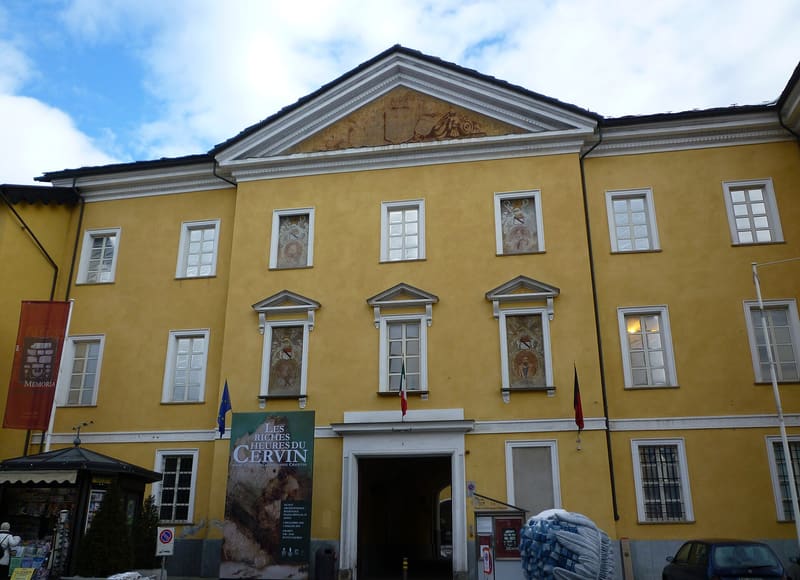
In the basement lie the remains of the Roman Principalis Sinistra gate
The museum occupies the former Challant barracks, once the convent of the Visitandines founded in 1633. The route runs from Prehistory to the Middle Ages: anthropomorphic stelae from Saint-Martin-de-Corléans, Roman grave goods, the bronze balteus, a belt decorated with battle scenes, and an eighth-century ambo. In the basement lie the remains of the Roman Principalis Sinistra gate.
 One-day guide · freeAugusta Praetoria in a DayA day's walk through Roman Aosta passes here: nine stops among gates, theatre and the forum's underground galleries.Open the guide →
Visiting
October–March 10:00–13:00 and 14:00–18:00 every day, April–September 9:00–19:00 every day; last admission 30 minutes before closing; closed on 25 December and 1 January. Entry with the ‘Aosta archeologica’ combined ticket (valid 6 months, 5 sites): full price €10, concession €8 (parties of at least 25 paying people, groups with a licensed tourist guide, Touring Club Italiano/FAI/Aosta Valley Card/Forte di Bard agreements), free for those up to and including age 25, for people with a certified disability and their companion, for school groups and for holders of the Abbonamento Musei card.
Collections
Collecting room — The tour opens with the memory of canon Justin Boson, first director of the Royal Museum in 1929: on display are North African pottery and oil lamps together with Sumerian tablets of economic texts from the Third Dynasty of Ur (2100–2000 BC).
Prehistory and protohistory — Next comes the section with the anthropomorphic stelae found at the Saint-Martin-de-Corléans site, alongside material ranging from the Mesolithic to the time of the Salassi, a pre-Roman Alpine people.
Roman period — This is the largest section: a model reconstructs the city of Augusta Praetoria (present-day Aosta); there are grave goods from the San Rocco necropolis, the remains of a thermopolium (a public establishment selling food and drink) and a silver bust of Jupiter Graius, found at the Little St Bernard Pass. The best-known piece is the balteus, a Roman soldier's bronze belt decorated with a battle scene between Romans and Barbarians.
Christian and medieval period — The tour ends with a room containing the eighth-century ambo (the pulpit from which the liturgical readings were read), found in the excavations of Aosta Cathedral, together with grave goods from the fourth to the fourteenth century.
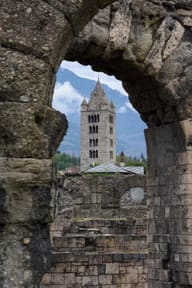
The underground rooms — They hold the remains of the Porta Principalis Sinistra, one of the entrances to the Roman city, with the floor levels of the period.
The private collections — The Pautasso collection gathers coins from the Greek period to the Savoyard period; the Carugo collection includes Etruscan, Egyptian and Mesopotamian finds.
History
The building that now houses the MAR stands on a fortified house, the fortified house of a noble family, that belonged to the Vaudan family. In 1633 the marquis Pierre-Philibert Roncas and his wife Émérentienne de Vaudan turned it into a convent for the Visitandine nuns; the monastery took on its present appearance around the middle of the eighteenth century. From 1802 the building became a barracks, named after the Challant, the family of soldiers and governors of the Aosta Valley who are also remembered in the nineteenth-century frescoes on the façade; some rooms were adapted as stables, a theatre and storerooms.
The excavations carried out before the restoration work uncovered, beneath the building, the remains of the Porta Principalis Sinistra, one of the four gates of the Roman city of Augusta Praetoria, together with a stretch of the ring of walls: today they can be visited along underground routes.
The museum was founded as the Royal Museum in 1929, with canon Justin Boson as its first director; the first room is now dedicated to his memory and to the theme of collecting. Two private collections are linked to the museum: the Pautasso numismatic collection, about 720 coins from the Greek period to the Savoyard period, and the Carugo collection, with Etruscan, Egyptian and Mesopotamian finds.
The ground floor of the former barracks was later converted into the Regional Archaeological Museum, which today tells the story of human presence in the valley from the Mesolithic to the late Middle Ages; the upper floors host the art exhibitions organised by the regional department of culture.
Nearby
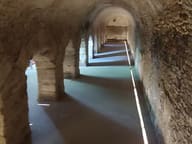 Forum CryptoporticusThe horseshoe-shaped galleries measure 71.80 m along the sides and 87.10 m in the centre
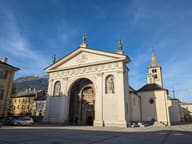 Aosta CathedralIn the choir, two medieval mosaics: the twelve months and the four rivers of Paradise
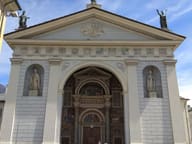 Aosta Cathedral Treasury MuseumThe ivory diptych of 406: the consul Probus had the emperor Honorius carved on it
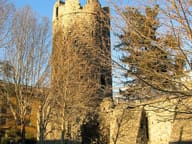 Tour NeuveCrenellated cylindrical tower at the north-west corner, of the De Turre Nova lords
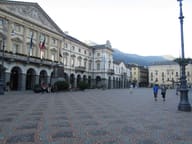 AostaOn 30 and 31 January the Sant'Orso Fair brings over a thousand artisans to the centre
- Porta DecumanaWest gate demolished in 1812; the remains are in the basement of the Regional Library