 The Aosta Trip
Bailiffs' Tower
Tour du Bailliage
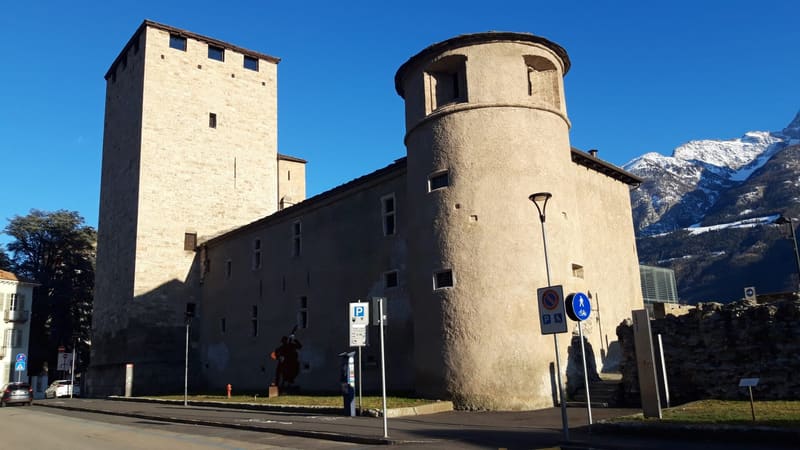
Residence of the bailiffs, then a prison until 1984, now the Conservatoire
At the north-east corner of the walls, between Via Guido Rey and Via Jean-Baptiste de la Pierre, the tower appears as an elongated fortified block, with a circular tower marking its corner. In some stretches, the facing of small blocks was obtained by dismantling pieces of the adjacent Roman walls. It cannot be entered as a tourist site: you see it from outside, as the home of the Aosta Valley Conservatoire.

Visiting
It cannot be visited as an archaeological site: it is the working home of the Aosta Valley Conservatoire. The exterior can be freely seen from the street.
History
At the north-east corner of the Roman walls, between today's Via Guido Rey and Via Jean-Baptiste de la Pierre, stands a tower built in the Middle Ages on the structures of an earlier Roman corner tower, mentioned in a document as early as 1192.
In the thirteenth century the tower was remodelled by the noble De Palais, or De Palacio, family, who controlled it: to raise the structure, the De Palais partly dismantled the adjacent Roman walls and reused their blocks. In 1263 Guglielmo De Palacio ceded it to the Count of Savoy, while keeping some rights over the building until 1311, when another member of the family, Aimone, transferred his own claims to his brother.
From the fifteenth century the tower became the seat of the bailiffs, the officials who administered the Aosta Valley on behalf of the Count of Savoy (hence the name, Tour du Bailliage in Old French): in 1406, under the bailiff Jean de Pectigny, a circular tower and a west wing were built there, while in 1540, under Antonio di Leschaux, the building was enlarged further. In the same period the valley's court and prisons also moved there.
In 1626 the ducal representatives left the tower for the more suitable seat of Palazzo Roncas: from then on the building kept only its function as a prison, until the penitentiary closed in 1984, which left it empty for years.
After a restoration completed in 2013, since 2014 the tower has housed the accredited Aosta Valley Music Institute, the Conservatoire: the exterior can be seen freely from the street, but the building cannot be visited as an archaeological site.
Nearby
 Roman AmphitheatreOf the sixty arches from the first century AD only eight remain, inside a convent
 Tour FromageMentioned in a deed of 1191, from the fifteenth century it passed to the Vaudan by marriage
 Roman TheatreSouth façade 22 metres high, with three tiers of openings that get smaller towards the top
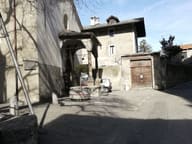 San Lorenzo Early Christian Church Archaeological AreaFifth-century Latin-cross basilica, a few metres below the floor of the present church
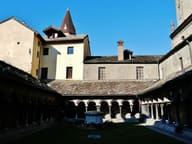 Sant'Orso Collegiate ChurchA capital in the cloister is dated 1133: the canons' communal life began here
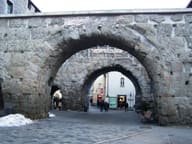 Porta PraetoriaOn the east side the marble facing added in the Claudian period (AD 41–54) survives