 The Aosta Trip
Roman Amphitheatre
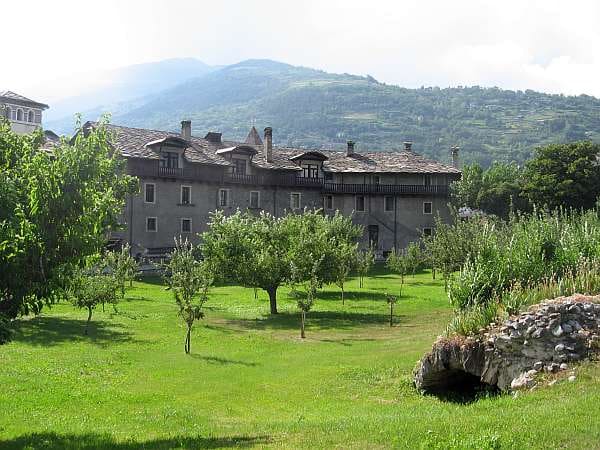
Of the sixty arches from the first century AD only eight remain, inside a convent
The monument is almost entirely buried: from outside the convent you can see nothing. Going in, you find a courtyard with an orchard in place of the arena and, on one side, eight arches on two levels built into the walls of the monastery. Unlike the nearby Roman theatre, here there are no tiers of seating or remains of the stage, only the curve of the perimeter wall.

Visiting
The monument is privately owned and lies inside the convent of the Sisters of St Joseph, at Via Anfiteatro 4 in Aosta (phone 0165 262149). There are no public opening hours on record: you ask for access at the convent's porter's lodge, and the visit, when granted, is accompanied by the sisters. Some visitors report being welcomed without difficulty, but on other occasions access has been refused: it is best to phone the convent before going.
History
The amphitheatre was built next to the Roman theatre, in the north-eastern sector of the city, probably in the Julio-Claudian period (first century AD), a few decades after the foundation of Augusta Praetoria in 25 BC. It had an elliptical plan of about 94x74 metres, with sixty arches arranged on two levels and two tiers of seating: the public climbed to their seats by twelve staircases and moved between the sectors along an open corridor.
With the spread of Christianity and the end of the gladiatorial games, the building lost its function and began to be stripped of its building stone. By the Middle Ages its Roman origin had been forgotten: documents call it palatium rotundum, ‘round palace’, and a family that held control of it took from this the name De Palacio or Du Palais.
In 1247 the Viscount of Aosta, Goffredo di Challant, had a convent built on the ruins to house the Catherinian nuns fleeing from Valais: the new walls incorporated the surviving Roman arches, eight of which are still visible today in the north-west sector. The complex was altered in 1496 and again after the Napoleonic suppressions of 1803; since 1831 the Sisters of St Joseph have been established there, and they still occupy it.
Today the monument is privately owned, incorporated into the convent in Via Anfiteatro in Aosta. The arena, occupied by an orchard, and the Roman arches can only be visited by asking the sisters for permission: according to visitors' accounts, access is granted but not guaranteed on every occasion.
Nearby
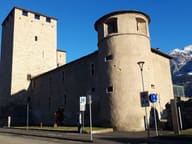 Bailiffs' TowerResidence of the bailiffs, then a prison until 1984, now the Conservatoire
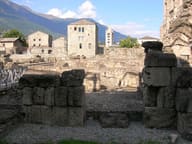 Tour FromageMentioned in a deed of 1191, from the fifteenth century it passed to the Vaudan by marriage
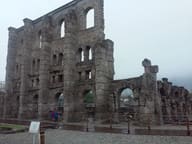 Roman TheatreSouth façade 22 metres high, with three tiers of openings that get smaller towards the top
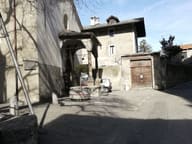 San Lorenzo Early Christian Church Archaeological AreaFifth-century Latin-cross basilica, a few metres below the floor of the present church
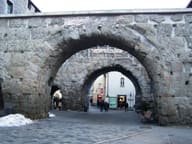 Porta PraetoriaOn the east side the marble facing added in the Claudian period (AD 41–54) survives
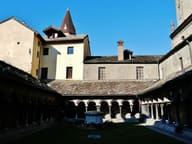 Sant'Orso Collegiate ChurchA capital in the cloister is dated 1133: the canons' communal life began here