 The Aosta Trip
Ru Neuf
Medieval channel carrying the water of the Artanavaz from Étroubles to the Aosta hillside
An almost level path follows the channel for about 13 km, from the intake below Étroubles to the hillside above Arpuilles, mostly through woodland. The ru runs half in the open and the rest in a tunnel or pipe, with suspended sections protected by a railing. Along the way there are the ‘Je te salue’ grotto with the statue of the Madonna and the crossing of the Buthier; from the plateau of Arpuilles and Excenex you can see from the Velan to the Ruitor, by way of the Emilius.

Visiting
The whole route, from Reysod to Étroubles, is 10.3 km and almost level; it is usually done in sections, from the access points along the channel (L'Ilette, Échevennoz, La Clusaz, above Condéminaz, Pierre-Besse, Roisod and Excenex, Plan d'Avie). Two short sections: Échevennoz–Gignod, 5.3 km and 1h20 one way, 32 m height gain, easy, from April to November, with a car park at Échevennoz (turn off before the viaduct towards Chez-Les-Blancs-Dessus), a short variant from La Clusaz of 3.7 km, back the same way or by bus from Gignod; and Plan d'Avie–Roisod, above Arpuilles and Excenex, about an hour, by car as far as the former La Baita holiday camp.
Trails
- from Reysod (1,209 m) · ↑ 67 m · 2 h 42 min out, 2 h 37 min back · 10.3 km · E Walk · path 1 · May–October
Trails: data provided by the Struttura Forestazione e Sentieristica of the Aosta Valley Autonomous Region.
History
The channel takes the water of the Artanavaz below Étroubles and carries it to the dry fields of the Aosta hillside, which it still irrigates today. It is a medieval work: in the Middle Ages the inhabitants of Gignod and Échevennoz quarrelled over its maintenance, and some experts set the rules for dividing the work.
Nearby
- Ru BourgeoisFourteenth-century channel that crosses the Aosta hillside, lower down than the Ru Neuf
- Rifugio ChaligneAn old stone and wood alpine-pasture chalet, which became a hut on 21 June 2006
- Punta ChaligneEvery 16 August two processions, from Gignod and from Excenex, climb to the summit crosses
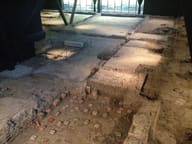 Consolata Roman VillaDiscovered by chance in 1971 during the construction of a building
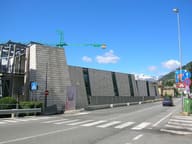 Saint-Martin-de-Corléans Megalithic Area (MegaMuseo)46 anthropomorphic stelae discovered 6 metres below street level
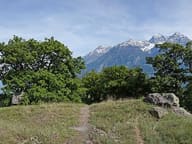 Tsatelet Nature ReserveOn the summit, a late Neolithic settlement from around 3000 BC and its necropolis