 The Aosta Trip
Aosta
Aoste
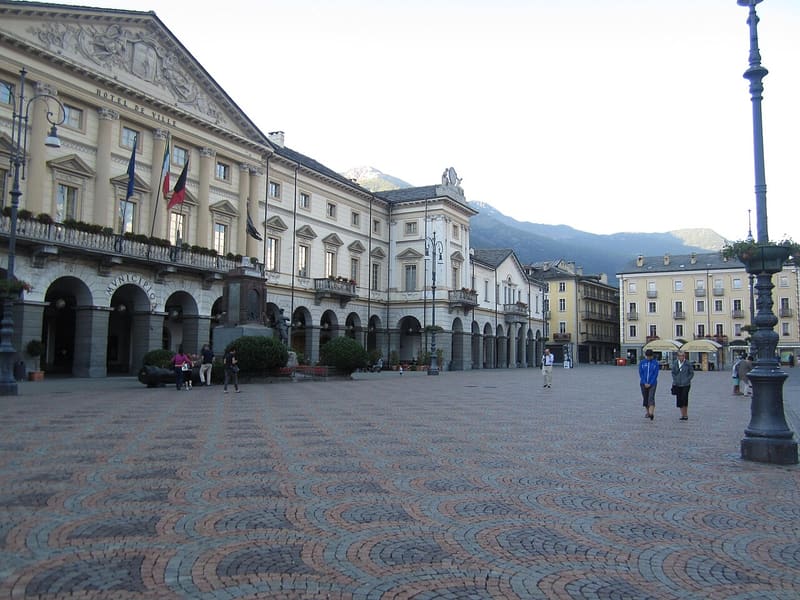
On 30 and 31 January the Sant'Orso Fair brings over a thousand artisans to the centre
Piazza Chanoux, the city's drawing room, is closed to the north by the Hôtel de Ville of 1839, with its arcades and the two fountains on the façade representing the Dora Baltea and the Buthier; in front stands Pietro Canonica's monument to the Aosta Valley Soldier, from 1924, and alongside it the Hôtel des États of 1724. From here the walk follows the grid of streets of the Roman city inside the walls: Via Porta Praetoria and, outside the gate, Via Sant'Anselmo, the ancient decumanus maximus, are the shopping streets between the Porta Praetoria, the collegiate church of Sant'Orso and the Arch of Augustus, in the medieval village. On the other side of the square, Via Croix-de-Ville with the 1541 stone cross above a fountain, in front of the Waldensian church, Place des Franchises and Via De Tillier and Via Aubert. Under the arcades of the square the Caffè Nazionale preserves a Gothic hall with a circular plan, the last remnant of the Cordeliers' convent.

Visiting
The point on the map is Piazza Chanoux. The centre is largely pedestrianised and you get around on foot. Covered pay car parks, open 24 hours (municipality information sheets, October 2025): Consolata (Viale Chabod 13, 130 spaces), Carrel (Avenue Carrel 1, 365 spaces, at the bus station next to the railway station, entrance from Via Vevey), Parking de la Ville (Via 1° Maggio, 540 spaces, about 500 metres from the centre with a pedestrian underpass; €0.50 an hour from 7:00 to 19:00 and €0.20 at night, March 2024 rates) and the Parini hospital car park (Via Roma); rates for Consolata and Carrel on the APS website. Free spaces in Piazza Ducler, Via Mazzini, Via Lavoratori Vittime del Col du Mont and Viale Partigiani; blue-marked pay bays throughout the town (official town guide, 2024). By train from Ivrea (with replacement buses) or by bus from Pont-Saint-Martin and from Courmayeur. You can visit the entrance hall and the grand staircase of the Hôtel de Ville, with the scale model of the Aosta Valley, during municipal office hours; the Hôtel des États opens for temporary exhibitions. Les Halles covered market on Tuesdays and Saturday mornings; on the second Sunday of the month Lo Tsaven, the Campagna Amica market, in Piazza Chanoux (2024). Sant'Orso Fair on 30 and 31 January in the streets of the centre (2027 edition confirmed).
History
Aosta began as Augusta Praetoria, the colony founded by the Romans in 25 BC after the defeat of the Salassi and named after Octavian Augustus. The town preserves most of its ring of walls and the grid layout of its streets: Via Sant'Anselmo follows the line of the decumanus maximus, which entered the town through the Porta Praetoria, and Piazza Giovanni XXIII, in front of the Cathedral, occupies the area of the forum. One reconstruction makes the laying of the first stone coincide with 23 December 25 BC, the winter solstice: on that day the sun rising over the Becca di Nona lights up the cross on top of the Croix-de-Ville fountain, aligned with the cardo maximus.
In the Middle Ages the town was divided between the Cité, inside the walls, and the suburb that had grown up outside the Porta Praetoria along Via Sant'Anselmo, around the collegiate church of Sant'Orso. In 1033 Anselm, the future Archbishop of Canterbury, was born; he is commemorated by a plaque at number 66 of the street that bears his name. In 1191 Count Thomas I of Savoy, still a minor and under the guardianship of Bonifacio di Monferrato, came to Aosta and made an agreement with Bishop Valberto and with the citizens and burghers, put in writing in a charter of franchises: the count undertook to defend the lives and property of the clergy and the inhabitants and not to demand any payment in money without the consent of the citizens, who in return promised him loyalty and help in war. In 1467 Duke Amadeus IX laid down the articles regulating the municipal council of Aosta and the election of the syndics; the same duke had the convent and the church of the Cordeliers enlarged, the Franciscans who occupied the area of the present square.
On 29 February 1536, while the French were occupying Savoy, the Estates General of the Duchy (clergy, nobility and communities), summoned urgently by the bailiff Mathieu de Lostan, confirmed their loyalty to the House of Savoy and refused to join the Reformation; on 7 March they created a governing body, the Conseil des Commis, which negotiated with France a neutrality agreement that was renewed several times until 1556. In 1541, to celebrate the expulsion of the Calvinists from the Valley, the citizens were ordered to paint the name of Jesus on all the doors of their houses, and in Via Croix-de-Ville the stone cross that gives the street its name, also known as Calvin's cross, was raised above the fountain.
In 1724 the Hôtel des États was built next to the convent; the General Assembly of the Estates, chaired by the bishop and the bailiff, and the Conseil des Commis met there, and the archives of the Duchy were kept there. From 1870 it also housed the court for a time, and today it hosts municipal offices and temporary exhibitions. The convent of the Cordeliers, badly damaged by the French revolutionary troops, was demolished: on its site, in 1839, the large porticoed neoclassical building of the Hôtel de Ville was built, with the two fountains on the façade that represent the Dora Baltea and the Buthier, and the square was created by pulling down the church of San Francesco, attached to the convent. The square, laid out under the reign of Charles Albert and named after him, was completed by the nineteenth-century buildings that surround it; in 1924 the monument to the Aosta Valley Soldier by Pietro Canonica was placed there. Of the convent there remains a Gothic hall with a circular plan, inside the Caffè Nazionale, under the porticoes.
Today the square bears the name of Émile Chanoux, notary and martyr of the Aosta Valley Resistance: he had founded the clandestine National Liberation Committee of Aosta in his office, and he was killed by the SS in 1944, at the age of 38. On 30 and 31 January the centre hosts the Sant'Orso Fair, with over a thousand artisans. Tradition dates it to the year 1000 and links it to the sabots, the wooden clogs that the canons of Sant'Orso handed out to the poor on the feast of their patron saint; it began in the suburb around the collegiate church and now fills the streets of the centre inside and outside the Roman walls. The night between the two days is the veillà, with the streets lit up and lively until dawn; under the porticoes of Piazza Chanoux the Atelier displays the work of the professional artisans.
Nearby
 Saint-Bénin CentreManzetti's automaton plays the flute with compressed air: twelve tunes on a cylinder
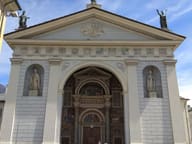 Aosta Cathedral Treasury MuseumThe ivory diptych of 406: the consul Probus had the emperor Honorius carved on it
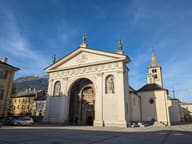 Aosta CathedralIn the choir, two medieval mosaics: the twelve months and the four rivers of Paradise
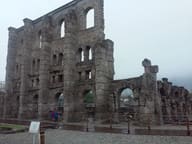 Roman TheatreSouth façade 22 metres high, with three tiers of openings that get smaller towards the top
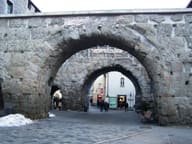 Porta PraetoriaOn the east side the marble facing added in the Claudian period (AD 41–54) survives
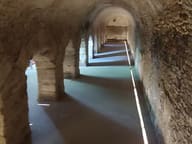 Forum CryptoporticusThe horseshoe-shaped galleries measure 71.80 m along the sides and 87.10 m in the centre