 The Aosta Trip
Tour du Pailleron
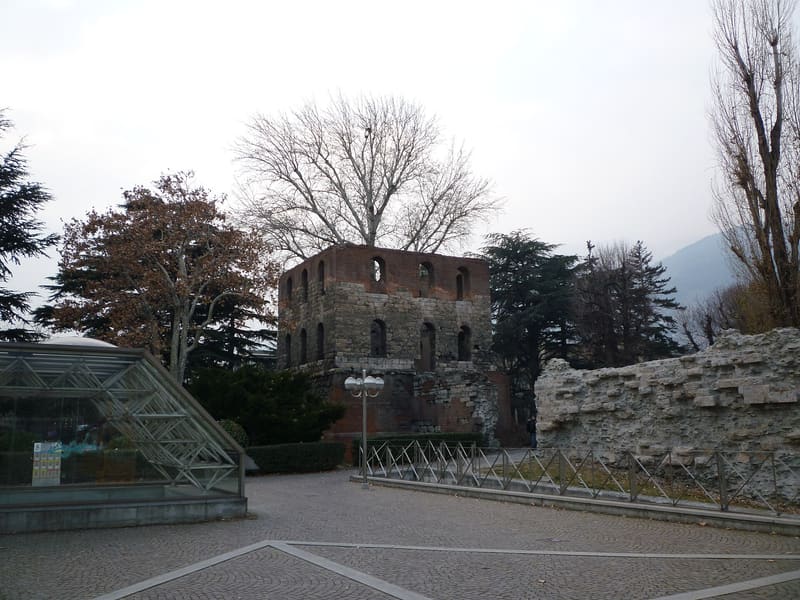
The best-preserved Roman tower of the walls, restored by d'Andrade from 1891
On Piazza Manzetti, in front of the station, rises the square-plan tower considered the best preserved of the whole ring of walls: on each side there are six large windows, three per floor. The original facing of small Roman blocks can be told at a glance from the part rebuilt in red brick in the nineteenth-century restoration, which was done this way precisely so as not to confuse the ancient with the added.

Visiting
The tower has no regular opening hours and can be seen from outside, from the station square; occasional openings for events are possible: it is best to check before you go.
History
On the southern side of the Roman walls, where the railway station square lies today, rises a square-plan tower that studies consider the best preserved of those in the ring of walls of Augusta Praetoria. The name Pailleron comes from its long use as a straw barn and grain store; a fire, at an unrecorded date, damaged its pitched roof.
In 1884 the mayor of Aosta proposed demolishing the tower, by then reduced to a ruin, but the Ministry of Public Education opposed this. This allowed Alfredo d'Andrade, the Portuguese architect who between the nineteenth and twentieth centuries restored many castles and monuments of the Aosta Valley, to step in: in 1891 he started the restoration work on the tower, in open dispute, in 1893, with Aosta town council.
D'Andrade followed a principle that was still new for the time: rebuilding the missing parts not by imitating the original Roman work, but by using a different, recognisable material, in this case red brick, so as never to confuse the ancient with the added. The result is the tower you see today, where the facing of small Roman blocks and the nineteenth-century brick sections remain clearly distinct on every side, each opened by six large windows, three per floor. The tower is also connected to a stretch of wall that was opened up in the Middle Ages to make a passage, the so-called porta ferrière.
Today the tower has no regular opening hours.
Nearby
 Saint-Bénin CentreManzetti's automaton plays the flute with compressed air: twelve tunes on a cylinder
 AostaOn 30 and 31 January the Sant'Orso Fair brings over a thousand artisans to the centre
 Bramafam TowerTower built in the thirteenth century on the Porta Principalis Dextera, south gate of the Roman walls
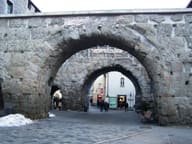 Porta PraetoriaOn the east side the marble facing added in the Claudian period (AD 41–54) survives
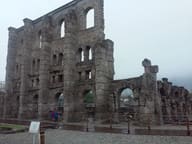 Roman TheatreSouth façade 22 metres high, with three tiers of openings that get smaller towards the top
 PilaFrom the centre of Aosta to the runs of Pila in 17 minutes by gondola