 The Aosta Trip
Saint-Bénin Centre
Manzetti's automaton plays the flute with compressed air: twelve tunes on a cylinder
The Baroque chapel of the priory, founded around the year 1000, hosts rotating temporary exhibitions and, in a room created in the old sacristy, the permanent exhibition on Innocenzo Manzetti. Here a modern display case holds the flute-playing automaton and the harmonium built by Manzetti himself, together with interactive screens on his biography.

Visiting
Tuesday–Sunday 10:00–13:00 and 14:00–18:00, closed on Mondays, on 25 December and on 1 January. Admission to the Manzetti room is free when no paid exhibitions are on; when a paid exhibition is on, the ticket also includes the Manzetti room.
Collections
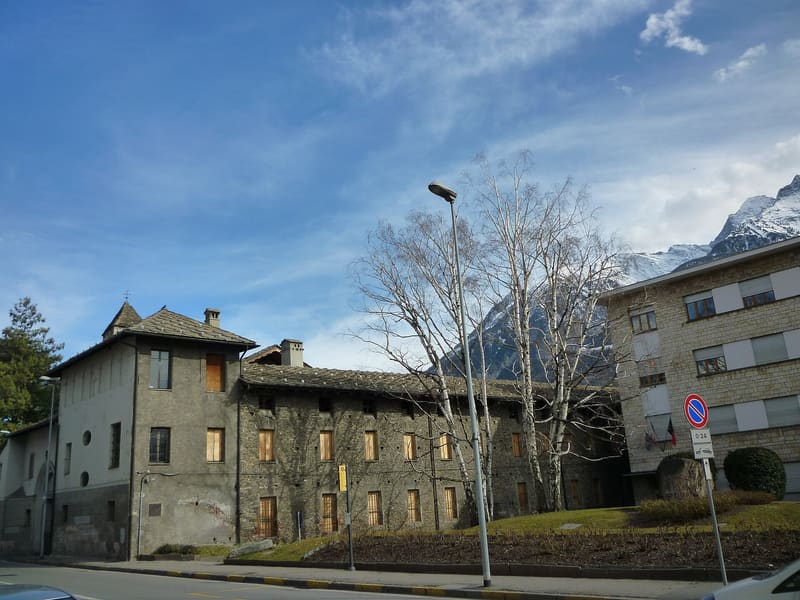
The chapel — The exhibition centre occupies the former church and convent of Saint-Bénin; in the seventeenth-century chapel, with a Baroque altar with twisted columns and a twelfth-century Romanesque bell tower, temporary exhibitions follow one another, staged since 1986 and therefore different depending on the period.
The Manzetti room — In the old sacristy of the church is the permanent room devoted to Innocenzo Manzetti (Aosta, 1826–1877), scientist and inventor: a modern glass case holds the original Automaton and harmonium, built by Manzetti himself.
The flute-playing Automaton — Built in 1840, when Manzetti was 14, it is the size of a man and is made of iron, steel, brass, walnut wood, rubber and chamois leather. It really plays a wooden transverse flute, operated by compressed air, and can perform up to twelve different airs programmed on a cylinder.
The multimedia displays — Six interactive wall screens illustrate Manzetti's biography, the historical context and his other inventions, including a steam car and hydraulic pumps; a 3D animation shows how the Automaton's mechanisms work in relation to the keys of the harmonium, while two simplified screens are designed for children.
History
The priory of Saint-Bénin was founded around the year 1000 by the Benedictines of the Piedmontese abbey of San Benigno di Fruttuaria; around 1177 it passed to the canons of San Bernardo del Mont-Joux (the order of the Great St Bernard). It still retains the Romanesque bell tower with thirteenth-century two-light windows and a Baroque altar with twisted columns.
In 1604, by virtue of a bull of Pope Clement VIII, the priory was turned into a college of higher studies: grammar, rhetoric and humanist culture were taught there. In the following decades the institute expanded, with chairs of philosophy from 1678 and of theology from 1702, and became one of the most renowned colleges in the Savoyard States; in 1772 it received the title of Collège royal. After the French requisition of 1793 the building changed function several times, serving as a military hospital, a secular school and a Jesuit institute, until in 1888 it became a state secondary school named after the Prince of Naples.
Restored after the Second World War, the complex found a new function in the seventeenth-century chapel: since 1986 the Aosta Valley Autonomous Region has staged temporary art exhibitions there, which over time have featured Rodin, Warhol, de Chirico and Canova, among others.
In the sacristy of the former church, in April 2012 the Region opened the permanent exhibition devoted to Innocenzo Manzetti (Aosta, 1826–1877), the scientist and inventor from Aosta who is credited with, among other things, an automaton and experiments in transmitting the voice over a distance. Curated by Mauro Caniggia Nicolotti and Luca Poggianti, the room displays in a glass case the original automaton and harmonium built by Manzetti, together with touch-screen panels on his life and his inventions.
Nearby
 Tour du PailleronThe best-preserved Roman tower of the walls, restored by d'Andrade from 1891
 AostaOn 30 and 31 January the Sant'Orso Fair brings over a thousand artisans to the centre
 Bramafam TowerTower built in the thirteenth century on the Porta Principalis Dextera, south gate of the Roman walls
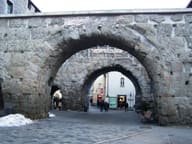 Porta PraetoriaOn the east side the marble facing added in the Claudian period (AD 41–54) survives
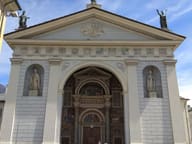 Aosta Cathedral Treasury MuseumThe ivory diptych of 406: the consul Probus had the emperor Honorius carved on it
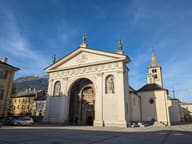 Aosta CathedralIn the choir, two medieval mosaics: the twelve months and the four rivers of Paradise