 The Aosta Trip
Bramafam Tower
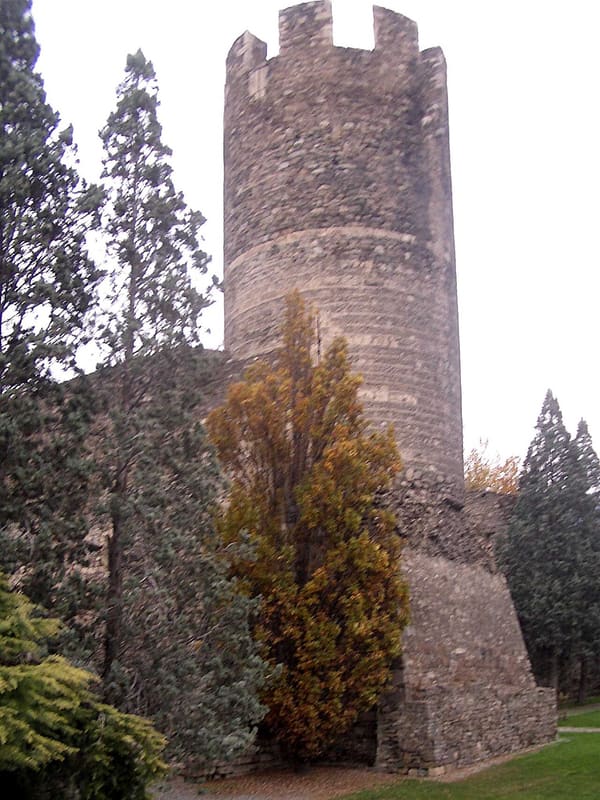
Tower built in the thirteenth century on the Porta Principalis Dextera, south gate of the Roman walls
At the junction of Via Bramafam and Viale Carducci, on the south side of the walls, stands a circular bastion with blocks of masonry at its base that are still Roman: this is where the Porta Principalis Dextera opened, the southern entrance to the city towards the bridge over the Dora. Above the Roman base rises the medieval building, a large block, once a residence, flanked by the cylindrical tower. You can only see it from outside, walking along the stretch of walls.

Visiting
It cannot be visited inside, only from outside: it is a stop on the route of about 3 km that runs along the Roman walls and the medieval towers of Aosta.
History
On the south side of the Roman walls of Augusta Praetoria stood the Porta Principalis Dextera, the southern entrance towards the bridge over the Dora. It had a single carriageway arch, with no inner courtyard, flanked by two towers. The excavations carried out between the late nineteenth century and 1936 found there, in 1894, the sandstone base of a statue of Augustus, erected by the Salassi in 23 BC to honour the emperor after the founding of the city.
On one of the two Roman towers of the gate stands a structure recorded as early as 1212–1214 under the name of Beatrice Tower: the name comes from Beatrice di Ginevra, who married Goffredo I di Challant in 1223. The Challants, who bore the title of viscounts of Aosta, controlled the whole south-west perimeter of the city walls, and in the first half of the thirteenth century they turned the tower into a real castle (a casaforte, the fortified house of a noble family), which was sacked in 1253 by Giacomo, lord of Quart.
In 1295 Ebalo I di Challant ceded the castle to the Count of Savoy, Amadeus V, receiving the fief of Montjovet in exchange; the Challants nevertheless kept some rights over the building, which in the eighteenth century was still let, in ruins, to members of the family. In the intervening centuries the castle changed owners several times, contested among local families, until by the end of the sixteenth century it was abandoned for good: a state it has kept to this day.
Two explanations of the name Bramafam circulate, neither of them confirmed by a historical document: according to a legend, a jealous Challant locked his wife in there, and she died of hunger; according to another theory, the tower housed the city's public granaries, where the population gathered ‘craving hunger’ in times of famine.
Today the complex, between the Roman base and the medieval masonry, can only be seen from outside, along the route that runs around the walls and towers of Aosta.
Nearby
 PilaFrom the centre of Aosta to the runs of Pila in 17 minutes by gondola
 Saint-Bénin CentreManzetti's automaton plays the flute with compressed air: twelve tunes on a cylinder
 Leper's TowerIn 1773 the Mauritian Order confined a leper who had come from Oneglia here
- Porta DecumanaWest gate demolished in 1812; the remains are in the basement of the Regional Library
 Tour du PailleronThe best-preserved Roman tower of the walls, restored by d'Andrade from 1891
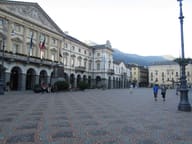 AostaOn 30 and 31 January the Sant'Orso Fair brings over a thousand artisans to the centre