 The Aosta Trip
Parish Treasury Museum
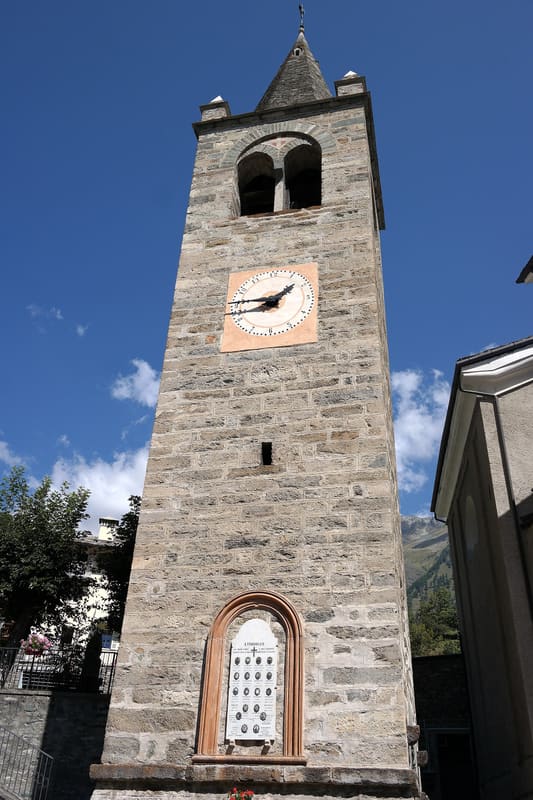
Five display cases of goldsmiths' work from 1400 on, opened in 2011 in Santa Maria Assunta
The treasury occupies five display cases beneath the right-hand women's gallery of the church of Santa Maria Assunta, whose Romanesque bell tower was built in 1480. It holds three chalices from the early fifteenth century, a Baroque processional cross in embossed silver, a partly gilded silver pyx of Swiss-German make from the early seventeenth century and painted wooden sculptures of a Pietà, from the Vachéry chapel.

Visiting
Open every day 9:00–19:00, inside the parish church of Santa Maria Assunta, in the historic centre. Free admission. During liturgical celebrations the opening hours may change.
Collections
Display case of the early chalices. Beneath the right-hand women's gallery of the church, the first display case holds the oldest pieces of the treasury: three chalices from the first decades of the fifteenth century, including one bearing the mark of a silversmith whose hand can also be recognised in a 1410 chalice from the church of Courmayeur, with the distinctive six-lobed foot and decorated knop widespread across the Alpine arc between Savoy, the Aosta Valley and the Canton of Vaud.
Display case of the Baroque silver. A second display case shows goldsmiths' work from the mid-eighteenth century: a large processional cross in sheets of embossed silver, the work of the Turin silversmith Antonio Benedetto Caire, a plain silver chalice by Giovanni Damodé, a goldsmith who also worked for the Savoyard court, and a sunburst monstrance.
Display case of the northern silver. A pyx in partly gilded silver, worked by embossing and casting, of Swiss-German make from the first half of the seventeenth century, bears witness to the trade and artistic exchanges along the roads that linked the Aosta Valley to the Germanic world across the Great St Bernard Pass.
Display case of the wooden sculptures. Two painted wooden statues depicting a Pietà, datable to between the sixteenth and seventeenth centuries, come from the Vachéry chapel and are the sculptural core of the treasury.
Display case of twentieth-century memory. A chalice in gilded silver from the early twentieth century ends the tour: it was used by Monsignor Nestor Adam for his first Mass in Étroubles in 1927, before he became Bishop of Sion, in Switzerland, from 1952 to 1977.
History
The community of Étroubles, on the ancient road that runs down from the Great St Bernard Pass towards Aosta, has a parish of medieval origin: a bull of Pope Alexander III of 1177 already mentions it as dependent on the provostry of the Great St Bernard. The original church, oriented differently from the present one with the altar facing east, was demolished because of lack of space and decay; the present building was rebuilt in the early years of the nineteenth century (1814 or 1815) on the Tour promontory, reusing, according to local tradition, the stones of the old tower that had belonged to the de La Tour family, which died out in the mid-fifteenth century. The bell tower, now separate from the body of the church, is on the other hand much older: it was built in 1480 by the master builder Yolli de Vuetto, from Gressoney, the same man who a few years later also built the bell tower of Gignod.
For centuries the running of the parish remained tied to the canons of the Great St Bernard, until in 1752 a bull of Pope Benedict XIV transferred the property of the provostry to the Order of Saints Maurice and Lazarus; only in 1929, with an agreement between State and Church, did the parish of Étroubles come under the direct jurisdiction of the Bishop of Aosta.
Over the centuries the church built up a heritage of goldsmiths' work and liturgical sculpture: three chalices from the first decades of the fifteenth century, including one bearing the mark of a silversmith who also made a 1410 chalice for the church of Courmayeur, following a lobed-foot model widespread across the Alpine arc between Savoy, the Aosta Valley and the Canton of Vaud; a Baroque processional cross in embossed silver by Antonio Benedetto Caire of Turin and a plain chalice by Giovanni Damodé, a silversmith who also worked for the Savoyard court, both from the second quarter of the eighteenth century; a pyx in partly gilded silver of Swiss-German make from the first half of the seventeenth century; and painted wooden sculptures of a Pietà, of sixteenth- or seventeenth-century origin, from the Vachéry chapel. A later chalice, from the early twentieth century, is linked to the memory of Monsignor Nestor Adam, who used it for his first Mass in Étroubles in 1927, before becoming Bishop of Sion from 1952 to 1977.
To safeguard this heritage and show it to the public, the parish set up five display cases beneath the right-hand women's gallery of the church, opened as the parish treasury on 22 July 2011. The museum is part of the church of Santa Maria Assunta and tells the story of a staging village on the Via Francigena towards the Great St Bernard Pass.
Nearby
 ÉtroublesSculptures and installations in the streets: an open-air museum since 2005, on the Via Francigena
- Ru de MenouveRu piped under a level dirt track as far as Alpe Ponteille, facing Mont Fallère
 Monte PagliettaLarge stone cairn on a knoll above Saint-Oyen, facing Mont Vélan
- Alpe ArsAlpine pasture at 1,975 m, reached almost on the level along the ru Collet, in the Ars valley
 Col ChampillonPass on the Alta Via 1 and the Tor des Géants, with views from Mont Blanc to the Grand Combin
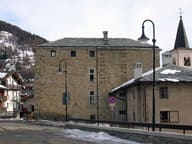 Bosses CastleIt has three storeys in a single block, with fifteenth-century cross-mullioned windows