 The Aosta Trip
Étroubles
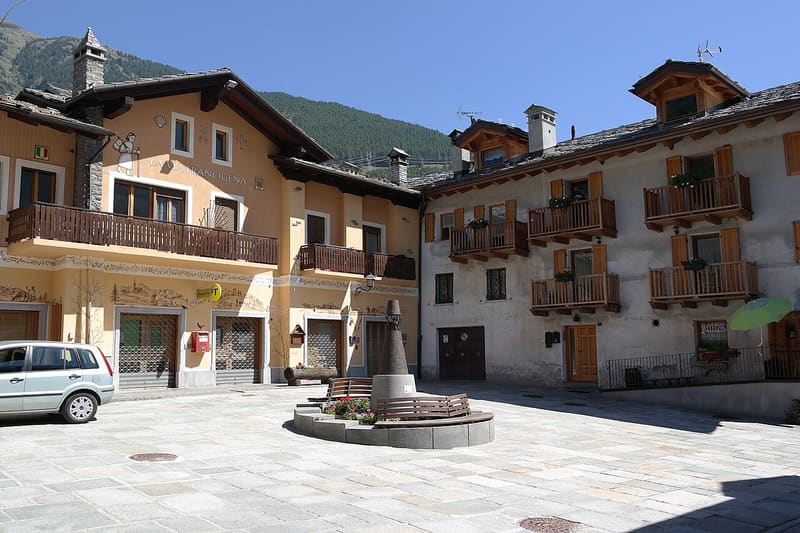
Sculptures and installations in the streets: an open-air museum since 2005, on the Via Francigena
The village lies at 1,270 metres, along the road that climbs to the Great St Bernard Pass: stone houses with stone-slab roofs, fountains and paved alleys. The sculptures and installations of the open-air museum are on display in the streets and in place Émile Chanoux. The fifteenth-century bell tower stands apart from the nineteenth-century church, and not far away is the building of the first rotating dairy in the Valley, now the fontina museum.

Visiting
By bus from Aosta on the Aosta – Saint-Rhémy-en-Bosses line (Arriva), in about 30 minutes. The tourist office is at place Émile Chanoux 8. Car parks: not given in the official sources consulted.
History
The name comes from the Latin Stipulae, the straw stubble left in the fields after the harvest, which gave the patois etrobla, ‘fields covered with straw’. After the victory over the Salassi, in 23 BC, the Romans control the pass of the Alpis Poenina, today's Great St Bernard Pass, and along the road to Gaul a station arises that local tradition identifies with Étroubles: Eudracinum, later Restopolis, probably the winter quarters of the military garrison. Other reconstructions, however, place Eudracinum a few kilometres higher up, at Saint-Rhémy.
In the Middle Ages the road over the pass becomes the Via Francigena, travelled at the end of the tenth century by Archbishop Sigeric of Canterbury on his way back from Rome; around 1050 St Bernard founds the hospice on the pass. The parish of Étroubles already appears in 1177 in a bull of Pope Alexander III as dependent on the provostry of the Great St Bernard, and its parish priests are canons of the hospice until 1752. In 1273 the House of Savoy authorises the inhabitants of Étroubles and Saint-Rhémy to escort travellers and merchants over the pass: this is the privilege of the ‘Viérie ou Marronnage’, which lasts 510 years, until 1783. In 1317 a hospice for pilgrims is founded in the village. From this period there remain the Vachéry tower, from the twelfth century, in the hamlet that gave its name to the family that owned it, and the dressed-stone bell tower built in 1480 by the master builder Yolli de Vuetto of Gressoney.
The old church, oriented from east to west and entered through the door of the bell tower, is demolished because it is small and in poor condition; the new Santa Maria Assunta, built in 1814 with the altar facing north, leaves the bell tower standing on its own. On the evening of 20 May 1800 Napoleon, who had crossed the Great St Bernard Pass with the army bound for Italy, arrives in Étroubles and spends the night in the parish house. In 1853 the first cooperative, or rotating, dairy in the Aosta Valley is founded here, where the producers took turns to process everyone's milk.
From 1880 Étroubles becomes a holiday resort, and by 1893 it already has two hotels; in 1904 Césarine Bertin builds the first small hydroelectric power station in the Great St Bernard valley. The Coumba Freida carnival brings the landzette onto the streets, costumes covered with beads and small mirrors which, according to the most widespread hypothesis, recall the uniforms of the Napoleonic soldiers of 1800.
In 2005, with the Fondation Pierre Gianadda of Martigny, the village becomes an open-air museum, ‘À Étroubles, avant toi sont passés…’: sculptures, installations and paintings by Aosta Valley, Italian, French and Swiss artists, added to with new works in the following years; that year Léonard Gianadda receives honorary citizenship. In 2010 Étroubles is the first municipality in the Aosta Valley to obtain the Orange Flag of the Touring Club Italiano, and it is one of the Borghi più belli d'Italia.
Nearby
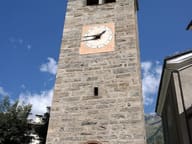 Parish Treasury MuseumFive display cases of goldsmiths' work from 1400 on, opened in 2011 in Santa Maria Assunta
- Ru de MenouveRu piped under a level dirt track as far as Alpe Ponteille, facing Mont Fallère
 Monte PagliettaLarge stone cairn on a knoll above Saint-Oyen, facing Mont Vélan
- Alpe ArsAlpine pasture at 1,975 m, reached almost on the level along the ru Collet, in the Ars valley
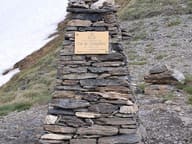 Col ChampillonPass on the Alta Via 1 and the Tor des Géants, with views from Mont Blanc to the Grand Combin
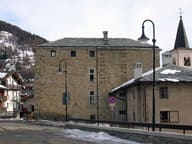 Bosses CastleIt has three storeys in a single block, with fifteenth-century cross-mullioned windows