 The Aosta Trip
Châtel-Argent
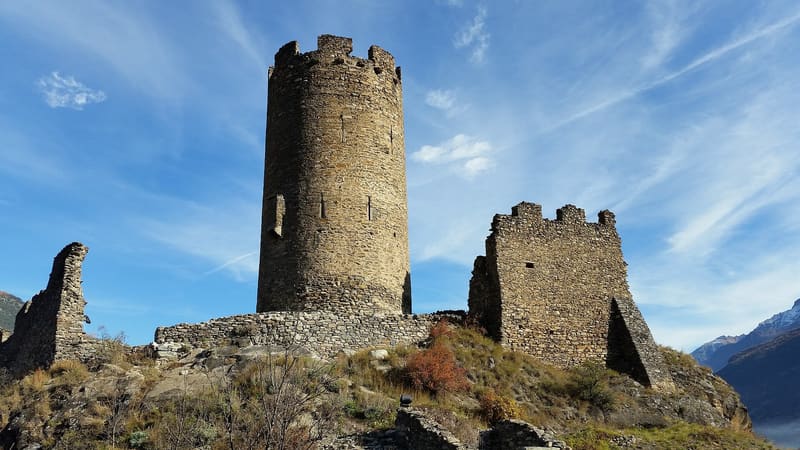
The name ‘Castrum Argenteum’ already appears in a document of 1176
From the bridge over the Dora Baltea in the centre of Villeneuve, a path of about a quarter of an hour climbs to the rocky spur. You walk freely inside a large walled enclosure with a watchtower, following an explanatory leaflet picked up at the wooden chalet in the car park. On the east side is the oldest part, the chapel dating from the eleventh to twelfth centuries; in the second enclosure, towards the west, a vaulted cistern and a circular keep remain. In the area around the stronghold, along the paths, there are also the Romanesque church of Santa Maria and the chapel of Santa Colomba.

Visiting
Self-guided and free all year round, with the multilingual leaflet (also as an app) that you pick up at the chalet in the car park at the entrance to the village; no building is roofed or heated, you walk among the walls in the open air. Only the guided tours are charged for, by booking with the Fondation Grand Paradis (+39 0165 75301): full price €3, concession €1.50, free up to the age of 6 inclusive, for people with disabilities and for residents of the Fondation's member municipalities; in autumn 2026 on Saturday 3, 10 and 17 October at 16:00. Access for people with disabilities from Champlong, a 100-metre dirt track on a gentle uphill slope, not included in the guided tour.
History
The rocky promontory of Châtel-Argent, above Villeneuve, was already inhabited in protohistoric times, as shown by an anthropomorphic stele found on the site, and was later fortified by the Salassi and then by the Romans to control the valley. The place name Castrum Argenteum appears in documents as early as around 1175–1176; according to some scholars the name may come from a mint said to have struck coins there in the Middle Ages.
The structure visible today was rebuilt, in all likelihood, around 1275 at the wish of Count Peter II of Savoy, by military engineers in his service; among them may have been the Savoyard Jacques de Saint-Georges, who two years later is recorded as active in Wales in the service of King Edward I of England. The oldest part of the complex is nevertheless the chapel, incorporated into the ring of walls and datable to the eleventh to twelfth centuries.
It is an enclosure castle: a large ring of walls encloses a circular keep about 15 metres high, with narrow arrow slits, a vaulted cistern and a raised entrance. The simplicity of the layout reflects an almost exclusively military function: unlike other Aosta Valley castles, Châtel-Argent always remained the direct property of the Counts of Savoy, even though over time the barony had various feudal lords, including the Bard, Challant and Roncas families, and it only occasionally hosted the count in person.
In the modern era, around 1817, a stepped ramp was cut into the rock to make access to the church of Santa Maria easier. Today the site is managed by the Fondation Grand Paradis, which organises its guided tours.
Nearby
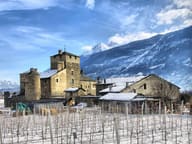 Sarriod de la Tour CastleIn the Hall of Heads, 171 carved wooden corbels, all different
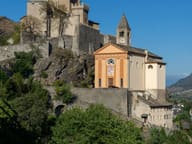 Saint-Pierre CastleThe core dates from the twelfth century, the four corner turrets from the nineteenth
 Introd CastleThe present polygonal plan dates from the fifteenth-century works, not from 1260
 Parc Animalier d'IntrodIbex, chamois, wolves and birds of prey along a 1.5 km path with a 150 m height gain
 Aymavilles CastleFour corner towers added in the fifteenth century, then Baroque between 1713 and 1728
 Pont d'Ael Aqueduct BridgeIn 3 BC Caius Avillius Caimus, from Padua, had the inscription carved on the bridge