 The Aosta Trip
Sarriod de la Tour Castle
In the Hall of Heads, 171 carved wooden corbels, all different
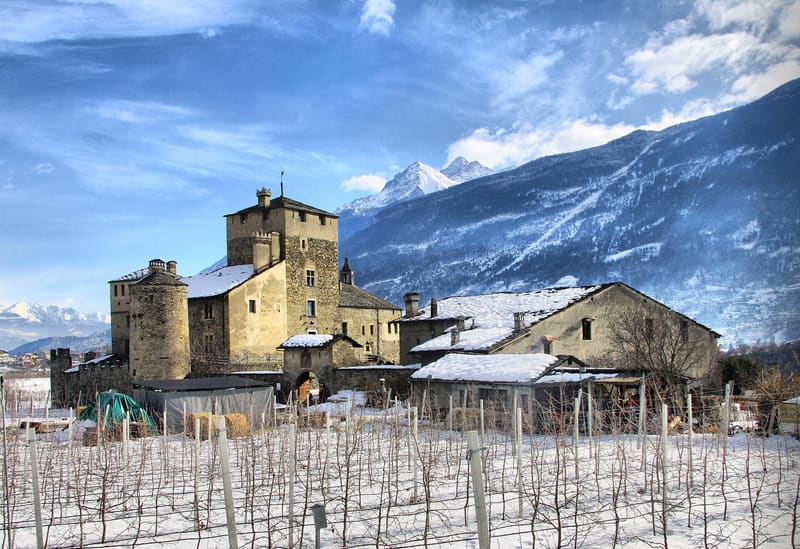
The castle stands low among the apple orchards, without slender towers. Inside, the route passes through rooms with some furniture and paintings to the Hall of Heads: on the ceiling, supported by 171 wooden corbels carved after 1431, ladies in headdresses, knights, sirens, dragons and monsters file past, no two alike. The chapel preserves thirteenth-century frescoes.
 One-day guide · freeThe Fairy-Tale CastlesA day among the castles west of Aosta passes here, from the towers of Saint-Pierre to the Roman bridge of Pont d'Ael.Open the guide →
Visiting
Guided tours only, groups of up to 25 people. Opening hours: October–March 10:00–13:00 and 14:00–17:00, April–September 9:00–19:00. Closed on Mondays, except in July, August and on public holidays, and on 25 December and 1 January. Full price €6, concession €4, aged 19–25 €3.
History
The Sarriod family is recorded in documents from the twelfth century, but the oldest core of the castle, a tower-keep enclosed by a small rectangular enclosure with an adjoining chapel, dates, according to some sources, from the first half of the thirteenth century, when it was founded by Guillaume Sarriod; around 1250 the structure was enlarged with the chapel.
In 1418 Jean and his brother Yblet divided their father's inheritance: from Jean came the Sarriod de La Tour branch, from Yblet the Sarriod d'Introd branch; sources date the expansion of the castle into a true noble residence to between 1420 and 1432, with the distinctive spiral staircase and the cross windows typical of fifteenth-century Aosta Valley Gothic. Antoine Sarriod, Jean's son, reconsecrated the chapel in 1478, dedicating it to the Virgin and St John the Evangelist, and had it painted with frescoes of the Crucifixion and St Christopher; the famous and very rare ceiling of carved heads is older, from the 1430s, in Jean's time.
At the end of the fifteenth century the enclosure was reinforced with round and semicircular defensive towers, and on the east side a new Gothic doorway was opened, topped by the Sarriod coat of arms. An east wing was added in the sixteenth century, a corner tower in the seventeenth; at the start of the eighteenth century came wall decorations and stucco fireplaces, while in 1732–1733 the soldier Jean-Gaspard Sarriod de La Tour had himself portrayed by the painter Giovanna Battista Buzano.
The Sarriod de La Tour family held the castle for about nine hundred years, until the death of the last descendant, Christine Sarriod de La Tour, on 4 November 1923; the property then passed to the Bensa family of Genoa and, in 1970, to the Aosta Valley Autonomous Region. In 1978 the medieval paintings of the chapel were rediscovered, hidden by a vault built in the eighteenth century; after restoration work that continued until the 2000s, the castle reopened to the public with new displays in 2018.
Nearby
 Saint-Pierre CastleThe core dates from the twelfth century, the four corner turrets from the nineteenth
 Châtel-ArgentThe name ‘Castrum Argenteum’ already appears in a document of 1176
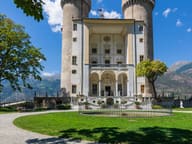 Aymavilles CastleFour corner towers added in the fifteenth century, then Baroque between 1713 and 1728
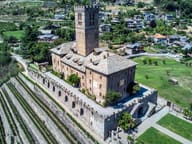 Sarre Royal CastleVictor Emmanuel II bought it in 1869 for his hunting trips
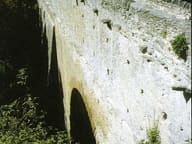 Pont d'Ael Aqueduct BridgeIn 3 BC Caius Avillius Caimus, from Padua, had the inscription carved on the bridge
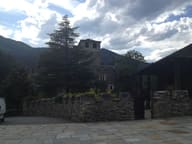 Introd CastleThe present polygonal plan dates from the fifteenth-century works, not from 1260