 The Aosta Trip
La Mothe Castle
Château de la Mothe
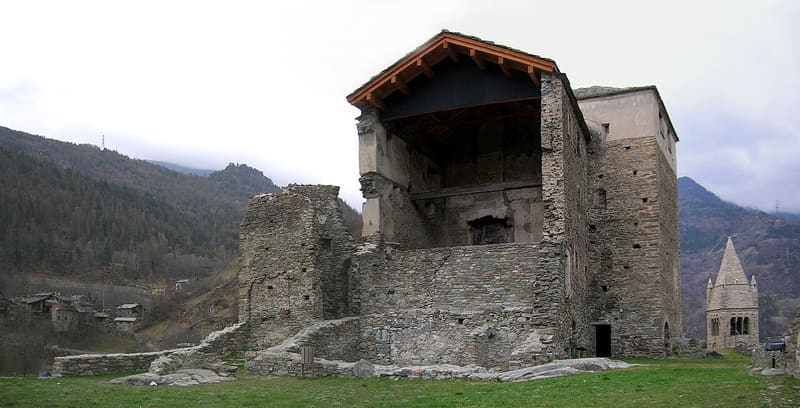
Closed since 2026 for work on the Museum of the Alpine Future, €6.5 million from the PNRR
You can see it from the SS 26, on the left heading towards Courmayeur, near Arvier town hall: on the crag above the village the square four-storey tower stands out, 14 metres high and covered by a wooden roof rebuilt during the restoration, with beside it the walls of the sixteenth-century central block, the stair tower to the south and the ring of walls that follows the rock. From the terraced garden behind the church of San Sulpizio the view takes in the village, the Enfer vineyards and the main valley.

Visiting
Closed to the public: since the beginning of 2026 the castle has been the building site of the Museum of the Alpine Future (PNRR project ‘Agile Arvier’, €6.5 million). In September 2026 the four lots of works were reported as almost complete, but the municipality and the Region have not set an opening date or decided who will run the museum. Until 2025 the area inside the ring of walls was freely open, without custodians, with the interiors visible from below. You can see it from the SS 26 and from the centre of Arvier, near the town hall; you go up by the flight of steps behind the parish church of San Sulpizio, a short walk on stone ramps. By bus on the Arriva Aosta–Courmayeur line.
History
La Mothe Castle stands on a rocky promontory overlooking the village of Arvier and the main valley, beside the old road that follows the line of the Roman road to Gaul. Little is known of its history. The first mention dates from 1287, a feudal homage paid by Aimone de Arverio to the Count of Savoy. According to the eighteenth-century historian Jean-Baptiste de Tillier, the name comes from Aimar de La Mothe, a Savoyard nobleman who came to the valley towards the end of the thirteenth century, married the heiress of the de Arverio family and restored the castle, giving it his own name. Dendrochronological analysis has dated the timber reused in later buildings to 1236–1237: nothing else remains of that first building.
In 1376 the castle passed to the d'Avise family, who according to de Tillier kept it ‘as a pleasure house’, and in those years it was rebuilt: the great tower, 13 metres by 8 and 14 high, on four storeys, without a single arrow slit, with single-light windows and a projecting latrine, is a stately residence more than a fortress. A document of 1408 mentions houses begun and still to be finished on the crag above the public road. In the fifteenth century the ring of walls was reshaped along the rocky spur and a building went up in the north-east corner, of which a window with a seat remains.
At the beginning of the sixteenth century, with beams felled in 1514, the d'Avise family built the large central block that links the great tower to the building on the east, with a piano nobile with a decorated fireplace, a large cross window opened in the great tower, a stair tower to the south with spiral stone steps, a new carved entrance doorway and frescoes with nature subjects on the third floor. At the end of the seventeenth century, through the marriage of two d'Avise sisters, the castle passed into the joint ownership of the Lostan and the Sarriod de La Tour families.
Abandonment came in the first half of the eighteenth century: by 1740 the east wing had already collapsed. From then on the complex served as a stable and hayloft, with cobbled floors, troughs for watering the animals and small channels, and the ground floor of the great tower reduced to a shelter for animals; the growth of the village erased the layout of the concentric rings of walls. Arvier municipality, which had bought it from private owners in a state of abandonment, made it a priority in its 2005–2010 programme: within the Interreg ALCOTRA ‘RITI’ project, with the Conseil général of Haute-Savoie, it entrusted the regional Superintendency with the archaeological excavations, begun in May 2006, and then with the conservative restoration, which cost about €600,000 shared between the European Union, the Region and the municipality and was completed in September 2008. Since then the area inside the ring of walls has remained freely open and has hosted concerts and visits on the Cammino Balteo.
In 2022 the castle became part of the project ‘Agile Arvier, la cultura del cambiamento’, €20 million from the PNRR (the Ministry of Culture's Borghi call, NextGenerationEU funds), with €6.5 million earmarked for the Museum of the Alpine Future: an accessible route with walkways resting against the rock, an external lift and an installation of twenty works of art on change in the mountains, curated by Alberto Fiz. The scaffolding went up in March 2026; in September 2026 the four lots were reported as almost complete, with the management still to be settled with the Region.
Nearby
 Parc Animalier d'IntrodIbex, chamois, wolves and birds of prey along a 1.5 km path with a 150 m height gain
- Saint-Nicolas Cross-Country TrailsAt Fossaz a 2.5 km loop is floodlit and you can ski in the evening too
 Introd CastleThe present polygonal plan dates from the fifteenth-century works, not from 1260
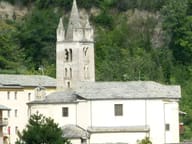 Parish Museum of Sacred ArtWooden statues and gold work from the fifteenth to the nineteenth century in the church of San Brizio
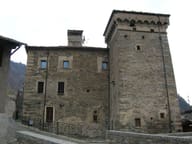 Avise CastleThe corbel room has fourteen carved wooden corbels
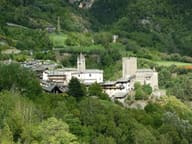 AviseThe castle, the Maison de Blonay and the Cré fortified house: three homes of the lords of Avise