 The Aosta Trip
Avise
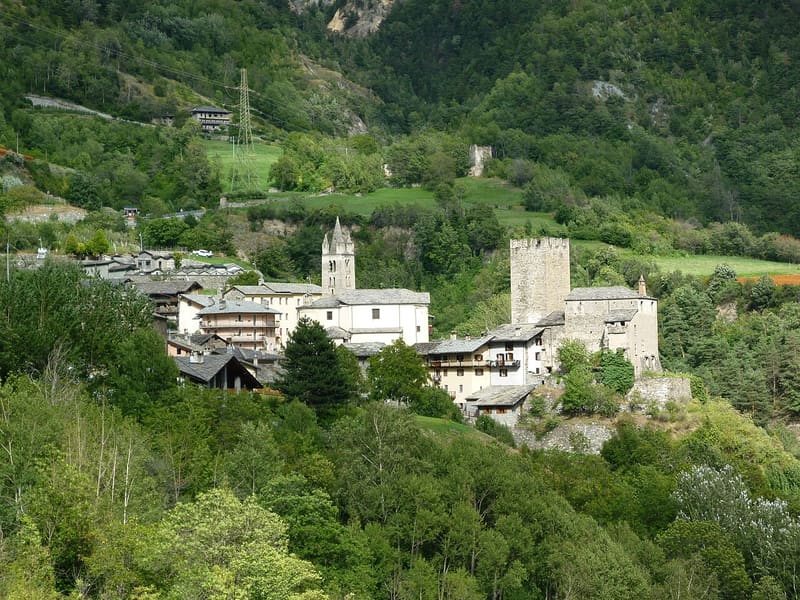
The castle, the Maison de Blonay and the Cré fortified house: three homes of the lords of Avise
The village lies at 762 metres, on the left side of the Dora, among the vines from which Petit Rouge is made. Next to the church of San Brizio, with its neoclassical façade and spire-topped bell tower, rises the square tower of the Maison de Blonay. The family motto, ‘Qui tost Avise tart se repent’, is carved on the main door of the fifteenth-century castle; where the main village ends, on the edge of a promontory, the ruins of the Cré fortified house remain.

Visiting
By bus from Aosta on the Aosta – Courmayeur line (Arriva, timetables for the ‘Alta Valle’ area); Avise is 28 km from Aosta. The castle of Avise is private and houses a restaurant with rooms; the Maison de Blonay and the fortified house of Cré cannot be visited: you can see them from outside, from the streets of the village. Car parks: not given in the official sources consulted.
History
A little below the main village, at Pierre Taillée, the valley narrows into a gorge about 400 metres long, with sheer walls some sixty metres high above the Dora. The Roman road to Gaul crossed it halfway up the slope on the orographic right bank, gaining height near Runaz and cutting through the rock, before descending again towards the Equilivaz bridge. It is this unavoidable passage that gave Avise, for centuries, control of the traffic on the transalpine road. A local tradition says that the first church, dedicated to St Martin, stood on the Roman road between Runaz and Pierre Taillée and was destroyed together with Runaz by armies passing through between the ninth and tenth centuries, to be rebuilt later on the other bank of the Dora and dedicated to St Brice, disciple and successor of Martin.
The fief belonged to the lords of Avise, with jurisdiction over Avise, the whole of Valgrisenche, the villages of Leverogne and Runaz and some villages of present-day Saint-Nicolas. Their motto, ‘Qui tost Avise tart se repent’, plays on the family name. At the end of the fifteenth century the lordship was divided among four brothers: Jean l'Ancien had Valgrisenche, Boniface Avise, Rolet Leverogne and Planaval, Jean le Jeune Runaz. Boniface built the three-storey castle with the square tower in the main village, while Jean le Jeune turned the fortified house of Runaz, the Maison de Mosse, into a residence, with late Gothic windows in Villeneuve stone.
The Maison de Blonay, next to the church, combines a square twelfth-century tower, known as ‘des Prisons’, with a fifteenth-century wing with cross windows: it was the residence of the d'Avise family and only in 1645 passed to the de Blonay brothers, who gave it its name; as late as 1787 Philippe de Blonay, with the other lords of Avise, claimed the right to imprison wrongdoers. The Cré fortified house, perhaps from the tenth century, belonged to Pierre d'Avise, vice-bailiff of Aosta in 1425, and in the second half of the century was ceded to the ducal official Bonifacio Ducrest. The d'Avise died out in 1729 and their fiefs passed to the barons de Blonay; the Region bought the family archive in 1962.
The parish is recorded as early as the twelfth century. In 1400 two benefactors, uncle and nephew, both named Antoine d'Avise, had the bell tower built by master Pierre Sella. A stained-glass window of 1530 depicted Grat-Humbert d'Avise presented by St Gratus, and in 1719 Baroness Marie de Charmette gave the church a reliquary. In 1863–1864 the medieval church was demolished and rebuilt, saving the Baroque altars; the new building was consecrated in 1869, and since 2007 one of its chapels has housed the sacred art museum.
The fortifications above Pierre Taillée played a part during the French invasions of 1691 and 1704–1706. The stretch of Roman road, already restored between the late nineteenth century and the first half of the twentieth, has recently been consolidated; the passage cannot be visited and today the state road goes through it in a tunnel.
Nearby
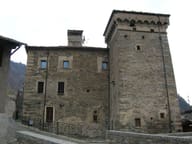 Avise CastleThe corbel room has fourteen carved wooden corbels
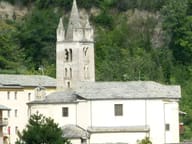 Parish Museum of Sacred ArtWooden statues and gold work from the fifteenth to the nineteenth century in the church of San Brizio
- Ru de CharbonnièreRu that takes its water from the Vertosan stream; view of Emilius, Becca di Nona and Grivola
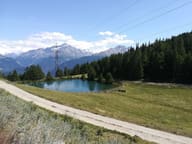 Lago di JouxA small lake in a pine wood at 1,902 m, with a little chapel in a nearby clearing
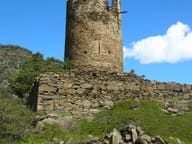 Montmayeur CastleThe cylindrical tower of 1271 still keeps its swallowtail merlons
- Saint-Nicolas Cross-Country TrailsAt Fossaz a 2.5 km loop is floodlit and you can ski in the evening too