 The Aosta Trip
Fénis Castle
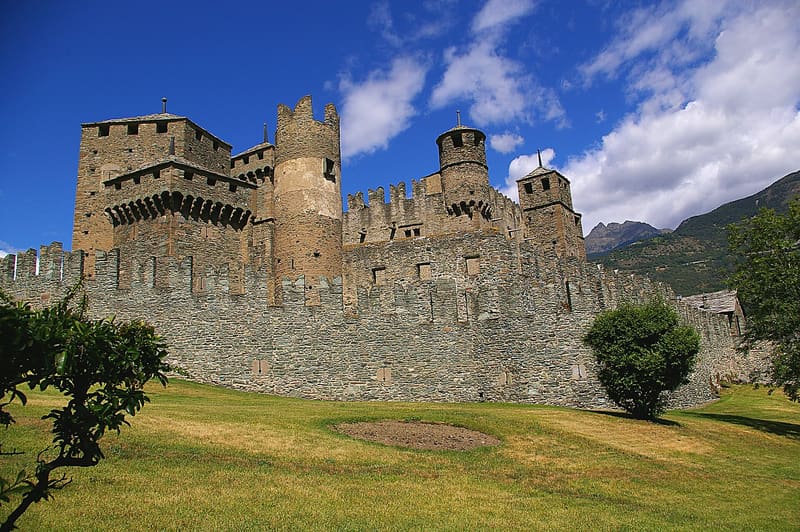
In the courtyard, a semicircular staircase beneath the fresco of St George and the Dragon
The castle has a pentagonal plan, with circular towers at the corners and a double ring of walls. In the courtyard a semicircular staircase rises beneath the fresco of St George and the Dragon, while the wooden balconies bear maxims written in Old French.
 One-day guide · freeThe Valley of the ChallantA day among the castles of the middle valley passes here: three homes of the Challant family and a museum of modern art.Open the guide →
Visiting
Guided tours only, groups of up to 25, French/English audio guide included. Opening hours: October–March 10:00–13:00 and 14:00–17:00, April–September 9:00–19:00. Closed on Mondays, except in July, August and on public holidays, and on 25 December. Full price €10, concession €7; tickets also online at midaticket.it.
History
Fénis Castle is first recorded in 1242 as the property of Gotofredo di Challant, Viscount of Aosta: at the time it was little more than a dovecote tower, a square tower and a residential block enclosed by a single wall. Aimone di Challant, who inherited the fief in 1337, began work around 1340 that gave the castle its distinctive pentagonal plan and double ring of walls.
His son Bonifacio I di Challant, after serving as inspector of the Savoyard fortresses, renovated the interior from 1392: he added a storey, levelled the floors, built a wing to the west and created the famous semicircular stone staircase with wooden galleries overlooking the courtyard. His son Bonifacio II then had the courtyard decorated with frescoes by the painter Giacomino da Ivrea.
After the death of Bonifacio I in 1426 the Challant-Fénis family entered a long economic decline that lasted until 1705, when the castle passed to Giorgio Francesco di Challant Châtillon; in 1716 he sold it, for 90,000 lire, to Count Baldassarre Castellar di Saluzzo Paesana, who was burdened with debt. Other changes of ownership followed (the Ansermin family from 1798 to 1863, then Michele Baldassarre Rosset di Quart), while the building was reduced to a hayloft and cowshed.
In 1895 (one source gives 1896) Giuseppe Rosset ceded the castle to the Italian State for 15,000 lire, through the Portuguese architect Alfredo d'Andrade, who had already noted its state of neglect during an inspection in 1868. D'Andrade carried out a first restoration campaign between 1898 and 1920, focused on consolidating walls and roofs; a second campaign, begun in 1935 under the minister Cesare Maria De Vecchi and the architect Vittorio Mesturino, restored its medieval appearance and set up the Aosta Valley Furniture Museum.
Declared a national monument in 1896, the castle now belongs to the Aosta Valley Autonomous Region and can only be visited on guided tours.
Nearby
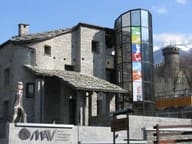 MAV - Museum of Traditional Aosta Valley CraftsThe more than 500 works of the Brocherel collection open the route, in the Memory room
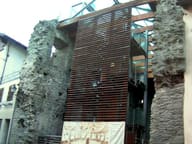 Pilate's CastleTwo corner turrets and three of the four perimeter walls in exposed stone remain
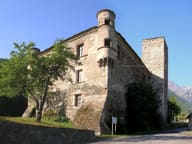 Saint-Marcel CastleIt stands on the road to the valley of the old iron, copper and manganese mines
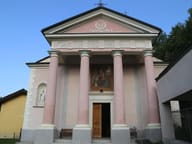 Plout SanctuaryA Greek-cross sanctuary of 1851, with the wooden statue of the Virgin donated in 1744
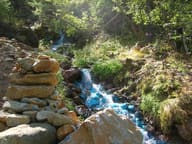 Eve Verda (Green Waters)The stream bed is covered by a turquoise copper deposit, described as early as 1749
- Ru MarseillerFifteenth-century channel carrying water from the Matterhorn valley to Verrayes and Saint-Denis