 The Aosta Trip
Map › Churches and sanctuaries
Plout Sanctuary
Sanctuaire Notre-Dame-de-Tout-Pouvoir de Plout
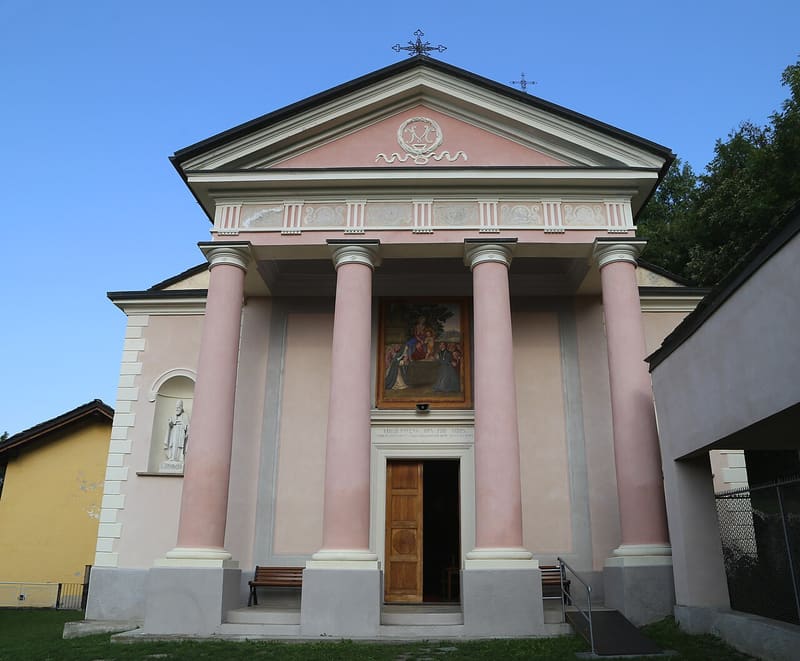
A Greek-cross sanctuary of 1851, with the wooden statue of the Virgin donated in 1744
The sanctuary stands in the woods at 952 m, above Saint-Marcel, with its bell tower and dome showing through the trees. The Neoclassical façade has a four-column portico; inside, the walls are covered with ex-votos and on the high altar stands the wooden statue of the Vergine de Tout-Pouvoir, with the sceptre and the Child on her left arm. You can also reach it on foot from the Moulin car park in less than an hour, on a wide path through the woods.

Visiting
From the official page, with no year given (the ‘Sunday 13 June’ it mentions falls in 2021): from May open on Wednesdays from 16:30 until the 18:30 Mass; July and August open every day 10:00–18:00; Mass every Wednesday at 18:30 and on Sundays at 19:00 from mid-June to the end of September. Night-time procession on the weekend closest to 14 September and, in recent years, a daytime one in July. Parish of Sant'Ilario, Nus: 0165 767901; on site 0165 768896. By car: a few minutes from Saint-Marcel on the road that climbs towards Les Druges; for parking it is best to ask the municipality. On foot: from the public car park in the hamlet of Troil/Moulin (693 m), path 11B then 11C, a wide path through the woods that is never steep: 234 m of ascent (284 in the trail register), 1.5 km, 51 minutes (regional trail register, difficulty E), recommended from April to November.
History
The place has been venerated since the fourteenth century. Originally a small shrine cut into the rock housed a statue of the Madonna, called Notre-Dame des Ermites, before which the inhabitants of the valley came to pray.
In the seventeenth century a mason, seriously injured in one leg, called on the Virgin and, once healed, built the first chapel. The faithful increased and in 1715 a larger building was put up. In 1744 the prior Charles Beltram donated a new wooden statue of the Virgin, with the sceptre and the Child on her left arm: it is the one that still stands on the high altar, with the title of Virgin de Tout-Pouvoir, ‘of all power’, which replaced the old title ‘des Ermites’.
The present sanctuary dates from the mid-nineteenth century, on a Greek cross plan with the dome at the centre and a neoclassical façade with a four-column pronaos. The consecration dates from 1851; according to another dating the work was finished in 1853. The interior walls are covered with ex-votos left by the faithful.
The main feast is linked to 14 September, the Exaltation of the Holy Cross: the procession takes place at night on the weekend closest to that date, and in recent years there has also been one by day in July. The sanctuary belongs to the parish of Sant'Ilario di Nus, which looks after its openings from May to September.
Nearby
 Saint-Marcel CastleIt stands on the road to the valley of the old iron, copper and manganese mines
 Pilate's CastleTwo corner turrets and three of the four perimeter walls in exposed stone remain
 Eve Verda (Green Waters)The stream bed is covered by a turquoise copper deposit, described as early as 1749
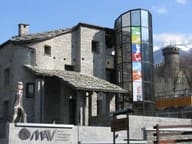 MAV - Museum of Traditional Aosta Valley CraftsThe more than 500 works of the Brocherel collection open the route, in the Memory room
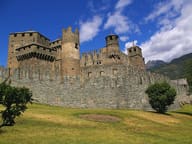 Fénis CastleIn the courtyard, a semicircular staircase beneath the fresco of St George and the Dragon
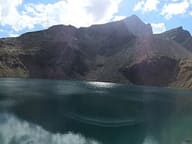 Bivacco MénabréazFormer Beck Peccoz hunting lodge on the shore of the first of the three Laures lakes