 The Aosta Trip
Pilate's Castle
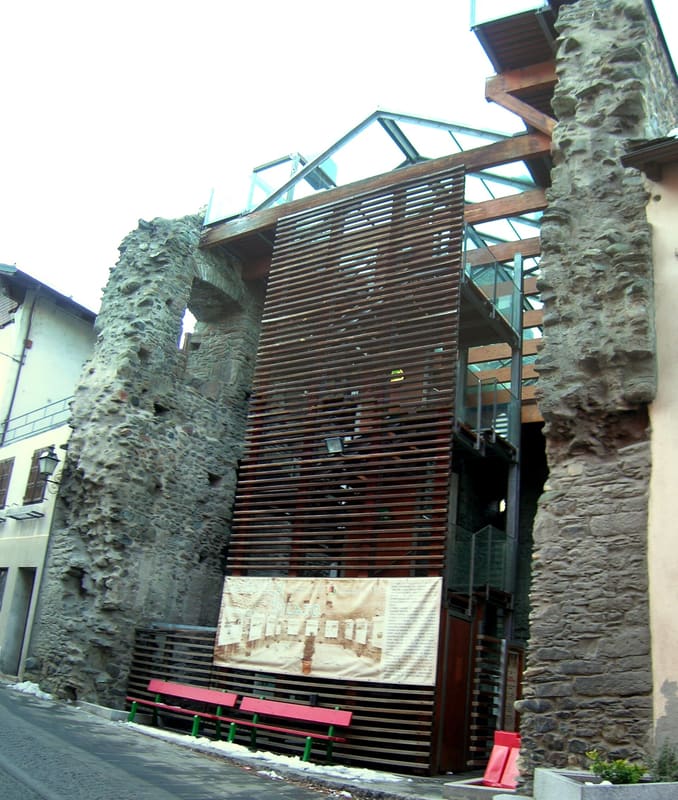
Two corner turrets and three of the four perimeter walls in exposed stone remain
The ruin occupies the centre of the village of Nus. Of the four original façades, three perimeter walls and two corner turrets remain, reached by a small staircase that leads to the upper walkway.

Visiting
The castle is owned by Nus municipality and there is a wine bar inside: you go in as a customer, during the bar's opening hours, and you can often climb the staircase to the upper level of the turrets. The opening hours are not published: it is best to check before going (Nus municipality, 0165 763763).
History
Pilate's Castle stands in the centre of Nus, along the ancient road that ran up the valley. The sources disagree on the date of construction: some place it in the twelfth to thirteenth centuries, others in the fourteenth; the first certain document is an act of feudal homage of 1337, in which Alexandre and Jean de Nus, lords of the place, describe ‘the crenellated house situated in the village of Nus at the entrance to the settlement towards Aosta’. It was therefore a fortified house, that is, the fortified home of a noble family, built by the lords of Nus as both residence and stronghold.
The building had a rectangular plan, with two corner turrets and four storeys, enclosed by thick perimeter walls in exposed stone. Towards the end of the sixteenth century a fire destroyed most of the fortified house and the family documents kept there were lost; the lords of Nus then abandoned the residence and moved to the castle above, built on a more defensible promontory (the present Nus Castle).
The name Pilate has nothing to do with this story: it comes from a legend according to which Pontius Pilate, travelling into exile in Gaul after the condemnation of Jesus, stopped at this place.
Between the late nineteenth and the early twentieth century the south wall, the one with the main entrance, was demolished to widen the road; the remains suffered further damage in the 1960s as a result of a car accident. The ruins were later restored, with the addition of a glass and steel roof and a metal staircase that lets you climb to the upper level of the turrets. Today the site is owned by Nus municipality and houses a wine bar.
Nearby
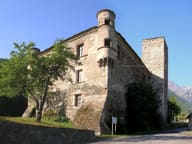 Saint-Marcel CastleIt stands on the road to the valley of the old iron, copper and manganese mines
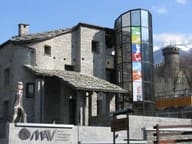 MAV - Museum of Traditional Aosta Valley CraftsThe more than 500 works of the Brocherel collection open the route, in the Memory room
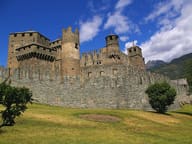 Fénis CastleIn the courtyard, a semicircular staircase beneath the fresco of St George and the Dragon
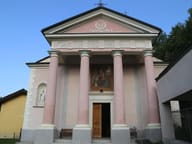 Plout SanctuaryA Greek-cross sanctuary of 1851, with the wooden statue of the Virgin donated in 1744
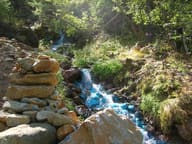 Eve Verda (Green Waters)The stream bed is covered by a turquoise copper deposit, described as early as 1749
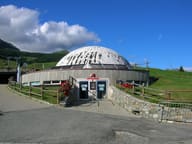 Aosta Valley Astronomical Observatory and Lignan PlanetariumOn the Teaching Terrace, seven 25 cm telescopes host the Saturday night tours