 The Aosta Trip
Arnad
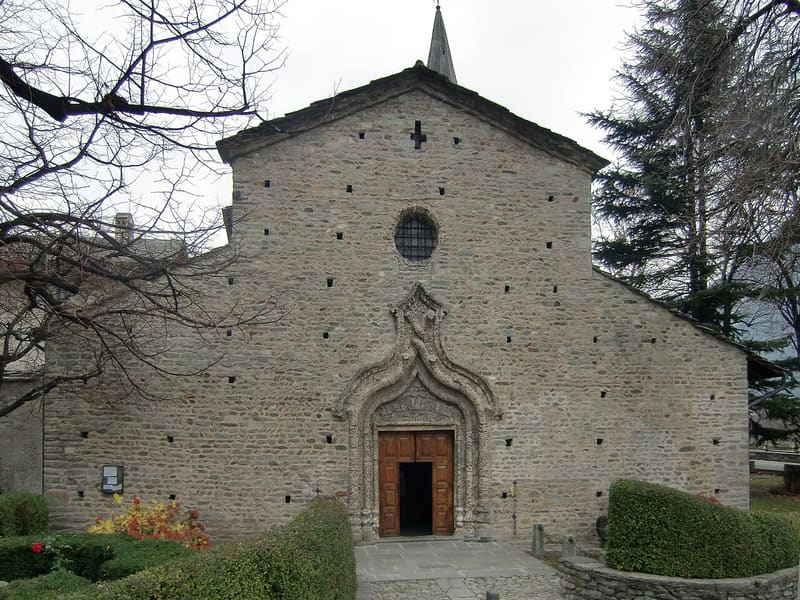
San Martino, with three aisles, is the most important example of Romanesque in the Aosta Valley
You visit the village starting from the church of San Martino at Arnad-Le-Vieux, on the plain where the main valley widens: a stone façade with a fifteenth-century tufa portal, the keel arch depicting two intertwined tree trunks, a rose window and a square bell tower with a tall spire. Not far away, the village of Ville keeps the Ohta fortified house, gathered around a tower with two-metre walls and its door about 8 metres above the ground. On the slopes, the vineyards and Vallaise Castle.

Visiting
You visit the village starting from the church of San Martino, in the hamlet of Arnad-Le-Vieux; the interior can be visited before and after services or during events. The village of Ville and Vallaise Castle are in other hamlets of the municipality. By bus: the Arriva Pont-Saint-Martin–Aosta line, or the VITA Group Carema–Montjovet circular service.
History
The upper castle, which overlooks the village and is now a ruin, seems to date from the thirteenth century and to go back to the De Arnado nobles. Then the history of Arnad becomes that of the Vallaise family: the tower of Ville, known as ‘Tor de l'Ohta’, is mentioned in a document of 1295 as the property of Pietro di Vallaise, and in 1351 the Vallaise family hosted Count Amadeus VI of Savoy for lunch in the upper castle.
The village of Ville is gathered around that early medieval tower, square in plan, with walls two metres thick and the original entrance about eight metres above the ground. In the fourteenth century the settlement was probably enclosed by a ring of walls or by its outer houses joined together: the franchises granted to the men of Arnad in 1321 by Amedeo di Vallaise in fact provided that the lord could order the necessary work on the village walls. Besides the lords' houses, those of notables, notaries and officials remain, with large halls, big fireplaces and stone spiral staircases, the ‘viret’.
According to the most widespread reconstruction, the church of San Martino began as the chapel of a monastery of the Benedictines of Fruttuaria on the plain of Arnad-Le-Vieux; traces of that phase remain in the foundations and in the central apse. In the eleventh century a flood destroyed the parish church further down the valley, dedicated to Saint-Germain d'Auxerre, and the chapel was rebuilt and enlarged as the new parish church, with three aisles in river cobbles and tufa blocks. In 1181 the Benedictines ceded it to the prior of Saint-Gilles at Verrès. In the late fifteenth century, in the years of Giorgio di Challant, the church received its cross vaults and the tufa portal with the two intertwined trunks, perhaps in homage to the marriage between a Vallaise baroness and a Challant count of Issogne. The seventeenth century made it Baroque, with a domed crossing tower and two side chapels, one of the Vallaise barons and one of the Confraternity of the Rosary; the restorations of 1949–52 removed much of those additions and gave it back its Romanesque and late Gothic appearance. In the roof space of the left aisle there are frescoes by a painter known as the ‘Master of Arnad’, close to those dated 1428 at Fleuran, in Issogne.
Between 1660 and 1670 Baron Félix-Charles-François Vallaise-Romagnano transformed the family residence into the Vallaise Castle you see today among the vineyards. When the male line of the Vallaise died out, the castle was sold around the mid-nineteenth century to the Turin merchant Giacobini, passed in 1926 to the De Bernardi family and finally to the Region. In the eighteenth century, between 1770 and 1776, the stone footbridge of Echallod was built, hump-backed on three arches, linking the hamlets on the left bank of the Dora to the rest of the municipality.
Today Arnad is known above all for its lard: Vallée d'Aoste Lard d'Arnad PDO has its own festival, the Féhta dou lar, which has been held on the last weekend of August for more than fifty years.
Nearby
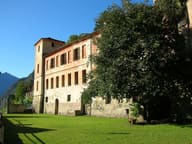 Vallaise CastleThe Hall of Honour preserves ten frescoed views of the former Vallaise fiefs
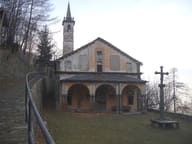 Machaby SanctuaryRebuilt in 1687, restored in 2021–2023; feast of Our Lady of the Snows on 5 August
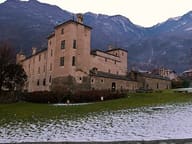 Issogne CastleIn the courtyard, the wrought-iron pomegranate fountain, a symbol of prosperity
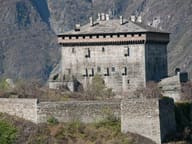 Verrès CastleIn 1536 Renato di Challant strengthened the walls to withstand firearms
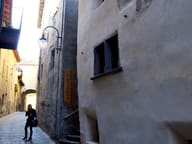 Bard VillageThe bullet holes from the Napoleonic siege of 1800 remain on Palazzo Nicole
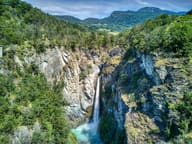 Cascata di IsollazThe Évançon drops almost 50 metres between two rock walls