 The Aosta Trip
Leper's Tower
Tour du Lépreux
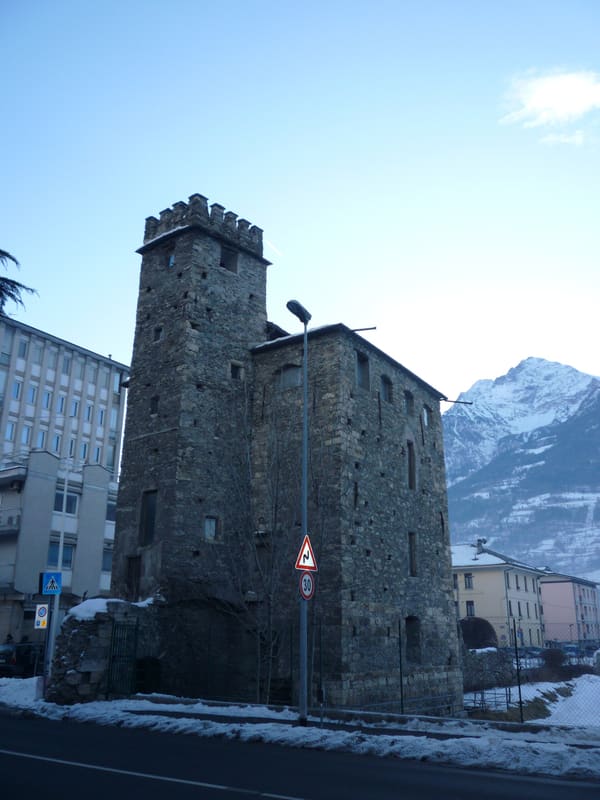
In 1773 the Mauritian Order confined a leper who had come from Oneglia here
The tower is set into the Roman walls, with a stair block added in the fifteenth century on the north side and stone windows opening on the south side. Built as a bastion of the Roman walls, in the Middle Ages it became a residence.

Visiting
The interior cannot be visited. You can see it from outside along the Roman walls of Aosta, in Via Torre del Lebbroso, at the junction with Via Festaz.
History
The tower stands on the western side of the Roman walls of Augusta Praetoria, built in the Middle Ages on a Roman bastion. It was originally called the Friour or De Friours tower after the noble family who lived there and who first appear in a document of 1191; the Friour also occupied the now-vanished Porta Decumana. In the fifteenth century the structure was enlarged with a stair tower on the north side and stone windows on the south side. Abandoned, the tower later became known locally as the Tour de la frayeur (‘tower of fright’).
In 1773 the building was bought by the Mauritian Order, which set up a hospice there for sick people who were to be isolated from the city. Between 1773 and 1803 Pietro Bernardo Guasco, from Oneglia, who suffered from leprosy, was confined there. It is not certain that Guasco lived with his sister, who was also ill: Xavier de Maistre's tale and some texts mention her, other accounts speak of Guasco alone. His story inspired the Savoyard writer Xavier de Maistre, who in 1811 published the tale Le lépreux de la cité d'Aoste (The Leper of the City of Aosta), in which the protagonist tends a garden and has a complicated relationship with his sister, ill like him. It is a literary work, not a historical account, and the details of his life should therefore be read as a narrative reworking.
In 1890 the tower was restored by the Regional Office for the Monuments of Piedmont and Liguria directed by Alfredo D'Andrade, the Portuguese architect who in the late nineteenth century oversaw the restoration of many castles in the valley; the work brought the stepped structure of the Roman base back to light. Today the tower, which is publicly owned, cannot be visited, but for years it was an exhibition venue of the regional administration.
Nearby
- Porta DecumanaWest gate demolished in 1812; the remains are in the basement of the Regional Library
 Bramafam TowerTower built in the thirteenth century on the Porta Principalis Dextera, south gate of the Roman walls
 PilaFrom the centre of Aosta to the runs of Pila in 17 minutes by gondola
 Saint-Bénin CentreManzetti's automaton plays the flute with compressed air: twelve tunes on a cylinder
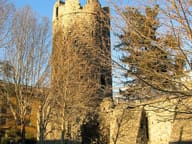 Tour NeuveCrenellated cylindrical tower at the north-west corner, of the De Turre Nova lords
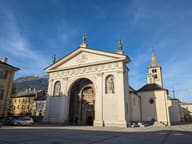 Aosta CathedralIn the choir, two medieval mosaics: the twelve months and the four rivers of Paradise