 The Aosta Trip
Tour de Villa
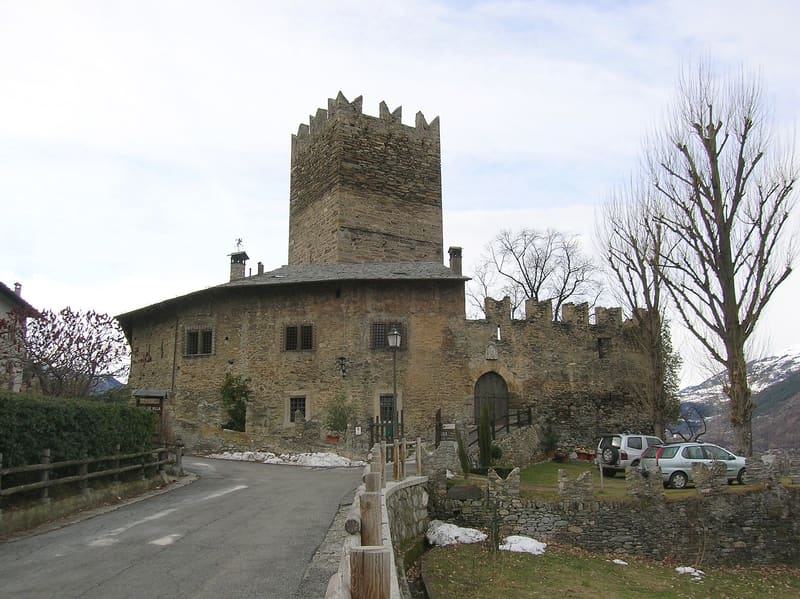
The tower is over 20 metres high, with walls of 2.5 metres at the base
It stands above the church of Sainte-Marie-Madeleine: a tower over twenty metres high and a residential block, enclosed by crenellations similar to those of the castle of Introd. Inside, not open to the public, is the hall of honour with frescoed coats of arms of noble families, from the Aosta Valley and from elsewhere, allied to the La Tour family, presumably datable to the second half of the fifteenth century.

Visiting
Private property, now housing a bed & breakfast: you can only see it from outside, visitors cannot go in.
History
The Tour de Villa, in Gressan, is linked to the family of the lords ‘de Villa’ or ‘de La Tour de Villa’, among the oldest in the Aosta Valley: its founder Guido already appears in 1242 in an alliance pact with the Count of Savoy for the conquest of the fort of Bard, but according to some historians the tower – over 20 metres high, with walls of about 2.5 metres at the base – is older, built around 1191. In the thirteenth century the family long held the office of vicedomini of Aosta.
The complex, originally consisting of the tower alone, gained in the fifteenth century – when defensive needs eased – a residential block on a semicircular plan over three floors, enclosed together with the tower by a crenellated ring of walls. In the hall of honour a cycle of frescoes from the second half of the fifteenth century shows the coats of arms of the noble families allied to the La Tour de Villa.
The family died out in 1693 with the death of Grat Philibert de La Tour, the last male descendant; the inheritance passed to the Aymonier and Carrel families and then, in decline, to the vestry for the poor of the parish of San Lorenzo in Aosta, hence the popular name ‘Tour des pauvres’, the tower of the poor.
In 1864 the merchant Vincent Carlin bought the ruins and in 1885 resold them to the Bishop of Aosta, Monsignor Joseph-Auguste Duc, who restored it thoroughly and turned it into a summer residence. In 1921 it passed to Baron Gerbore di Saint-Nicolas and since 1945 it has belonged to the Arruga family of Milan. Today it is private property, partly used as a bed & breakfast, visible only from outside.
Nearby
 Maison des Anciens RemèdesThe route presents 38 plants of Aosta Valley tradition in a late-seventeenth-century barn
 Sarre Royal CastleVictor Emmanuel II bought it in 1869 for his hunting trips
 Saint-Martin-de-Corléans Megalithic Area (MegaMuseo)46 anthropomorphic stelae discovered 6 metres below street level
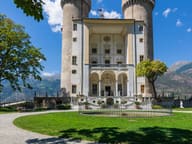 Aymavilles CastleFour corner towers added in the fifteenth century, then Baroque between 1713 and 1728
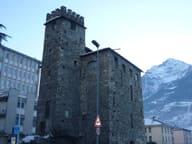 Leper's TowerIn 1773 the Mauritian Order confined a leper who had come from Oneglia here
- Porta DecumanaWest gate demolished in 1812; the remains are in the basement of the Regional Library