 The Aosta Trip
Petit-Monde Ethnographic Museum
Musée Petit Monde
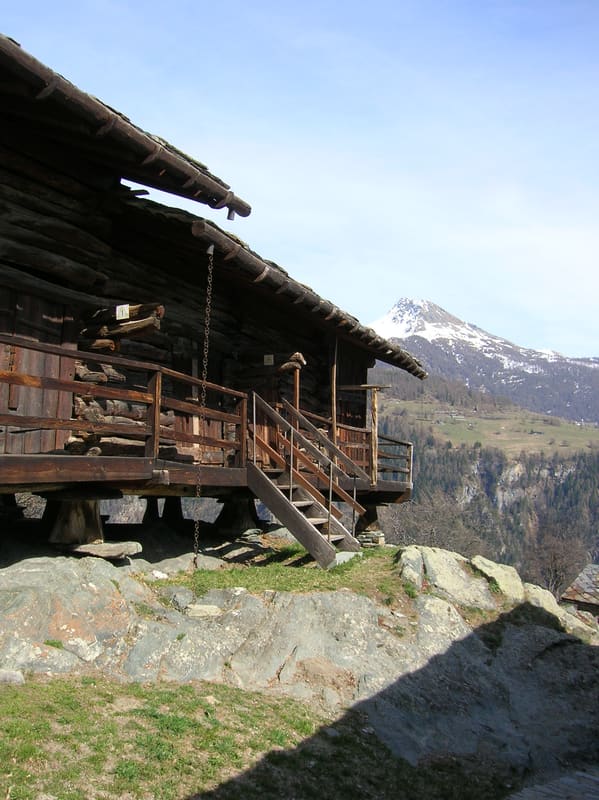
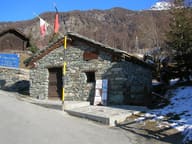
Row raccard, grange and grenier from 1463–1700 at Triatel, with a mill on the stream
You reach the museum on foot from Torgnon with a panoramic walk to Triatel, on the Créta de Triaté. The route passes through three traditional buildings of larch wood on stone bases: the row raccard, unique in the valley, from 1463–1503, with the ‘Il labirinto della memoria’ route on the ground floor and the collections on haymaking, grain, the mule and the cowshed on the upper floor; the grange (grandze) from 1700 with the tools for processing milk, bread and meat; the grenier from 1470 with the tools of the woodcutter and the carpenter. The visit ends at the mill, a short distance away on the Petit Monde stream.

Visiting
Summer 2026: free admission on the weekends of 4–5 and 11–12 July, every day from 18 July to 30 August, and the weekend of 5–6 September; opening hours 10:00–13:00 and 15:00–18:00, with one-hour guided tours at 11:00 and 16:00. During the rest of the year, open by booking, with an admission charge. Contacts: municipal library 0166 540213, tourist office 0166 540433.
Collections
Ground floor of the raccard — Il labirinto della memoria. The route begins with the permanent exhibition ‘Il labirinto della memoria’, panels of accessible text and illustrations by the artist Francesco Corni that tell the story of the origins and evolution of the village of Triatel and Etirol and the social organisation of its inhabitants, autonomous from the rest of Torgnon since the thirteenth century.
Upper floor of the raccard — Haymaking and cowshed life. The collections on the upper floor, set up in the old storage spaces (the tsé and the tzambron), follow the rhythms of mountain farm work in four themed sections: haymaking, growing grain, mule breeding and life in the cowshed, with the original tools used by the villagers.
The grange — The products of peasant life. The grange building, the hayloft and cowshed of 1700, holds the objects used to prepare the typical products of the rural Aosta Valley diet, from dairy produce to preserves.
The grenier — Woodcutters and carpenters. The grenier, the building divided into separate cells for each family in the village, displays the work tools of the woodcutter and the carpenter, trades linked to the use of the larch from which the museum buildings themselves are built.
The mill. The visit ends a short distance away, at the mill on the Petit Monde stream, which once served the whole community of Triatel and Etirol for grinding the grain grown in the nearby fields.
History
The hamlets of Triatel and Etirol, above Torgnon, have formed since time immemorial a small world of their own, separate from the rest of the village and for this reason called the Petit-Monde. As early as the thirteenth century its inhabitants obtained autonomous rights over land and property, and in 1750 they collectively paid 1,280 lire to free themselves from their feudal obligations to the local lord, the payment in kind or in labour owed in exchange for the land granted. From then on the small community managed by itself the irrigation of the fields, a communal mill and a communal oven, and in 1783 it even opened its own school, independent of the one in the main village.
The village preserves three traditional buildings built between the fifteenth and the eighteenth centuries in local larch on stone bases: a terraced raccard, a granary on wooden stilts (the pilotis) that kept rodents away, built between 1463 and 1503 and the only example of its kind in the Aosta Valley; a grange, that is a hay barn and cowshed, from 1700; a grenier, the storehouse with small cells assigned to each household, from about 1470.
With the gradual abandonment of traditional farming life in the twentieth century these buildings lost their original function. Torgnon municipality promoted their conservation restoration and turned them into an ethnographic museum, opened in 2004: the route ‘Il labirinto della memoria’, with accessible text panels and illustrations by Francesco Corni, tells of the origins and development of the village on the ground floor of the raccard, while the upper floors and the other buildings show the tools of the farming and herding life of the past.
Today the museum, which you can reach on foot from Torgnon along a panoramic walk, is run by the municipality together with the municipal library and offers guided tours in the summer months; the route ends with a visit to a mill still in working order on the nearby Petit Monde stream.
Nearby
 TorgnonAn 8-seater gondola goes up from the village to the Chantorné basin, at 1,868 m
 ChamoisThe village with no roads for cars: you go up to the lifts by cable car from Buisson
- Gilliarey Sanctuary1866 chapel on a rocky spur above Buisson, facing the Matterhorn
- Torgnon Cross-Country TrailsThe Gilliarey loop climbs to 2,200 m, at the sanctuary, with a view of the Matterhorn
 Alpe ChâteauAlpine pasture from 1780 beside the ruins of the Chavacour hospice, on the route to Valais
 La Magdeleine MillsEight watermills in a chain along a stream, three of them grinding again