 The Aosta Trip
Chamousira Gold Mine
Tunnel dug into the Fenilliaz vein, worked from 1900 until the early 1980s
From the car park a woodland path, with steps, takes you in about 20 minutes to the reception centre overlooking the Val d'Ayas, where you find the ticket office and the Joseph Herbet Documentation Centre with historical photos and maps. The guided tour goes down into the level 7 tunnels (and in the Adventure version level 6 as well) of the Fenilliaz vein, at about 5–10 degrees, between original rock walls and video installations. A helmet is compulsory and provided on site.

Visiting
Opening is seasonal: at weekends from June to September and every day in August, with 1-hour slots for the Classic tour (suitable for everyone, max 18 people) and 1 and a half hour slots for the Adventure tour (min age 7, max 15 people). The exact times of the daily slots are uncertain: it is best to ask the ticket office beforehand (+39 379 263 5757). Full price (from age 14) €10, concession (ages 6–13 and disabled visitors) €6, free for under-5s. The route is not wheelchair accessible; animals are not allowed.
Collections
History of the mine. The Chamousira gold deposit, above Brusson, was discovered in 1899 and worked from 1900 until the early 1980s. Between 1903 and 1907 the Fenilliaz vein was successfully worked by the English company The Evançon Gold Mining Company Limited; the concession then passed to the Italian Rivetti family, with lesser results. The total underground length of the tunnels is about 1,570 metres.
The Joseph Herbet documentation centre. In the early twentieth century Joseph Herbet was head miner at the Fenilliaz and Chamousira gold mines for the English company. A keen photographer, with a 13x18 bellows camera he photographed people, families and places, documenting in particular mining work in the Brusson and Challand areas. A selection of these images, together with historical maps of the period, is on permanent display in the centre named after him, housed in the Brusson municipal library.
The mine museum. Higher up, in a panoramic building built where the ore cableway once arrived, the mine museum tells the story of mining and how it was organised, from English to Italian management.
The tunnel visit. With a guide you walk through the level 7 tunnel of the Fenilliaz vein, dug into the mountain; the temperature inside ranges between 5 and 10 degrees all year round (other sources give an average of about 8 degrees) and visitors are given a helmet. The route is not wheelchair accessible.
History
The Chamousira-Fenilliaz basin, above Brusson, holds the most important gold mine in the Aosta Valley. Interest in the gold-bearing veins of the Evançon is old (the lords of Challant were already involved with them from the thirteenth century), but modern exploitation dates from the twentieth century: the deposit was discovered in 1899 and work began in 1900, carried out by The Evançon Gold Mining Company Limited, an English company which in 1902 employed 19 workers.
Activity reached its peak between 1903 and 1907 under English management: the workforce rose to about a hundred, almost all from the villages of Brusson, while the technical staff were mostly English, among them Joseph Herbet, a mine foreman who documented the period in photographs. In 1903 a cableway was built to carry the ore down the valley, and by 1906 the Fenilliaz vein had been worked on seven levels for about 1,570 metres in total, with gold production estimated at about 4 tonnes.
After 1907 activity declined rapidly because of poor profitability and was abandoned by 1909; the English company's concession was revoked in 1913 for inactivity. There followed minor, intermittent resumptions: a 1929–1933 concession to Axerio and Panisari with modest results, that of Cavalier Rivetti from 1937 to 1949 with about fifteen workers, and later managements (Filippa Agostino, Franco Filippa, Bitossi) until the early 1980s, when activity ceased for good.
From 2013 the Region launched a project to restore and promote the site, funded with about €1.14 million from the POR FESR 2007–2013: the level 7 tunnel (125 metres) was made safe and passable, and a small documentation centre named after Joseph Herbet was set up in Brusson, with period photographs and maps, and multimedia stations on explosives, transport, extraction techniques and the miner's life. The restoration was completed in 2015 and since then the site, which also includes the old foundry, the miners' houses and the powder magazine, can be visited with a guide.
Nearby
- Brusson, EstoulSunny runs in the hamlet of Estoul, above Brusson: 9 runs, none of them black
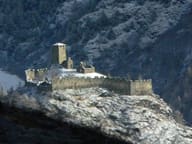 Graines CastleBeside the walls, the Romanesque church of San Martino with herringbone walls
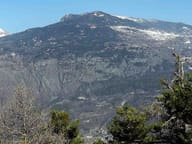 Testa di ComagnaStone cross on the summit, with a view of Mont Néry, Mont Avic and Mont Blanc
- Brusson Cross-Country TrailsBetween 1982 and 2001 the Vollon plateau hosted five World Cup races
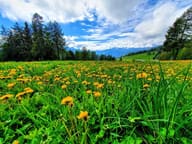 Col de JouxIn the woods at the pass flows the Ru Courtaud, an irrigation channel granted in 1393
- Col TzecorePlateau among larches with a picnic area and views of Mont Blanc and Monte Zerbion