 The Aosta Trip
Graines Castle
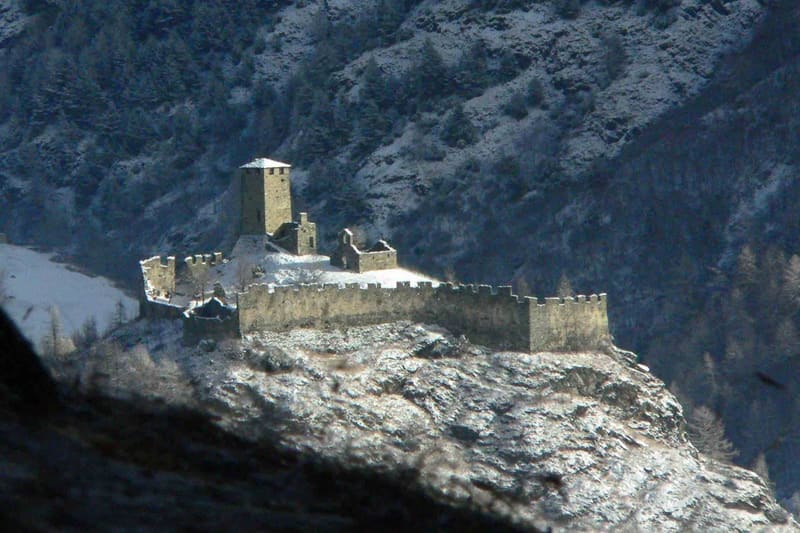
Beside the walls, the Romanesque church of San Martino with herringbone walls
A short path through the woods from Arcesaz leads to the remains of the castle walls, set against the slope and adapted to the terrain. You can enter the walled perimeter freely and see the tall crenellated square tower up close, but you cannot climb it. Next to it are the ruins of the Romanesque church of San Martino, with decorations in the apse and herringbone masonry.

Visiting
Free admission inside the walls, all year round; the tower cannot be visited. In summer guided tours are organised: it is best to check the times before setting out.
History
The origins of the fief of Graines, in the upper Val d'Ayas, date from 515, when the King of the Burgundians, Sigismund the Saint, gave numerous estates, including the fertile fief of Graines, to the abbey of Saint-Maurice d'Agaune, in Valais. In 1263 the monks granted the castle and the surrounding lands in fief to Gotofredo di Challant: so began almost six centuries of administration by the Challant family, always as vassals of the abbey.
The building you see today, a typical primitive defensive work set on a height controlling the Val d'Ayas and the access to the upper Gressoney valley, took shape during the eleventh century: a crenellated tower on a quadrangular plan, a chapel and a ring of walls that follows the natural lie of the land. There are also the remains of a minor Romanesque church dedicated to St Martin, with a single nave and a semicircular apse, with stretches of herringbone masonry. In the fifteenth century the defences were strengthened and the castle served as a stronghold for Caterina di Challant during the succession disputes that followed the death of her father, Francesco di Challant.
On the death of Gabriella, the last of the Challant family, in 1841, the castle, by then dilapidated, passed to the Passerin d'Entrèves family, who granted its usufruct to Brusson municipality. Between the late nineteenth and the early twentieth century the architect Alfredo d'Andrade, Portuguese by birth and responsible for the restoration of many castles in the valley, worked with Giuseppe Giacosa to consolidate and partly rebuild the western section of the keep, the main tower, and some stretches of the ring of walls.
In the 1990s further safety work was carried out, without altering the now established appearance of the ruin. Since 2010 an archaeological investigation has gathered new data with a view to completing the restoration of some areas, including the outer face of the southern ring of walls and the buildings to the south-west; the most recent work was carried out under the AVER cross-border programme, between Savoy, Valais and the Aosta Valley, which made the site accessible to the public. Today you can visit the castle freely inside the walls, while the tower is not open to visitors.
Nearby
- Chamousira Gold MineTunnel dug into the Fenilliaz vein, worked from 1900 until the early 1980s
- Brusson, EstoulSunny runs in the hamlet of Estoul, above Brusson: 9 runs, none of them black
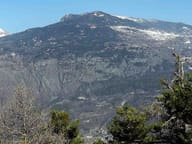 Testa di ComagnaStone cross on the summit, with a view of Mont Néry, Mont Avic and Mont Blanc
- Col TzecorePlateau among larches with a picnic area and views of Mont Blanc and Monte Zerbion
- Brusson Cross-Country TrailsBetween 1982 and 2001 the Vollon plateau hosted five World Cup races
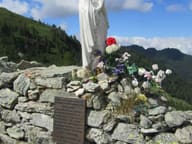 Colle RanzolaA plaque to Tolstoy, who came this way in 1857, and a dry-stone wall from 1800 against Napoleon