 The Aosta Trip
Great St Bernard Pass
Col du Grand-Saint-Bernard
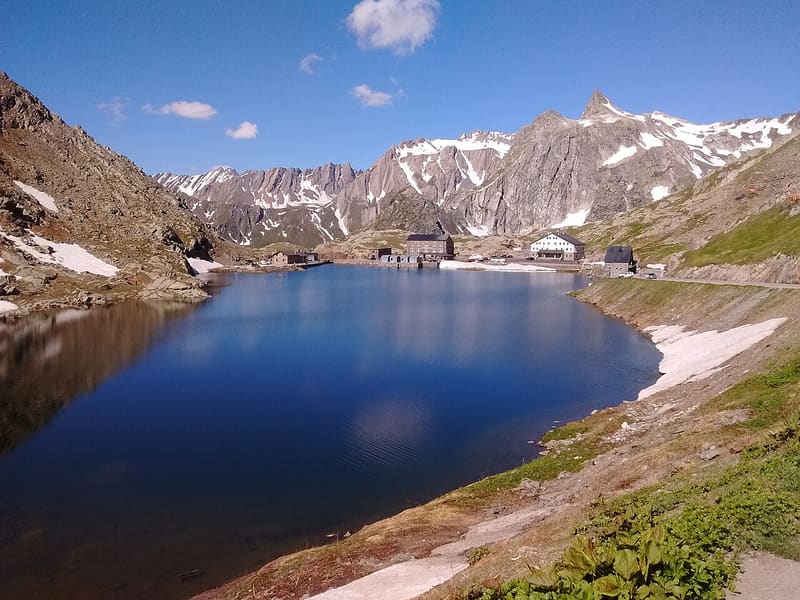
A pass at 2,472 m: in May 1800 Napoleon crossed it with 40,000 men
The pass is a basin of rock and snow closed off by the Chenalette to the north, Mont Mort to the south and the Pain de Sucre to the west, with almost constant wind and up to twenty metres of snow a year. In the middle lies a small lake, frozen until late spring; on the shore the hospice with the hotel and the museum are already in Switzerland, because the border runs across the pass. On the Italian side, at the Plan de Jupiter above the road, the 1905 bronze statue of St Bernard faces the valley, and the Roman roadway is still carved into the rock.

Visiting
By car: the SS 27 Great St Bernard road from Aosta via Étroubles and Saint-Rhémy-en-Bosses; from the junction at km 19.8 you go to the tunnel, which is tolled and open all year round, while the pass road continues from Cerisey. Winter closure of the 7.5 km between Cerisey and the border: in 2025 closed from 8:00 on Monday 20 October, after reopening on Friday 6 June 2025; reopening expected in June 2026; normally passable from mid-June to mid-October (Anas and regional source, 2025–2026). At the pass: lake, statue and border; hospice, hotel and museum on the Swiss side. Museum open in the summer season, depending on when the road opens, every day 10:00–18:00, last admission 17:30, adults CHF 12, seniors 10, children and students 7, free up to age 7 (hospice, 2026); church and treasury free entry; dogs at the pass from June to September, walks with the dogs in July and August, 2.5 km and 205 m of height gain in 1 h 30–2 h, CHF 350 per group of up to 8 people, from age 8, museum included, by booking (Fondation Barry, 2026). On foot: two routes from the regional trail register already on this page, from Saint-Rhémy 2 h 41 and from the main road 2 h 50.
Trails
- from Saint-Rhémy (1,640 m) · ↑ 837 m · 2 h 41 min out, 1 h 47 min back · 5.9 km · E Hike · path TDC - 13B · June–September
- from Strada Statale 27, start str militare (1,699 m) · ↑ 754 m · 2 h 50 min out, 1 h 58 min back · 6.7 km · E Hike · path 13 · June–September
Trails: data provided by the Struttura Forestazione e Sentieristica of the Aosta Valley Autonomous Region.
History
Since Roman times the pass has been a favoured route across the Alps. At the top stood a temple dedicated to Jupiter Poeninus, around which lie the archaeological remains of the Plan de Jupiter, and the ancient roadway cut by the Romans can still be seen in the rock. Coins, votive tablets and other objects found on the pass are in the hospice museum, which holds about 1,350 archaeological finds.
Around the middle of the eleventh century St Bernard of Menthon, archdeacon of Aosta, had a hospice built on the pass to protect travellers, who arrived frightened and often robbed by brigands, and entrusted it to a congregation of canons regular. The pass was already on the pilgrims' road: Sigeric, Archbishop of Canterbury, returning from Rome in 990, noted ‘Sce Remei’, Saint-Rhémy, among the stages, and around 1154 the Icelandic abbot Nikulas of Munkathvera wrote that he had stopped at the ‘Bjanardz spitali’, Bernard's hospice. The hospice church dates from the thirteenth century and was rebuilt in its present form in 1686; the canons still take in guests all year round, and with 25 metres of snow the pass can be reached in winter only on skis or snowshoes.
Dogs have been at the hospice since at least the seventeenth century: they helped the canons to beat a track in fresh snow, to sense approaching avalanches and to find lost travellers. The St Bernard breed was developed from their breeding in the nineteenth century. Since 2005 the kennel has belonged to the Fondation Barry of Martigny, and from June to September some of the dogs return to the pass, where in July and August they go with visitors on walks around the hospice.
In May 1800, in the second Italian campaign, Napoleon Bonaparte took the Army of the Reserve over the pass, about 40,000 men with horses and artillery: a logistical feat of eight days, with the cannons dismantled and dragged over the snow inside hollowed-out tree trunks. The vanguard took Aosta, the army stopped below the fort of Bard and the campaign ended with the victory of Marengo.
The pass road, the SS 27 on the Italian side, closes every winter: in 2025 Anas closed the 7.5 km between Cerisey and the border from 20 October, after reopening them on 6 June, with the snow blowers having been at work since mid-April. Since 19 March 1964 the Great St Bernard Tunnel, 5,798 m long and tolled, has linked Italy and Switzerland in every season. On the Italian side the bronze statue of St Bernard, erected at the Plan de Jupiter in 1905 and blessed on 13 July of that year, has carried since 1923 the plaque recording Pius XI's proclamation of the saint as patron of the Alps.
Nearby
- Col Fenêtre de FerretFrom the pass, the Grandes Jorasses and Mont Dolent seen from the east, above the Fenêtre lakes
 Col Nord de MenouveBelow the pass a tunnel towards Switzerland was dug in 1856, stopped after about 70 m
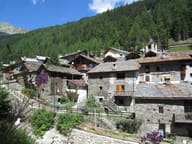 Saint-RhémyFrom 1627 its inhabitants were ‘snow soldiers’ in the service of the Great St Bernard Pass
 Monte PagliettaLarge stone cairn on a knoll above Saint-Oyen, facing Mont Vélan
- Bivacco MollineA 16-place bivouac hut, open all year round, at the foot of Mont Vélan (3,710 m)
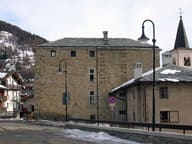 Bosses CastleIt has three storeys in a single block, with fifteenth-century cross-mullioned windows