 The Aosta Trip
Saint-Rhémy
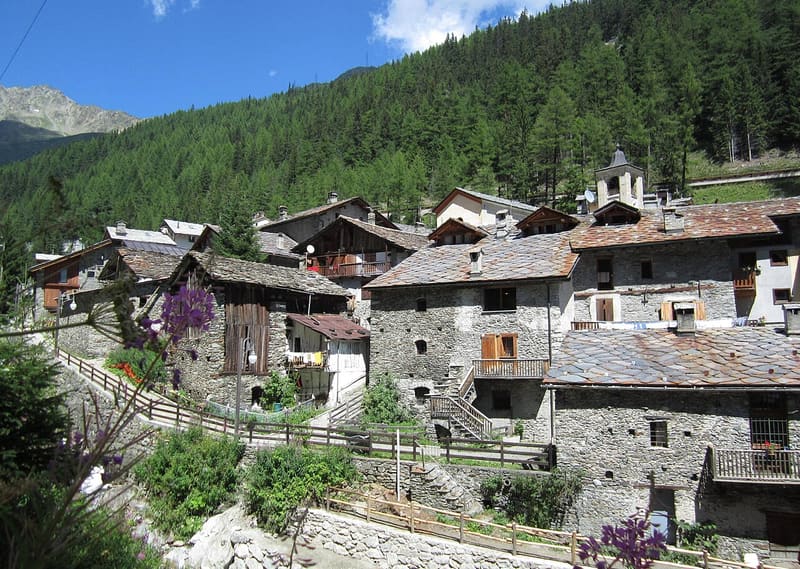
From 1627 its inhabitants were ‘snow soldiers’ in the service of the Great St Bernard Pass
A compact group of stone houses with stone-slab roofs and wooden balconies, below the woods, on the old road to the pass. Above the roofs rises the bell tower of San Remigio, the 1784 church frescoed inside by the Stornone brothers. On the houses you can still read the carved initials of the builders.

Visiting
By bus from Aosta on the Aosta – Saint-Rhémy-en-Bosses line (Arriva, timetables for the ‘Centro valle’ area). You can visit the church of San Remigio with a guide by booking, from June to September, by contacting the parish. Car parks: not stated in the official sources consulted.
History
The Great St Bernard Pass was already in use in protohistoric times, when the Aosta Valley belonged to the Salassi. In 1842, while digging to build the presbytery, rows of skeletons with their feet pointing south came to light at Saint-Rhémy; they were regarded as probably Neolithic. The Romans made the pass a route of communication under the emperor Claudius, around AD 47, and at Saint-Rhémy a mansio arose, a staging post with lodgings, a market and a station for animals, called Eudracinum. Other reconstructions, however, place Eudracinum at Étroubles, further down the valley.
The village takes its name from St Remigius, bishop of Reims, to whom the church is dedicated. In the itinerary of Archbishop Sigeric of Canterbury, on his way back from Rome around 990, Saint-Rhémy is stage XLVIII, ‘Sce Remei’: the road would later take the name Via Francigena. Around 1050 the hospice founded by St Bernard was completed on the pass. In 1250 Nicolas Richardi de Vachéry had the Fontinte hospital built, and in 1273 the Charter of Franchises reserved to the inhabitants the right to accompany travellers and goods to the pass as marronniers, guides and porters. The 1397 accounts of the Great St Bernard hospice are the first record of Bosses ham.
In 1627 Duke Charles Emmanuel I of Savoy exempted the inhabitants from military service in exchange for a specific task: they became ‘soldats de la neige’, snow soldiers, a small army commanded by the mayor that kept the pass road clear and rescued travellers swept away by avalanches. The service lasted until 1915. In May 1800 Napoleon's army came down from the Great St Bernard; on 20 May the First Consul passed through Saint-Rhémy and went on to Étroubles.
The church of San Remigio was built in 1784 on the foundations of an Early Christian building; in 1898 the Stornone brothers of Ivrea frescoed its interior and painted the high altar canvas with the Madonna and St Remigius, while the liturgical furnishings are older than the church itself. At Bosses the parish church of San Leonardo, from 1861–1862, is among the first neo-Gothic buildings in the Aosta Valley, and it too was decorated by the Stornone. The castle of Bosses, of medieval origin, was entirely rebuilt in the fifteenth century.
The raw ham cured with mountain herbs, produced at about 1,600 metres, was granted Protected Designation of Origin status in July 1996 as Vallée d'Aoste Jambon de Bosses, and in August the hamlet of Saint-Léonard holds a festival in its honour. As at Étroubles, the Coumba Freida carnival brings the landzette onto the streets, costumes that recall the uniforms of Napoleonic soldiers.
Nearby
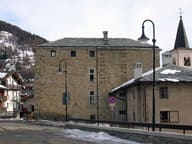 Bosses CastleIt has three storeys in a single block, with fifteenth-century cross-mullioned windows
 Monte PagliettaLarge stone cairn on a knoll above Saint-Oyen, facing Mont Vélan
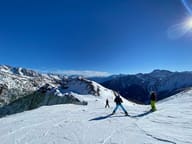 Crévacol20 km of south-facing runs, from 1,640 to 2,450 m above Saint-Rhémy
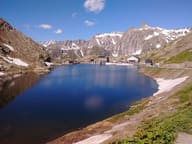 Great St Bernard PassA pass at 2,472 m: in May 1800 Napoleon crossed it with 40,000 men
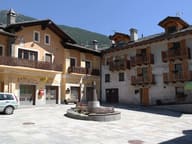 ÉtroublesSculptures and installations in the streets: an open-air museum since 2005, on the Via Francigena
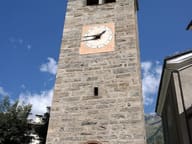 Parish Treasury MuseumFive display cases of goldsmiths' work from 1400 on, opened in 2011 in Santa Maria Assunta