 The Aosta Trip
Map › Churches and sanctuaries
San Giacomo Church in Issime
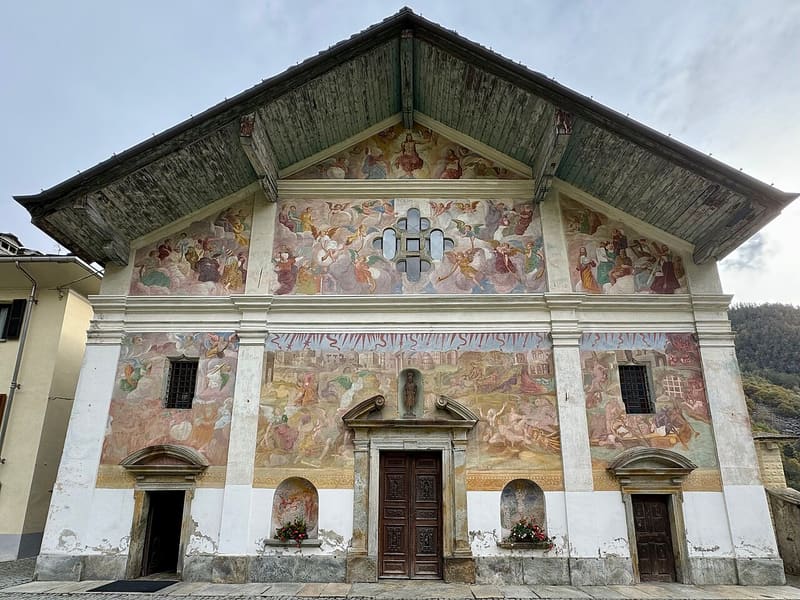
The Last Judgement on the façade, from 1698, is the largest in the Aosta Valley
Arriving from Pont-Saint-Martin you can see the church from the regional road, in the centre of the village. The façade is entirely covered by the fresco of the Last Judgement: Paradise at the top, beneath the broad slope of the roof, the fall of Babylon in the centre, Purgatory and the resurrection of the dead at the bottom left, Hell on the right. In front, the forecourt is enclosed by fifteen frescoed niches with the mysteries of the Rosary. Inside, the high altar in gilded and lacquered wood bears 182 statues; at the entrance are the display cases of the small parish museum, with wooden statues, silverware and a reliquary from 1675.

Visiting
The church stands in the centre of Issime, on regional road 44 of the Lys Valley. The façade and the forecourt with the niches can always be seen from outside. For the interior and the parish museum neither the parish nor the municipality publishes opening hours (checked on 01/10/2026): a local guide gives the church as open all day except during services, with free admission; for the museum it is best to ask the parish (0125 344010) or the municipality (0125 344033). Car park: no official information found; next to the church there are the meadow with the playground and the benches. By bus on the Pont-Saint-Martin–Gressoney line, about 30 minutes from Pont-Saint-Martin.
History
The first certain record of the parish of San Giacomo is a bull of Pope Lucius III of 7 May 1184. In the twelfth century Issime had become independent of Perloz and for centuries administered three neighbouring communities, which became independent parishes between 1660 and 1786. Of the medieval church there remain, in the left aisle, the pointed arch that was the base of the bell tower and the Romanesque baptismal font. The village is a Walser colony: the settlers came from Valais between the twelfth and thirteenth centuries, and töitschu is still spoken in the village.
The present building comes from a rebuilding begun on 8 June 1683, when the curate Jean Pierre Biolley signed the contract with the master builder Giovanni Christille and with workers from Valsesia. The interior has a nave and two aisles with barrel vaults, separated by six stone columns. The wooden portal, carved at the end of the seventeenth century, shows sacred figures in four large panels and cherubs' heads in the small ones; above it, in a niche, is the wooden statue of St James, patron of the village together with St Sebastian.
The façade was frescoed between 1698 and 1700, at the end of the rebuilding, by Biondi, a Genevan painter and portraitist who lived in Aosta. It is the largest Last Judgement in the Aosta Valley and copies, details included, the nine-sheet print by Pieter de Jode the Elder, published in Antwerp in 1615, itself taken from the painting by Jean Cousin the Younger for the Minims of Vincennes, of about 1575, now in the Louvre: Paradise at the top, the fall of Babylon in the centre, Purgatory and the resurrection of the dead at the bottom left, Hell on the right. A Last Judgement already existed on the earlier church: in 1676 the contract for the façade at Perloz asked for Paradise, Purgatory and Hell ‘as at Issime’.
In the same years, between 1698 and 1700, the Gilardi brothers, from Valsesia, made the Baroque high altar with 182 statues in gilded and lacquered wood. The pulpit, from 1710, has carved panels with the Evangelists. In 1755 the forecourt was enclosed by fifteen niches, frescoed by Antonio Facio di Valprato with the mysteries of the Rosary and the apostles.
The restoration work begun in 1984 brought to light remains of the original church; in 1986 the parish museum was opened in the rooms by the entrance, one of the thirty or so museums of sacred art set up in Aosta Valley parishes with contributions from the Region. It holds works of Swiss-German influence, including a fifteenth-century wooden statue of St James, silverware and a reliquary from 1675; in 2006 the Region catalogued 109 objects there. The municipality points out that the church has been declared a national monument.
Nearby
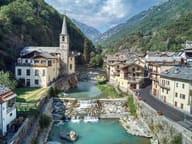 FontainemoreA stone bridge with a single 22-metre arch crosses the Lys to the church
 Colle della VecchiaIn the rock two women from the two valleys greet each other: ‘buon giorno, guten tag’ (1877)
- Cascata di NielA 28 m vertical drop of the Niel stream, visible from the village of Gaby
- Coumarial Cross-Country TrailsFacing south-east, the Coumarial trails get the sun until dusk
 Colle della GragliascaAt the pass an engraving marks the 7,360 m of mule track climbed from Rosazza, in Valle Cervo
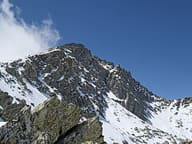 Mont CrabunCross with a wooden Christ; below the summit a bivouac hut in two parts, from 1989 and 1993