 The Aosta Trip
Saint-Germain Castle
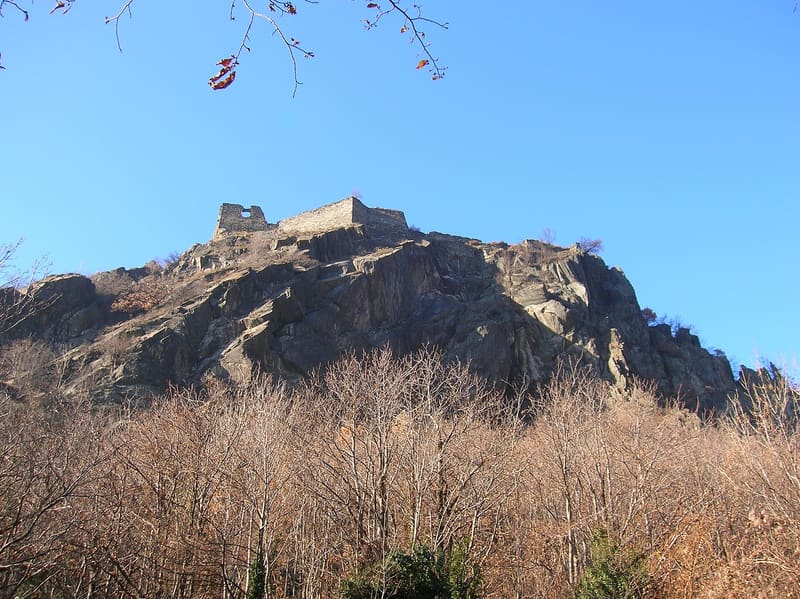
From 1438 a Savoyard garrison was stationed here, moved to Forte di Bard in 1661
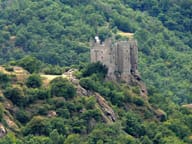
Little remains of the original structure: the tower still dominates the hill known in Roman times as Mons Jovis and can be seen from the road and from the village below. The entrance gate is closed and you cannot go near it because of the danger of collapse.

Visiting
It cannot be visited: the gate is closed because of the danger of collapse. The tower can be seen from the road and from the village of Montjovet below. For any openings you can enquire at Montjovet municipality (0166 79131).
History
Saint-Germain Castle dominates Montjovet from the top of a hill that in Roman times was known as Mons Jovis. It was built between the eleventh and twelfth centuries by the De Montjovet family, to control the road below and collect tolls from travellers; in 1250 Bermond di Montjovet is recorded as the owner of both castles in the area, and in 1261 he shares it with Ebalo I di Challant.
Between 1270 and 1294 the castle passed to the House of Savoy: Philippe Bermond, known as Feidino di Montjovet, had made himself hated by the people of the valley and by travellers for his excessive tolls, and the Count of Savoy took the opportunity to take the fortress from him, compensating him with the lordship of Coazze in Val Sangone. In 1295 the fief passed to the Challant family: Ebalo I di Challant received it in exchange for giving up the viscountcy of Aosta. In 1377 Ibleto di Challant held the Bishop of Vercelli, Giovanni Fieschi, hostage at Montjovet after he had been captured by the insurgents of Biella; the agreement that freed him was signed at Verrès on 25 April 1378. In 1438 Francesco di Challant brought the castle back under the control of the House of Savoy, which installed a military garrison there.
After 1438 the House of Savoy had a Renaissance bastion added, together with defences suited to firearms: because of its high position above the valley, the castle was among the most strategic in the region.
In 1661 Charles Emmanuel II of Savoy ordered the garrison to be moved to the fort of Bard and the castle of Montjovet to be made unusable, and it was left to decay; by the early eighteenth century it was already a ruin. Today it is owned by the Aosta Valley Autonomous Region: a gate prevents access because of the danger of collapse, but the tower remains visible in the landscape.
Nearby
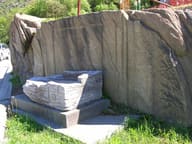 Roman Road to Gaul at MontjovetWheel ruts cut into the rock, on a carriageway more than 4.5 metres wide
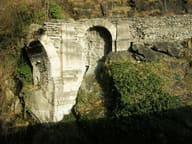 Saint-Vincent Roman BridgeThe central arch collapsed on 8 June 1839: the left abutment and part of the right remain
 Saint-Vincent SpaWater from the Fons Salutis spring, discovered in 1770; outdoor pools at 36 °C
- Col TzecorePlateau among larches with a picnic area and views of Mont Blanc and Monte Zerbion
 Ussel CastlePassed to the Region in 1983; linked to Marcel Bich, the Bic pen baron
- Casinò de la ValléeOpened on 29 March 1947 in the Grand Hôtel Billia; today 3,500 m² and over 400 slots