 The Aosta Trip
Ussel Castle
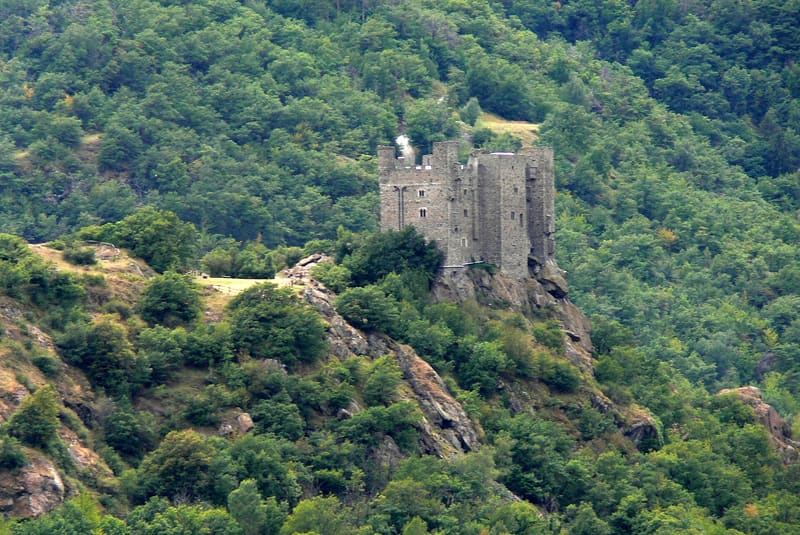
Passed to the Region in 1983; linked to Marcel Bich, the Bic pen baron
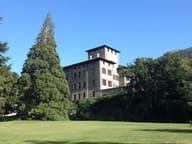
Walking up from the car park you reach a compact, squared-off building with no inner courtyard: it is the first single-block castle in the valley, a single building with no ring of walls. Two cylindrical towers mark the south side, three quadrangular ones the north side around the keep, the main tower. Inside you can see decorated two-light windows and monumental fireplaces with large stone corbels, but only the ground floor and a small room on the first floor are open.

Visiting
Open in summer, by guided tour only. In 2026 it was open from 11 July to 27 September: 11 July–2 August and 5–27 September on Saturdays and Sundays only, 8–30 August every day. It is now closed; there are no dates on record for 2027 yet. Guided tour of 45 minutes (max 25 people), departures at 10:15, 11:15, 12:15, 15:00, 16:00, 17:00 and 18:00. Full price €8, aged 19–25 €4, free for under-18s; free admission on 19, 20, 26 and 27 September. From the car park, about 15 minutes' walk uphill on a mule track; not suitable for wheelchairs and pushchairs.
History
Ebalo II di Challant had the castle built from scratch, and it is dated to 1343: an agreement of 1337 had assigned Ebalo the fiefs of Saint-Marcel and Ussel, but a six-year restriction postponed its construction. The castle is considered the first example in the Aosta Valley of a ‘single-block’ castle, that is, one made up of a single compact structure shaped like a parallelepiped, without the traditional courtyard layout.
The main façade, facing south, has two-light windows and is crowned at the sides by two cylindrical turrets; on the north side three quadrangular towers are incorporated, the central one more imposing than the others. Inside, monumental fireplaces and small blind arches carved in stone survive.
In the following decades, in step with the political events of the valley, the castle passed several times from the Challant family to the House of Savoy and back. The last lord of Ussel from the family, Francesco di Challant, died in 1470; from then on the building lost its residential function, was used as a prison and barracks and then remained abandoned for a long time.
In 1846 the Challant line died out and its property passed to the Passerin d'Entrèves family. In 1983 the Aosta Valley Autonomous Region acquired the castle: the sources do not agree on the exact role of Baron Marcel Bich, an industrialist from Châtillon and founder of Bic, who according to one version bought the castle from the Passerin d'Entrèves family to donate it to the Region and according to another only financed its restoration. The restoration work, carried out between 1988 and 1999, made it possible to use the castle as an exhibition space, with a footpath along the wall walks overlooking the Châtillon plain: today it can be visited only in summer, during temporary exhibitions.
Nearby
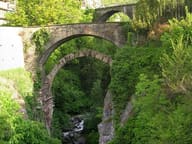 Châtillon Roman BridgeThe Roman abutments, with a 15-metre arch, still carry the bridge over the Marmore
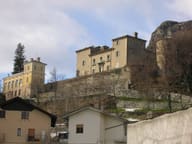 Passerin d'Entrèves CastlePrivate castle; entry to the park with monumental trees is free
- Casinò de la ValléeOpened on 29 March 1947 in the Grand Hôtel Billia; today 3,500 m² and over 400 slots
- Ru de la PlaineIrrigation channel of 1325 bringing Valtournenche water to Châtillon and Saint-Vincent
 Saint-Vincent SpaWater from the Fons Salutis spring, discovered in 1770; outdoor pools at 36 °C
 Gamba CastleIn the park, among 150 trees, grows a California giant sequoia