 The Aosta Trip
Antagnod
In the parish church of San Martino, a three-tiered Baroque altar consecrated in 1716
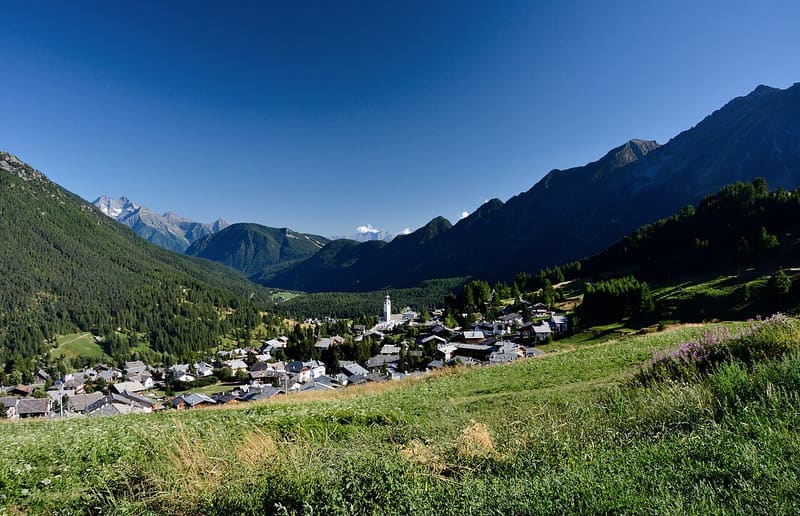
Antagnod lies at 1,710 metres, with the Monte Rosa massif in view. In the village the Maison Fournier stands out, with a long wooden balcony and a cylindrical turret with three stacked windows with inverted keel arches. The parish church of San Martino has three aisles on monolithic green stone columns, the Baroque altar in carved and gilded wood and a 49-metre bell tower topped by a dome with the statue of the Immaculate Conception.

Visiting
You get round the village on foot and it is always accessible. The sacred art museum, in the cemetery chapel next to the parish church, has free admission: in summer 2026 it is open from 4 July to 30 August, on Saturdays from 16:00 to 18:30 and on Sundays from 14:30 to 16:00; for a visit, contact the Ayas parish (0125 307120).
History
Ayas is not a village but a valley of villages, and Antagnod is its main village. The Latin name is Agatius. Inhabited by the Salassi until the Roman conquest, around 25 BC, the Val d'Ayas became a route of passage towards Valais, so much so that it was called Krämertal, the merchants' valley. Around 515 the territory was ceded to the abbey of Saint-Maurice d'Agaune; in the upper part of the valley, at Saint-Jacques, Walser settlers later established themselves. In the fourteenth century much of the valley passed to the Challant family and took the name Vallée de Challant-Ayas.
At Antagnod the Challant family kept their castellan, who governed the upper valley from a small fortified house: this is why the Maison Fournier is also called Maison Challant. You can recognise it by the wooden balcony and the cylindrical turret with three stacked windows with inverted keel arches. Today it houses the Institut Valdôtain de l'Artisanat de Tradition, with its shop, l'Artisanà: wooden objects, soapstone, wrought iron, textiles and ceramics.
The church of San Martino already existed in the Middle Ages: the pastoral visit of 1416 found two minor altars there, one dedicated to the Virgin. The building was remodelled in the late Gothic period, and a stone in the south wall bears the carved date 1497. Around 1500 a Swiss painter from the circle of the Masters of the Carnation painted the wings of the great shrine altarpiece, with the Annunciation and pairs of saints on a gold ground: the names Schan Berret and Martin Barret on the frame are perhaps those of the patrons. In 1713 two carvers from Valsesia replaced that altar with the present Baroque structure in painted and gilded wood, consecrated on 29 May 1716, which keeps the statues of the old altar in its central band: the Madonna and Child, St Anne, St James, St Martin as bishop, St Gratus and a St Martin on horseback.
In 1851 the parish priest Dandrès had the upper part of the medieval church pulled down and the pillars replaced with monolithic green stone columns; the new church, with three aisles, was consecrated on 24 October 1852, and of the old one the lower part of the perimeter walls and the choir remain. In 1856–57 Dandrès himself had the spire of the fifteenth-century bell tower demolished, the tower raised by ten metres and covered with a Byzantine-style dome and a marble statue of the Immaculate Conception: today it is 49 metres high and has a peal of ten bells. Inside, a baptismal font of 1838, and a pulpit and a singing gallery in carved walnut.
Next to the church, the cemetery chapel, from the late fifteenth century and once the seat of the confraternities, is now the sacred art museum. The rarest piece is a shrine Madonna datable to 1340–1350, probably brought from the upper Rhine through Switzerland: opening the Virgin's chest reveals the Trinity and two adoring angels. Only a few dozen remain in the world, because in 1745 Pope Benedict XIV banned the type; this is the only one found in the Aosta Valley. Turned into a Madonna of Oropa, clothed and with the faces repainted black (as documents from the nineteenth century onwards describe it), it stood in the niche of the altar of the Assumption, until in 2005 two scholars recognised what it was; the restoration dates from 2006.
Nearby
- AntagnodThe Vascotcha run is homologated for international downhill and super-G races
- Ayas Cross-Country TrailsThe Ayas trails pass through eight hamlets, with views of the Monte Rosa glacier
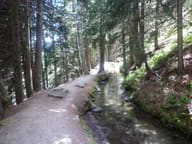 Ru Courtaud25 km channel dug between 1393 and 1433 to bring water from the Ventina to Saint-Vincent
- MascognazWalser village recorded since 1323, with rascards and the chapel of San Grato; waterfall below
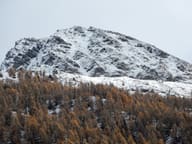 Mont TantanéBelow the summit, the walls of an Iron Age village of the Salassi at 2,440 m
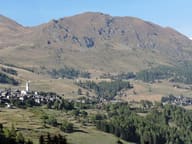 Monte FacciabellaFrom the summit ridge you can see Castore, Polluce, the Lyskamm and the Breithorn