Sarre, Saint-Pierre, Sarriod de la Tour, Aymavilles and the bridge-aqueduct of Pont d'Ael
5stops
21 minby car
10:00–17:00suggested times
theaostatrip.comPhoto: Lysippos, CC BY-SA 3.0
The route
From Sarre to Pont d'Ael
The castles are closed on Mondays, except in July, August and on public holidays; Sarre and Sarriod de la Tour can only be visited with a guide. The passage inside Pont d'Ael is open from April to September and, in October, on Saturdays and Sundays: the rest of the year the bridge is seen from outside.
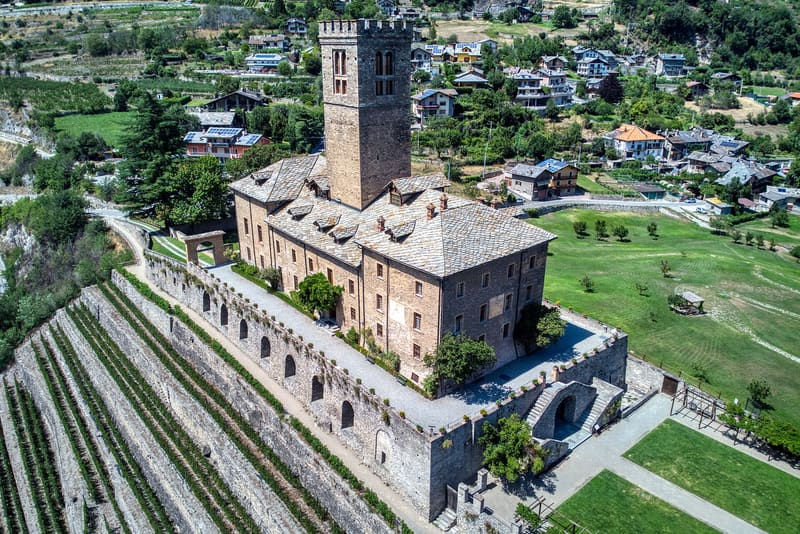
The castle has an elongated plan with a square central tower, raised when Victor Emmanuel II turned it into a hunting residence. The walls of the ground floor and the staircase are covered with hundreds of ibex and chamois trophies, collected at the wish of Umberto I. On the first floor you can see furniture recorded in an inventory of 1890.
The present castle was rebuilt in 1708 by Jean-François Ferrod, who kept only the medieval tower. A fortified building already existed in 1242. In 1869 Victor Emmanuel II bought it as a base for his hunting trips in the valley, followed by his son Umberto I. The Aosta Valley Region acquired it in 1989 for restoration.
If you go. Guided tours only, French/English audio guide available. Opening hours: Oct–Mar 10:00–13:00 and 14:00–17:00, Apr–Sep 9:00–19:00. Closed on Mondays, except in July, August and on public holidays; also closed on 25 December and 1 January. Full price €8, concession €6 only for groups of 25 paying people or with a tourist guide, aged 19–25 €3, free for under-18s. Last tour 30 minutes before closing.
2
11:35 · 75 min
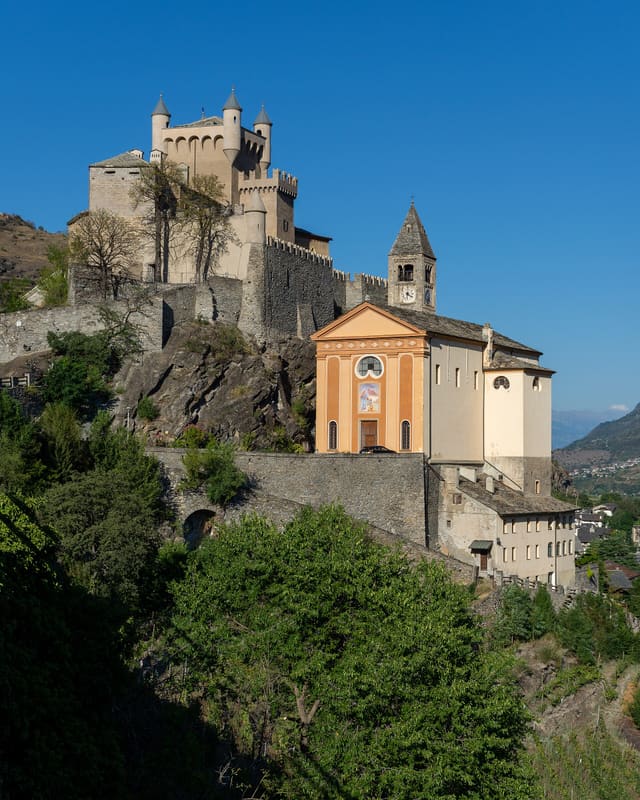
The core dates from the twelfth century, the four corner turrets from the nineteenth
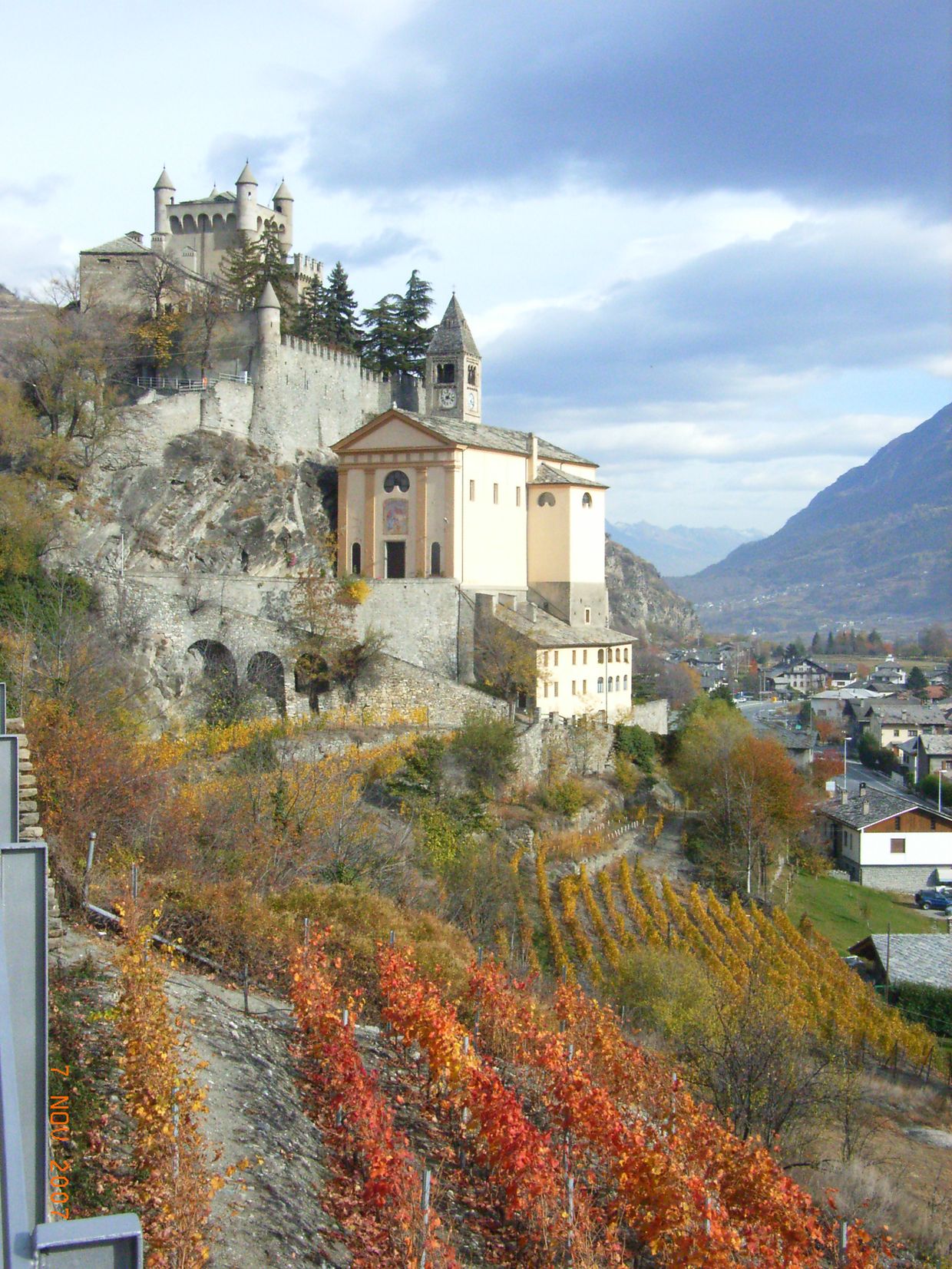
On a rocky spur, the castle shows its outline from afar, with the four corner turrets added in the nineteenth century. Inside, in the new 2022 display, the Efisio Noussan Regional Museum of Natural Sciences occupies 16 rooms on the flora, fauna and geology of the valley, with interactive exhibits and touch screens; there are no period-furnished rooms.
The oldest core dates from the twelfth century: two brothers ‘de castro Sancti Petri’ appear as co-owners of the castle in the Charter of Franchises of 1191. After passing through several noble families, it was enlarged in the seventeenth century by Pietro Filiberto Roncas. Having become the property of Saint-Pierre municipality, from 1985 it housed a first natural science museum, closed for restoration and reopened at the end of 2022.
If you go. Closed on Mondays (except public holidays), 25 December and 1 January. Opening hours: April–June and September 10:00–19:00; July and August 10:00–13:00 and 17:30–23:00, with free admission on Tuesdays from 20:30; October–March 10:00–18:00. Last admission is one hour before closing. Self-guided visit €10 (concession €8, aged 19–25 €3, free for under-18s), guided tour €15; duration about one hour. The lift may not be working: people with reduced mobility can only access rooms 1, 3 and 4. Special opening on Monday 7 December 2026.
3
14:05 · 45 min
In the Hall of Heads, 171 carved wooden corbels, all different
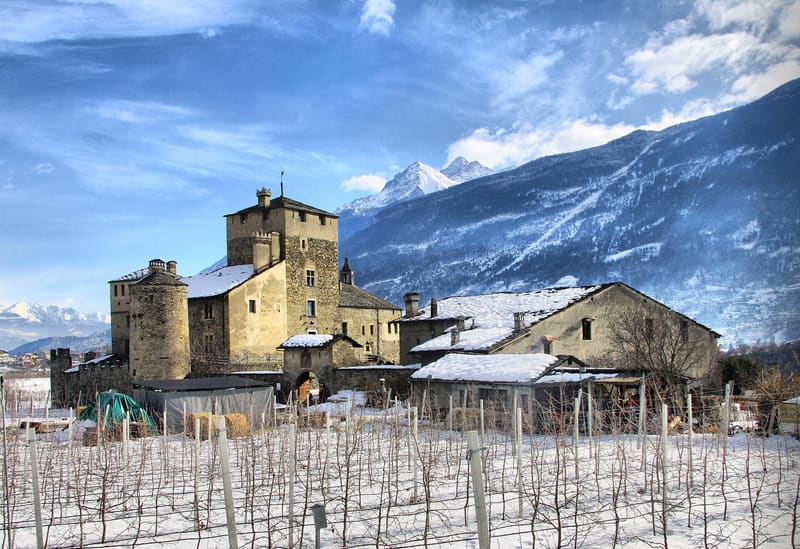
The castle stands low among the apple orchards, without slender towers. Inside, the route passes through rooms with some furniture and paintings to the Hall of Heads: on the ceiling, supported by 171 wooden corbels carved after 1431, ladies in headdresses, knights, sirens, dragons and monsters file past, no two alike. The chapel preserves thirteenth-century frescoes.
The Sarriod family is recorded in Saint-Pierre from the twelfth century. The oldest core, a square tower with a chapel, dates from the first half of the thirteenth century; in the first half of the fifteenth century Jean Sarriod added the residential buildings to the tower, with a spiral staircase and stone cross windows. The Sarriod de la Tour family held the castle until 1923; since 1970 it has belonged to the Aosta Valley Autonomous Region.
If you go. Guided tours only, groups of up to 25 people. Opening hours: October–March 10:00–13:00 and 14:00–17:00, April–September 9:00–19:00. Closed on Mondays, except in July, August and on public holidays, and on 25 December and 1 January. Full price €6, concession €4, aged 19–25 €3.
4
15:00 · 60 min
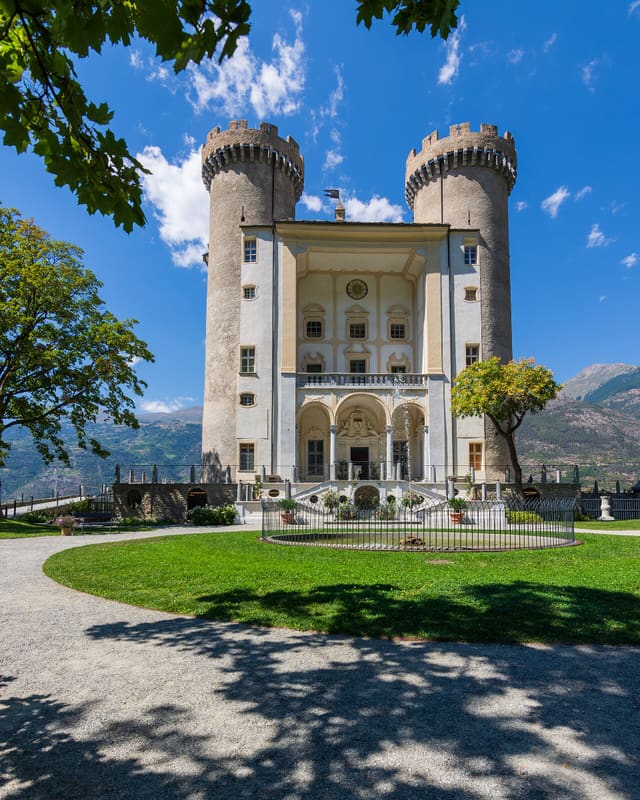
Four corner towers added in the fifteenth century, then Baroque between 1713 and 1728
The exterior shows four fifteenth-century corner towers and the Baroque loggias added by Joseph-Félix de Challant in the early eighteenth century, which softened the look of the medieval fortress. Inside, a museum route on four levels displays the collection of the Académie Saint-Anselme.
First mentioned in 1207 (or in 1287), it is enlarged by the Challant family between the fourteenth and fifteenth centuries with the four corner towers and the double ring of walls. Between 1713 and 1728 Joseph-Félix de Challant turns it into a Baroque residence, with loggias and stucco work. The Region buys it in 1970.
If you go. Unguided visit with optional audio guide (€2) or guided tour at 11:30 and 15:30, and at 17:30 from April to September. Opening hours: April–September 9:00–19:00, October–March 10:00–18:00. Closed on Mondays, except in July, August and on public holidays, and on 25 December. Full price €10, concession €7; guided tour €15, concession €10. Wheelchair accessible, but in September 2026 the lift was not guaranteed to be working.
5
16:10 · 50 min
In 3 BC Caius Avillius Caimus, from Padua, had the inscription carved on the bridge
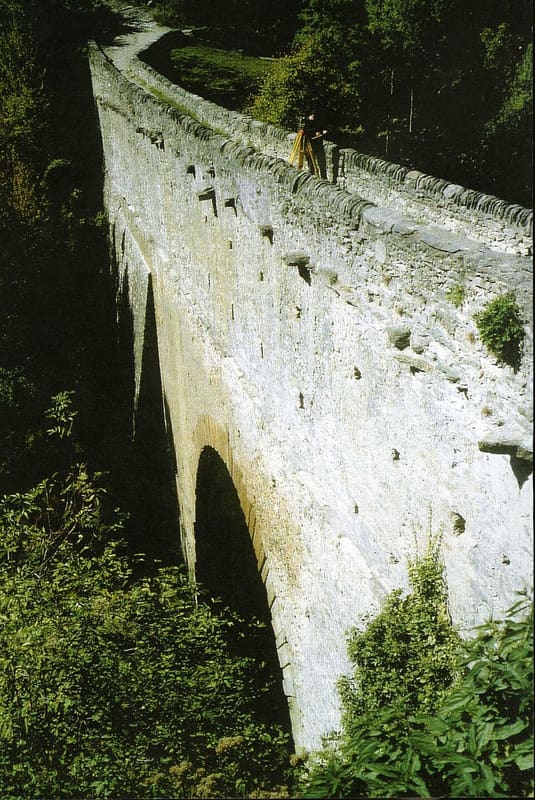
A single large arch of stone blocks spans the gorge of the Grand-Eyvia stream, 56 metres below. At the top ran the open channel that carried the water; beneath it, a covered passage about a metre wide, which you can now walk along on a glass-floored walkway suspended over the drop. Unlike the valley's town aqueducts, this one served a private purpose: carrying water to the bardiglio marble quarries.
The bridge was built in 3 BC at the behest of Caius Avillius Caimus, an entrepreneur from Patavium (present-day Padua) involved in the quarrying and working of marble, as recorded by the inscription carved on three slabs of the monument. Water taken upstream from the Grand-Eyvia thus reached the bardiglio marble quarries of Aymavilles. In the following centuries the stretch of service road cut into the rock on the right bank collapsed and the original route became inaccessible. Conservation work, with archaeological excavations and the conversion of an adjacent building into a visitor centre, made it possible to reopen a loop route: the collapsed stretch has been rebuilt as a steel walkway.
If you go. Open April–September 9:00–19:00, closed on Mondays (except public holidays and July–August); in October Saturdays and Sundays 10:00–13:00 and 14:00–17:00; closed November–March. Full price €5, concession €3 (groups of 25+, guided tours, partner agreements), free for under-18s and for people with disabilities. The ticket is only needed for the covered passage: you can see the outside of the bridge for free. Only partial wheelchair access; rucksacks and bulky bags are not allowed in the inner passage.
 1