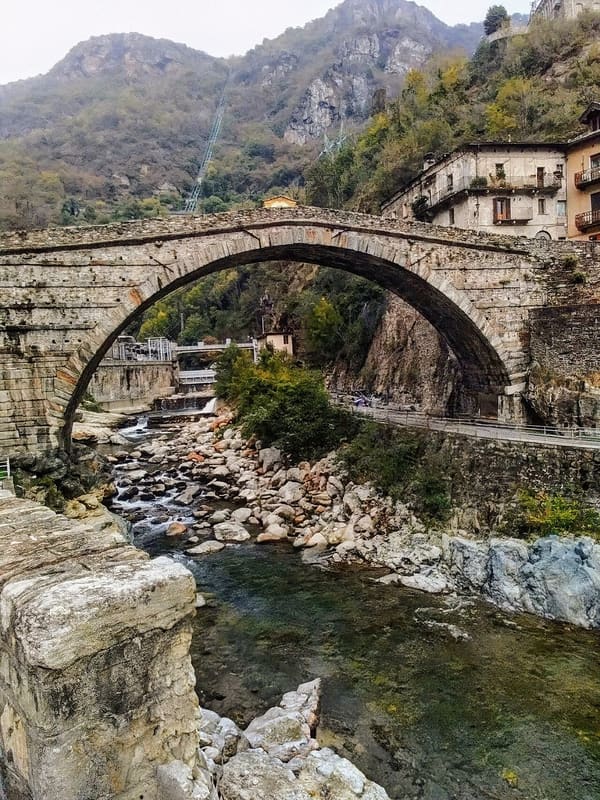
The bridge, now a footbridge, spans the Lys stream with a single large round arch; on the left side the substructures in polygonal blocks that support it remain visible. Next to it, in Piazza IV Novembre, the Saletta Lys houses the small museum dedicated to the bridge: photographs, drawings and documents explain its construction techniques, and a room shows an introductory film about the town.
Built in the first century BC along the road to Gaul, the Roman consular road that climbed from Eporedia (present-day Ivrea) towards the Aosta Valley, the bridge remained in use as the main crossing of the Lys until the nineteenth century, when a new road bridge was built alongside it and it was restored. It survived the Allied air raid of 23 August 1944, which hit the town of Pont-Saint-Martin hard. The museum that tells its story, set up in the Saletta Lys by the regional Superintendency and the municipality, is open every day with free admission.
If you go. Bridge always accessible on foot, no ticket. Roman Bridge Museum at Piazza IV Novembre 16: open every day 9:00–18:00, free admission.
2
10:35 · 50 min
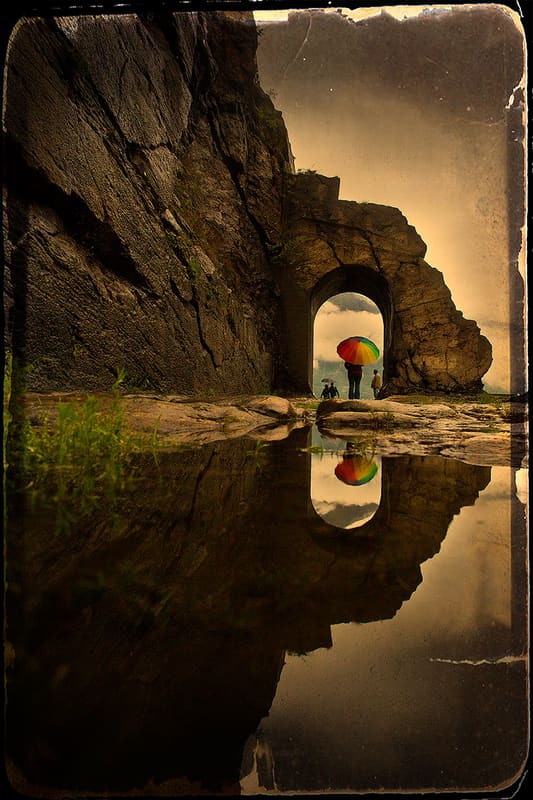
The stretch cut into the rock is 221 metres long, with walls up to 13 metres high
The road runs sunk into a vertically cut rock face, with an arched passage about 4 metres thick and high and 3 wide. On the road surface you can still see the ruts cut by cart wheels over two thousand years of traffic, and just beyond the arch the outline of a milestone protrudes, the stone that marked distances along Roman roads, inscribed ‘XXXVI’, the distance in miles from Aosta. It is one of the best-preserved stretches of Roman road in the whole Aosta Valley.
The road to Gaul linked Eporedia (Ivrea) to Augusta Praetoria (Aosta) and continued towards Transalpine Gaul. At Donnas the Romans cut the road directly into the rock of a spur overlooking the Dora Baltea. The sources disagree on the completion date: the historian Carlo Promis places it in 120 BC, while the archaeologist Pietro Barocelli and later studies consider a gradual construction more likely, completed only in the Claudian period (AD 41–54), when the road was paved and made passable for carts. In the Middle Ages the arch was reused as the fortified gate of the village of Donnas, closed at night.
If you go. Free, open access at any time, along the old route at the edge of the SS 26, on the border between Donnas and Bard.
3
11:30 · 90 min
The bullet holes from the Napoleonic siege of 1800 remain on Palazzo Nicole
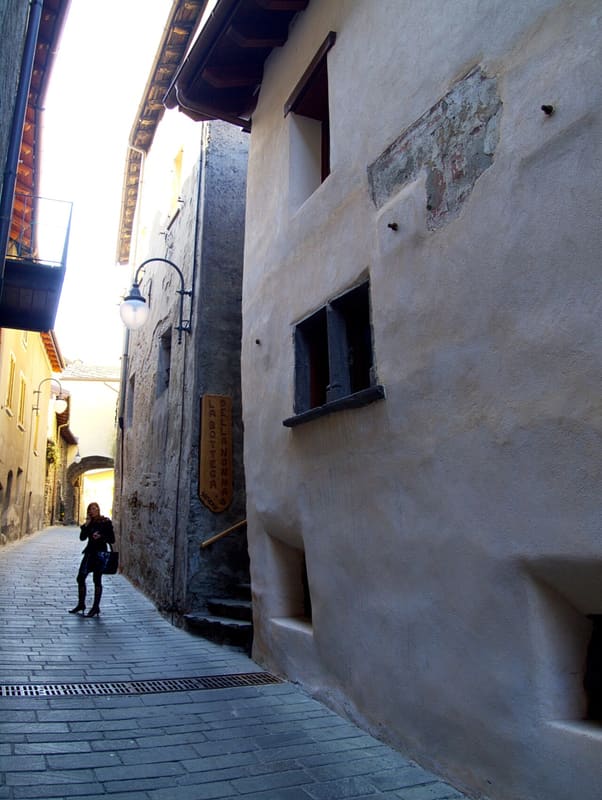
The village is a single uphill street, hemmed in between the Dora and the rock of the Fort, along the route of the Roman road to Gaul. On either side stand fifteenth- and sixteenth-century houses with cross-mullioned windows, two-light windows and remains of frescoed coats of arms; the entrance from the west passes under the arch of Palazzo Nicole. In the little square there is the fountain of 1598, with a stone column 170 cm high that ends in a carved head, the ‘Mascherone’.
Bard began as a transit village on the Roman road, at the narrowest point of the valley, and for centuries it lived on stopovers and tolls. More than twenty buildings from the thirteenth to the eighteenth century are classified as monumental houses, including Casa Challant, Casa Valperga and the eighteenth-century Palazzo Nicole, residence of the last counts of Bard. In 1862 traffic moved to the new carriage road and the village, left isolated, kept its medieval appearance almost intact.
If you go. The village is a pedestrian street at the foot of the Fort, always open. By car: from the SS 26 or the A5 motorway, exits Pont-Saint-Martin (6 km) and Verrès (9 km). Pay multi-storey car park at the foot of the Fort (daytime rate €5); free car parks: Liéron, about 300 m away, and San Giovanni, about 500 m along the SS 26, plus those in the centre of Hône. By train: Hône-Bard station, 600 m away, crossing the stone bridge over the Dora on foot; until 31 December 2026 replacement buses run on the Ivrea–Aosta line. VITA Group and Arriva scheduled buses, with stops on the SS 26.
4
14:20 · 180 min
It held up the Napoleonic army for about two weeks in May 1800
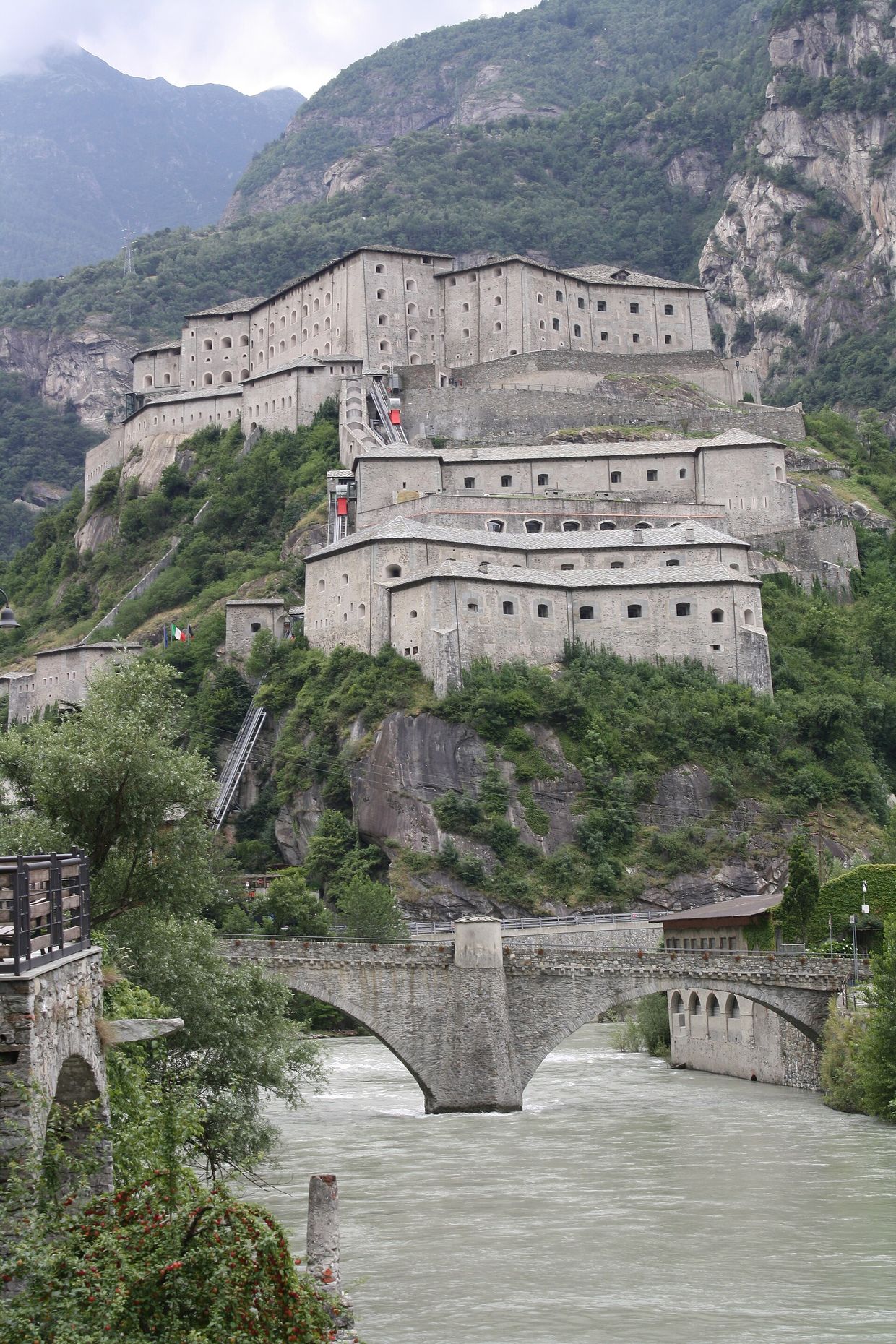
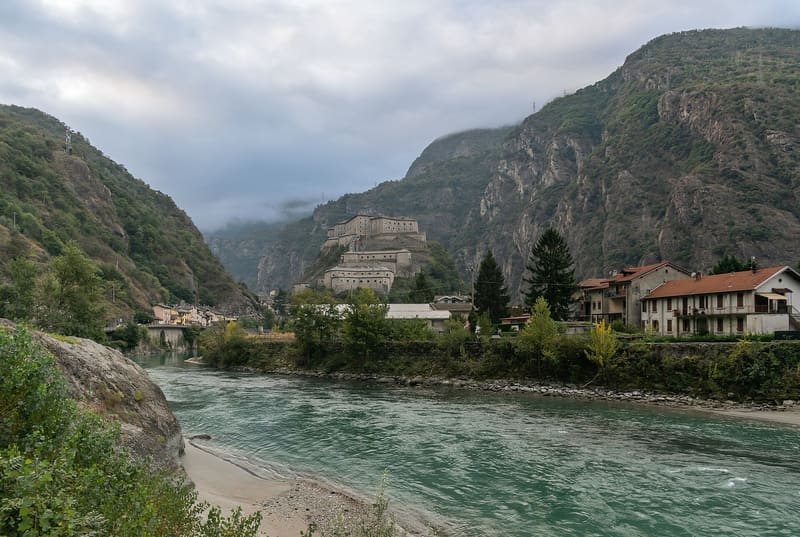
The fort occupies an entire rocky spur that closes off the valley, with three works in sequence: Ferdinando at the bottom, Vittorio in the middle, Carlo Alberto at the top. At the top, the arcaded Piazza d'Armi houses temporary exhibitions and the Museum of the Alps. Panoramic lifts rise from the medieval village to the upper works.
The site has been garrisoned since the sixth century; in 1034 it was described as an impregnable fortress. In 1800 Napoleon's army took about two weeks to get past the Austrian defences. Destroyed on Napoleon's orders, it was rebuilt from 1830 onwards by Charles Felix of Savoy as one of the most imposing military structures in the valley. Decommissioned in 1975, it reopened, restored, in 2006.
If you go. Opening hours: Tuesday–Friday 10:00–18:00, Saturdays, Sundays and public holidays 10:00–19:00. It is closed on Mondays, except from 27 July to 6 September, when the fort is open every day (in August from 10:00 to 19:00), and on some special opening days: it is best to check before setting off. Full price €15, concession €12 (over-65s, aged 19–25, students), free for under-18s; combined ticket for all the museums and exhibitions €24.
Photo credits
Cover Photo: Luigi Ippolito, CC BY-SA 3.0
1 Photo: Jeanne Griffin, CC BY-SA 4.0
2 Photo: Romain Bosonin, CC BY 3.0 / GFDL
3 Photo: pollobarca (Paul Barker Hemings), CC BY-SA 2.0
 1