 The Aosta Trip
Roman Bridge and Roman Bridge Museum
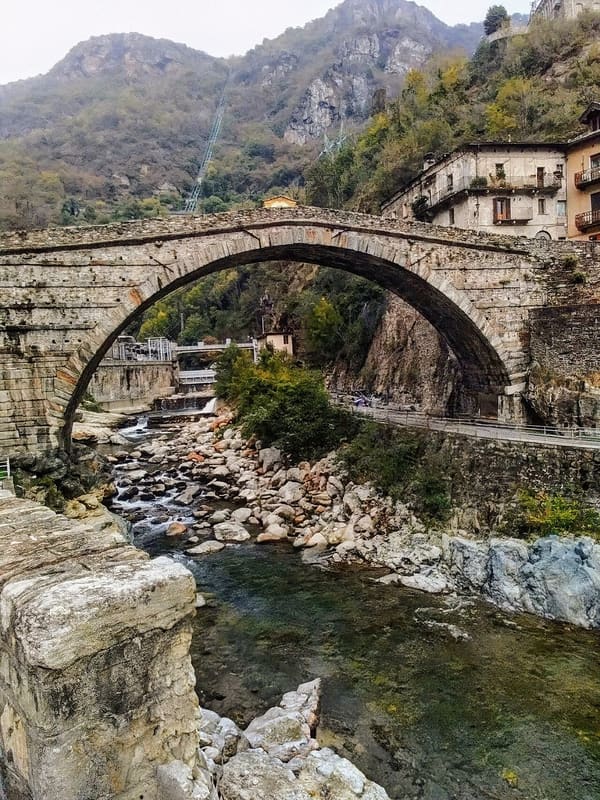
Single span of 31.55 metres, the widest among Roman bridges of its time in Europe
The bridge, now a footbridge, spans the Lys stream with a single large round arch; on the left side the substructures in polygonal blocks that support it remain visible. Next to it, in Piazza IV Novembre, the Saletta Lys houses the small museum dedicated to the bridge: photographs, drawings and documents explain its construction techniques, and a room shows an introductory film about the town.
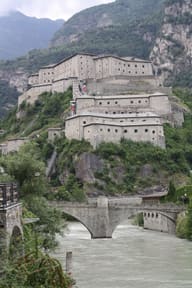 One-day guide · freeBard and the Road to GaulA day at the entrance to the valley passes here: the Roman road to Gaul, the village of Bard and its fort.Open the guide →
Visiting
Bridge always accessible on foot, no ticket. Roman Bridge Museum at Piazza IV Novembre 16: open every day 9:00–18:00, free admission.
Collections
The construction of the bridge — Photographs, drawings and documents explain how the Romans built, in the first century BC, the arch of 31.55 metres: the 87 stone voussoirs arranged in five independent parallel rings and filled with opus caementicium, a mix of stone chips and mortar used by the Romans instead of modern cement, and the paving of grooved polygonal slabs to stop pack animals from slipping.
The legend of the Devil's Bridge — A section tells the folk legend, handed down in the town's historical Carnival, according to which the bridge was built in a single night by the devil in exchange for the soul of the first living being to cross it: St Martin of Tours is said to have sent a dog across first, leaving the devil outwitted and without the promised payment.
The nineteenth-century restoration — Period documents and images show the work that, in the nineteenth century, consolidated the Roman bridge after the construction of a new road bridge alongside it, intended for vehicle traffic.
The 1944 bombing — Photographs and accounts recall the Allied air raid of 23 August 1944, which hit the town of Pont-Saint-Martin hard without, however, destroying the Roman bridge.
The introductory film — In the same small room a short film is shown presenting the town of Pont-Saint-Martin and its places of interest, useful for continuing the visit beyond the museum.
History
The bridge was built in the first century BC along the road to Gaul, the Roman consular road that linked Eporedia (present-day Ivrea) to the Aosta Valley through the Lys Valley. It has a single arch with a span of 31.55 metres, built with 87 voussoirs arranged in five independent parallel rings, set 32 centimetres apart and filled with opus caementicium (a mix of stone chips and mortar). The carriageway, 5 metres wide excluding the parapets, was paved with polygonal slabs cut with horizontal grooves so that the animals' hooves would not slip.
For almost two thousand years the bridge remained the only crossing of the Lys stream on this road, used by people, goods and troops until the nineteenth century. According to a folk tradition handed down in the town's historical Carnival, the bridge is said to have been built in one night by the devil in exchange for the soul of the first living being to cross it: St Martin of Tours, passing through on pilgrimage, reportedly sent a dog across first, leaving the devil outwitted.
In the nineteenth century the Roman bridge was flanked by a new road bridge and underwent a restoration, documented by photographs and drawings now kept in the museum dedicated to it; since then the old Roman bridge has continued to be used as a footbridge. On 23 August 1944 an Allied air raid hit the town of Pont-Saint-Martin hard, but the Roman bridge survived the attack.
Today the bridge, for pedestrians only, stands beside the Saletta Lys in Piazza IV Novembre, which since about 2003 has housed the Roman Bridge Museum, set up by the Region's Superintendency for Cultural Heritage and Activities together with Pont-Saint-Martin municipality, with photographs, drawings and documents on its history.
Nearby
- 'L CastelThe museum on the first floor recalls the bombing of the town on 23 August 1944
 Sanctuary of the Madonna della GuardiaOn the evening of 7 September, a torchlight procession from Pont-Saint-Martin to the sanctuary for the feast
 Pramotton TowerHexagonal medieval tower with its entrance door four metres off the ground
 Roman Road to Gaul and Donnas ArchThe stretch cut into the rock is 221 metres long, with walls up to 13 metres high
 Col FenêtreIn the meadows below the pass the rare wild peony flowers in early June
 Roman Road to Gaul at BardThe substructures above the fort's car park are 16 metres high and 58 long