 The Aosta Trip
Permanent Exhibition of Bobbin Lace ‘I merletti di Cogne’
The lace is woven on wooden bobbins, up to eighty at a time, on a pillow
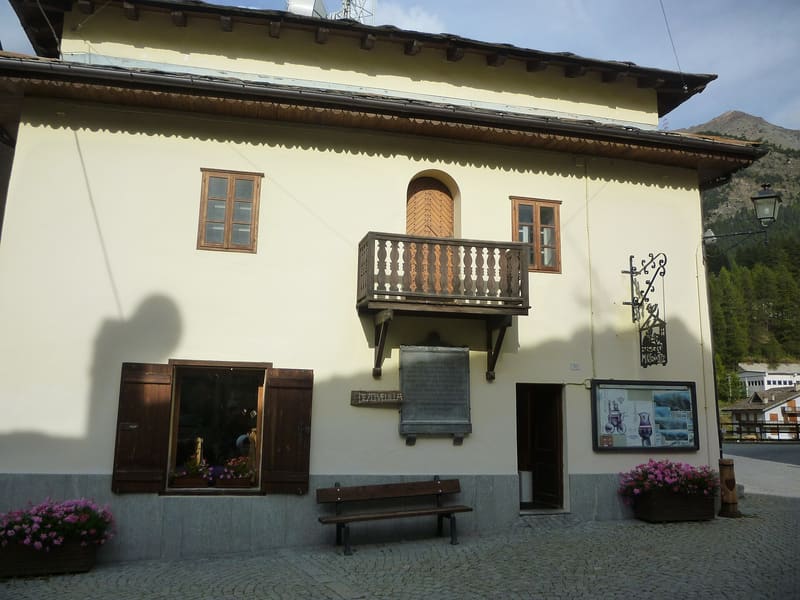
The exhibition occupies the Maison di Pitz, in Via Grappein, home of the Les Dentellières de Cogne cooperative. The display cases show doilies, tablecloths and curtains of bobbin lace together with costumes, necklaces and period photographs of the local tradition. In the room the lacemakers work live at the pillow, weaving linen thread on the bobbins; the pieces on display can also be bought.

Visiting
Open from April to October: April–21 June and 24 September–4 October Tuesday–Saturday 10:00–12:30 and 15:00–18:30 (closed on Sunday afternoons, except 31 May); 24–28 June 10:00–12:30 and 15:00–19:00; 1 July–6 September every day 10:00–12:30 and 15:00–19:30; 9–20 September 10:00–12:30 and 15:00–19:00 (closed on Sunday afternoons). Free admission. For the rest of the year it is best to ask locally.
Collections
Single room — The workshop and the exhibition. The visit takes place in a single space at the Maison di Pitz, where the cooperative's lacemakers work live at the tombolo, the cylindrical pillow on which the threads are fixed with pins, weaving linen thread on wooden bobbins that can number up to eighty for a single piece. The display cases show, and offer for sale, doilies, tablecloths and curtains of lace, with stylised motifs of animals and flowers inspired by Alpine nature.
Historical section. Alongside today's pieces, the exhibition keeps period photographs of the first lacemakers of Cogne, traditional costumes and necklaces, which document more than a century and a half of a craft handed down only through direct teaching, never with the paper patterns used elsewhere in Europe.
History
The tradition of bobbin lace, the lace that is woven with wooden bobbins on a pillow, arrived in Cogne around the mid-seventeenth century: in 1665 a group of Benedictine nuns fleeing the Burgundian monastery of Cluny took refuge in the Aosta Valley, as guests of some municipalities, and taught the local women the art of bobbin lace.
In Cogne the technique passed from hand to hand until 1853, when Honorée Guichardaz, a woman from the village, learned it from the women who kept the technique and in turn began passing it on to her fellow villagers. Since then Cogne lace has been handed down from mother to daughter exclusively by direct teaching, without the paper patterns used in French and Belgian production: a feature that makes the local tradition a case apart in the history of European lace.
During the twentieth century the lacemakers of Cogne joined together in a cooperative, Les Dentellières de Cogne, which has received several awards at editions of the Mostra-concorso dell'artigianato valdostano di tradizione. The cooperative is based at the Maison di Pitz, in Via Grappein, where the craftswomen still work live today, weaving linen thread on wooden bobbins that can number up to eighty per piece.
The same premises house the permanent exhibition ‘I merletti di Cogne’, a small museum where, alongside the items for sale, costumes, necklaces and period photographs of the local tradition are on display. In Cogne this craft has been practised without interruption for over a century and a half.
Nearby
 CogneThe main village looks onto the Sant'Orso meadow, at 1,544 m in the Gran Paradiso
 Cogne Cross-Country TrailsIn 2025 the Prati di Sant'Orso hosted three cross-country World Cup races
 Maison de Cogne Gérard Dayné Ethnographic MuseumThe beu, the cowshed where people and animals lived together to keep warm
 Gran Paradiso – Cogne Visitor CentreTaxidermy wolf and ibex and VR headsets in the Villaggio Minatori in Cogne
 CogneFrom the village a gondola climbs the wooded slopes of the Montseuc, among north-facing runs
 Exhibition Centre of the Aosta Valley Mining Park and the Cogne MineMagnetite and the life of the Colonna miners, in the rooms of the Miners' Village