 The Aosta Trip
Walser Ecomuseum
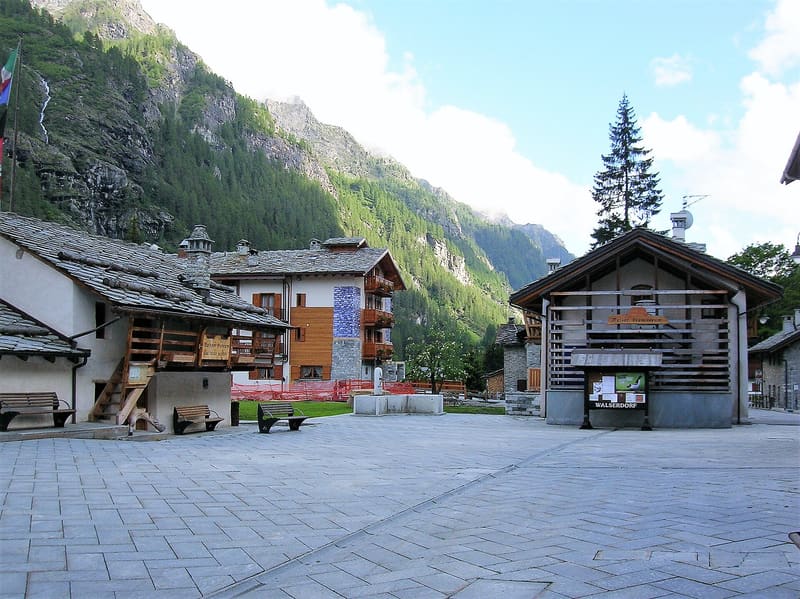
Puròhus farmhouse from 1772, with stable and living quarters under the same roof
The tour begins on the second floor of the building in Piazza Tâche, above the tourist office, and includes three municipal buildings. The Puròhus farmhouse, from 1772, shows the Wohngade, that is, stable and living quarters brought together under the same roof, the vaulted cellar and the hayloft with the work tools. The Pòtzschhus house museum displays the traditional gold-embroidered costumes on the first floor and, on the second, the section on Monte Rosa, the glaciers and mountaineering. The Binò Alpeltè hut, a rascard you can reach on foot, can only be visited in summer and shows how milk was processed on the alpine pasture.
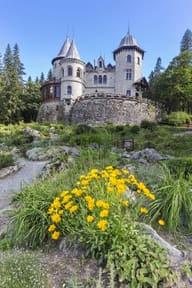 One-day guide · freeGressoney, the Valley of the WalserA day in the valley of the Walser passes here, between Queen Margherita's castle and the wooden houses of Gressoney.Open the guide →
Visiting
2026 seasonal opening hours, summer only: in June, some Saturdays and weekdays; in July and August, Wednesday–Saturday at 15:00, 16:00 and 17:00, Sunday 10:00–11:00 and 15:00–17:00; in September, Friday–Sunday with reduced hours. Full price €3, concession €2 (groups of more than 15 people, over-65s, students), free for under-18s and for disabled people with a companion. Group visits must be booked at least 15 days in advance.
Collections
The Puròhus, the farmhouse. In Piazza Tache you visit the Puròhus, a Walser dwelling house from 1772 that retains the traditional rural architecture: the Wohngade, that is, the stable-dwelling in which a wooden partition separated the people's space from the animals', whose warmth heated the house; a vaulted cellar with a beaten-earth floor; a hayloft full of tools that document the traditional trades of the valley.
The Pòtzschhus, ground floor: costumes and local memory. The Pòtzschhus, whose name in dialect denotes the typical Walser hayloft building (stadel), houses permanent exhibitions devoted to the area on several floors. On the ground floor there are clothes from the nineteenth and early twentieth centuries with the related photographic documentation, together with a reconstructed study devoted to Heinrich Welf (1912–2004), a leading figure in the protection of local Walser culture.
First floor: the traditional costume. On the first floor the exhibition ‘I colori nella tradizione’ traces the history of the local costume, with its fabrics and embroidery; the tourist office is in the same space.
Second floor: the Monte Rosa room. The top floor is devoted to the mountain: the history of mountaineering on the massif, the evolution of the glaciers and life in high-altitude huts, with references to the Angelo Mosso Scientific Institute and to the Regina Margherita hut, at 4,554 metres the highest in Europe. The placing, in 2008, of the statue of the Cristo delle Vette at 4,170 metres is also recorded.
The Binò Alpeltè hut. Open only in summer, from June to the end of September, the hut stands in a balma, a natural shelter under a boulder that protects from avalanches. Two adjoining buildings make up the whole: one housed about twenty head of livestock during milking, the other was used for processing milk on site.
History
The Walser are a people of Germanic origin who, from the thirteenth century, migrated from the upper Valais across the Teodulo pass and settled in the upper Lys Valley, then under the jurisdiction of the bishops of Sion. They brought with them the German language (töitschu), building techniques and an agro-pastoral organisation suited to the altitude, which in Gressoney-La-Trinité can still be read today in the rural architecture.
At the heart of the ecomuseum is the Puròhus, a farmhouse from 1772 that retains the traditional layout of the Wohngade, the stable-dwelling in which people and animals shared the same space to make use of their warmth, together with a vaulted cellar and a hayloft with period farm tools. The building was restored with European funds from the Interreg programme and opened as a house museum in July 2006.
In 2007 the four administrations of the Walser Mountain Community signed an agreement to develop a joint ‘open-air ecomuseum’ project. The project gave an institutional framework to work already begun in previous years with the cataloguing of local collections, started towards the end of the 1980s. The following year, in July 2008, the Pòtzschhus opened, an old stadel (hayloft-storehouse) renovated and turned into a house museum, with exhibitions on the history of the Monte Rosa massif, on traditional costumes and on Walser trade; also in 2008 the chapel of the dead (Tòtòtschappélo) was restored.
The tour is completed by the hut of the Binò Alpelté alpine pasture, built against a large natural boulder (balma) for shelter from the wind and the cold, and once able to house about twenty head of livestock, with an area for processing milk: it can only be visited in summer. With its base in Piazza Tache, the ecomuseum thus tells, in three different places, the story of the daily life, work and traditions of the Walser community of the upper Lys Valley.
Nearby
- Gressoney-La-Trinité Cross-Country TrailsIn November 2025 there was already skiing on a loop made with snow stored from the winter
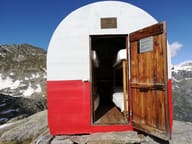 Bivacco Carlo GastaldiRed and white barrel-shaped bivouac hut on the rim of the basin of the three small Nétschò lakes
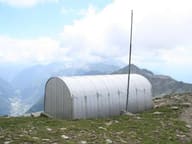 Bivacco Ulrich LateltinDreamt of in 1950 by the carpenter Ulrich Lateltin, built by his nephew in 1984
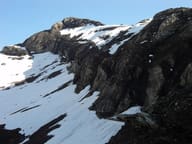 Testa GrigiaAntoine Laurent climbed it alone on 10 January 1864: the first documented Italian winter ascent
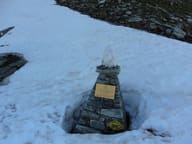 Colle PinterWalser pass between Ayas and Gressoney for grain and livestock; the Alta Via 1 crosses it
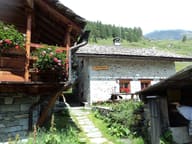 Rifugio Alpenzu GrandeInside Alpenzu Grande, a Walser village recorded as early as 1249
