 The Aosta Trip
Gressoney-Saint-Jean
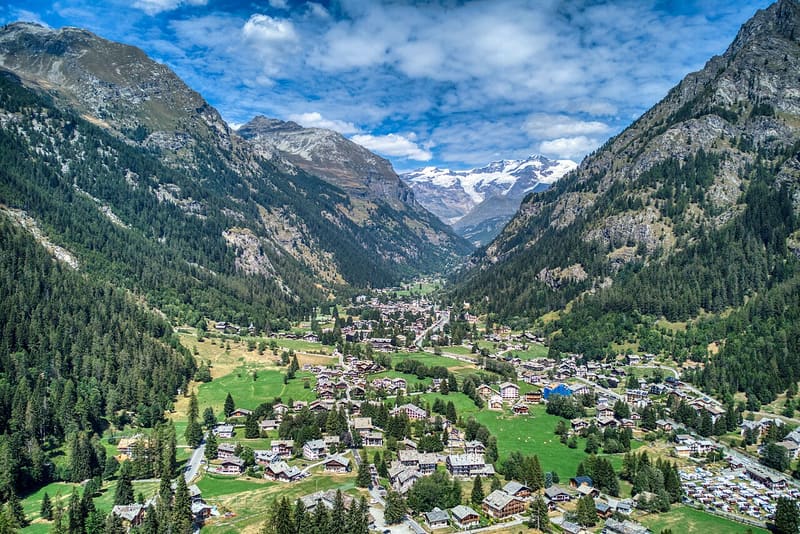
On the beams of the Walser merchants' houses, a heart topped by a 4
The village, at 1,385 metres, lies on a flat stretch of the Lys valley with the Lyskamm glacier and Monte Rosa at the far end. The centre has two squares: the lower one, with seventeenth- and eighteenth-century houses and the village's first inn, in wood, dated 1717; the upper one, dominated by the parish church of San Giovanni Battista, fronted by a portico of 1626 with fourteen Stations of the Cross shrines. On the main beams of the wooden houses you can read the year of construction, the owners' initials and, on the merchants' houses, their symbol.
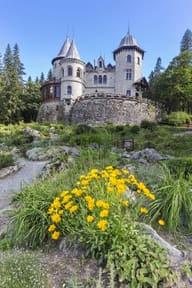 One-day guide · freeGressoney, the Valley of the WalserA day in the valley of the Walser passes here, between Queen Margherita's castle and the wooden houses of Gressoney.Open the guide →
Visiting
You get round the historic centre, with the two squares and the parish church, on foot. By bus: VITA Group's Pont-Saint-Martin-Gressoney line, about 50 minutes.
History
The name Gressoney is said to come from the Walser ‘Chreschen-eje’, meadow of watercress, the plant that grew along the rivulets of the meadows before reaching the main village. The territory is traditionally divided into Onderteil, from the village of Trentostä to the main village, Mettelteil, up to Léschelbalmo, and Oberteil, the upper part that is now Gressoney-La-Trinité: the two municipalities form a single community by origin, language and architecture. The Walser, an Alemannic people settled in the upper Valais, came down to the Italian side of Monte Rosa over the Colle del Teodulo, pushed by the bishop of Sion, who had possessions in the area, and in the Lys Valley they founded Gressoney, Issime and the high villages of Niel.
As elsewhere, the Walser settlers received special conditions from the lords of the land: the families shared out the land, held it on a hereditary lease and managed the territory themselves. When, from the second half of the fifteenth century, the Little Ice Age shrank meadows and fields, the men of Gressoney became ‘Krämer’, merchants: they carried cloth and silk to Switzerland and southern Germany, countries of their own language, and came back to invest their earnings in the village. The Lys Valley thus took the name Krämertal, valley of the merchants. On the main beams of their houses you can still make out the merchants' symbol, a heart topped by a four, between the initials J and M of Jesus and Mary. The coexistence of languages has also left its mark on surnames: Schmid became Faver, Zumstein Delapierre, Litschgi Liscoz.
The parish church of San Giovanni Battista bears a Gothic inscription of 1515 on its façade; the portico in front of the church, from 1626, has fourteen Stations of the Cross shrines, frescoed in the eighteenth century by the Gressoney painter Johann Joseph Franz Curta, and the present building is the result of an eighteenth-century rebuilding. Inside there are four seventeenth-century wooden altars, the organ donated by Queen Margherita and a small museum with a medieval crucifix that is among the oldest in the region. In the seventeenth century lessons at school were in Italian while Mass was in German; the first school in the village was founded in 1691, and in the village of Trinò a rectorate of 1748 opened another of the oldest schools in the Aosta Valley. In the early nineteenth century a bequest founded the Rial Merchant School at Obre Chaschtal, to train young traders.
The people of Gressoney were among the first to climb Monte Rosa, on several occasions between 1778 and 1820, and in 1875 they built the first hut for mountaineers there. Tourism arrived with Queen Margherita of Savoy, who between 1889 and 1925 made the village her usual summer residence: until 1903 she was a guest at the Art Nouveau villa of the Beck-Peccoz barons, now Villa Margherita and home of the town hall, then she moved to Castel Savoia, built for her at the Belvedere. The queen adopted the women's costume of Gressoney, with its gold filigree cap, and the Capanna Margherita, inaugurated in 1893 on the Punta Gnifetti, also links her name to the village. Giosue Carducci was often a guest in the valley.
In the twentieth century the arrival of Italian-speaking families pushed Titsch back (since 1934 Mass has been celebrated in Italian), but it holds on. In 1982 a group of residents of Gressoney and Issime founded the Walser Kulturzentrum, based in the main village; in 1992 the Walser Specialist Library was set up, and in 1998 a regional law for the protection of the Walser language and culture was passed. In 2017 the village received the Orange Flag of the Touring Club Italiano.
Nearby
 Gressoney-Saint-Jean Cross-Country TrailsAround Lago Gover, in the village, a 5.2 km loop is lit for skiing in the evening
 Beck-Peccoz Regional Museum of Alpine FaunaCollection of about 90 antique weapons and hunting trophies with horn anomalies
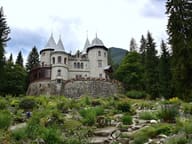 Castel SavoiaFirst stone laid on 24 August 1899 in the presence of Umberto I
- Gressoney-Saint-Jean, WeissmattenThe Leonardo David run is floodlit: on some evenings you can ski at night
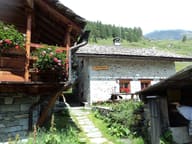 Rifugio Alpenzu GrandeInside Alpenzu Grande, a Walser village recorded as early as 1249
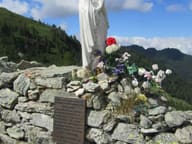 Colle RanzolaA plaque to Tolstoy, who came this way in 1857, and a dry-stone wall from 1800 against Napoleon