 The Aosta Trip
Châtillon Roman Bridge
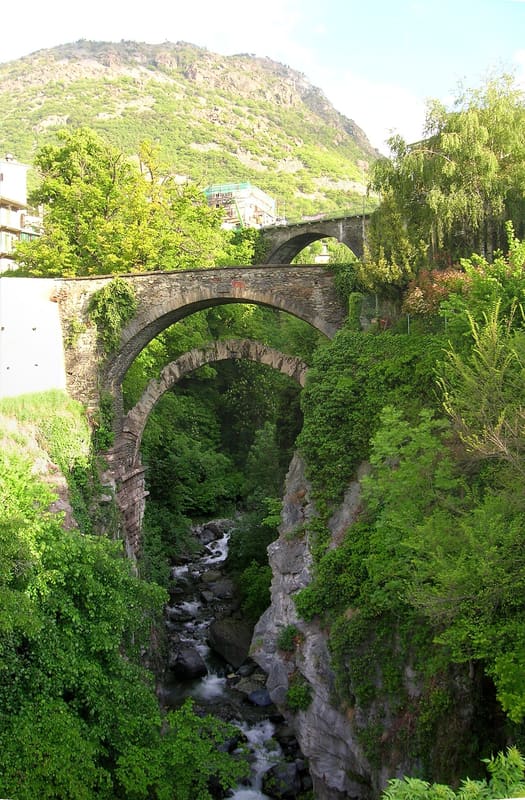
The Roman abutments, with a 15-metre arch, still carry the bridge over the Marmore
You can see the bridge from the road and from the mule track along the Marmore stream: it is the Roman abutments, in blocks of squared stone, that still carry the modern road surface today. On the stone the small notches used by the Romans to attach the lifting tongs remain visible.

Visiting
You can see it freely from the road and from the path along the Marmore, with no opening hours or ticket; you cannot walk on the Roman bridge, which is incorporated into the modern structure.
History
The Romans built the bridge on the road to Gaul to cross the Marmore stream, just outside Châtillon. It had a single round arch with a span of about 15 metres, with an internal structure of nine small arches (five of stone wedges alternating with four of concrete masonry, rubble bound with lime mortar) and a carriageway 4.60 metres wide, resting on abutments firmly anchored to the rock of the two banks. According to a local tradition, the very name of the Marmore stream is said to derive from the bridge.
For centuries the bridge served the traffic of the consular road, a crossing point towards the middle Aosta Valley. Its structure was, however, damaged in 1691, during the retreat of the French troops engaged in the War of the League of Augsburg: an engraving of 1797 already shows it rebuilt, perhaps in idealised form.
The upper part of the Roman carriageway has not survived, but the abutments and the layout of the structure remain functional: they have been incorporated into the bridge that still carries the road over the Marmore today, so much so that the ancient monument merges with the modern infrastructure that has absorbed it.
Today the bridge, still in use for local traffic, can be seen from the road and from the mule track that runs along the stream; on the squared stone of the Roman abutments the notches used by the builders to lift the blocks with tongs remain visible.
Nearby
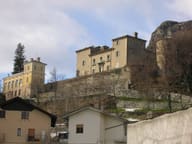 Passerin d'Entrèves CastlePrivate castle; entry to the park with monumental trees is free
- Ru de la PlaineIrrigation channel of 1325 bringing Valtournenche water to Châtillon and Saint-Vincent
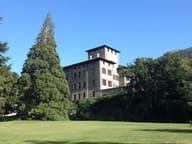 Gamba CastleIn the park, among 150 trees, grows a California giant sequoia
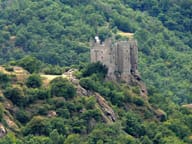 Ussel CastlePassed to the Region in 1983; linked to Marcel Bich, the Bic pen baron
- Casinò de la ValléeOpened on 29 March 1947 in the Grand Hôtel Billia; today 3,500 m² and over 400 slots
- Saint-Évence ChapelChapel of medieval origin on a plateau above the Valtournenche, within sight of the Matterhorn