 The Aosta Trip
Cly Castle
The Romanesque chapel dedicated to St Maurice preserves frescoes that are now faded
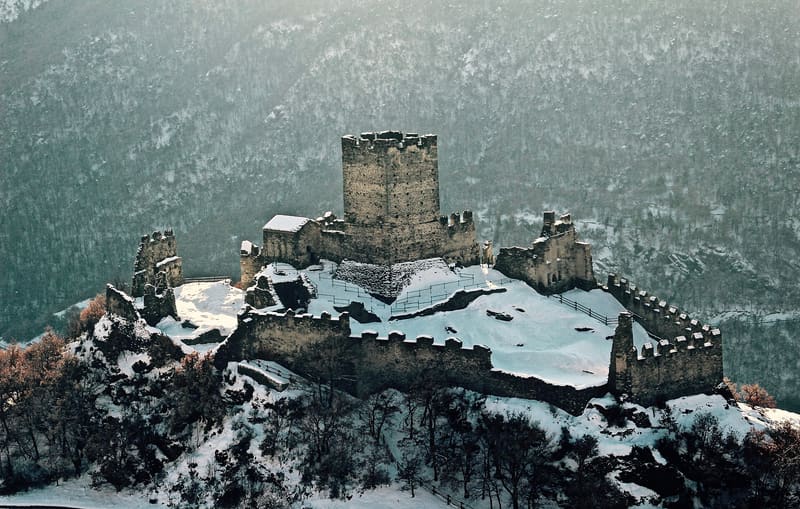
The castle occupies a rocky knoll above the valley, in an area with traces of protohistoric settlements. The remains are dominated by a keep, the main tower, built in the first decades of the eleventh century. Only the north entrance, the west esplanade and the chapel of San Maurizio, with its faded frescoes, can be visited, and only with a guide.

Visiting
You can only visit with a guide. From 1 July to 31 August visits run from Tuesday to Sunday, 10:00–12:30 (last admission at 12:00) and 14:30–18:00 (last admission at 17:30); in summer there is a charge for the visit. From September to June entry is by appointment only (+39 320 4369898), with a free guided tour weather permitting. The castle also opens for events. For information: Saint-Denis municipality (0166 546055). Not wheelchair accessible.
History
The rocky hill on which Cly Castle stands was already frequented in protohistoric times, between the Bronze and Iron Ages, as the 2006 excavations confirmed. The medieval site is first recorded in a deed that mentions the ‘cappella sancti Mauricij de castro Cliuo’; dendrochronological analysis of the timber structures of the donjon, the castle's main tower, nevertheless places the first core as early as around 1027, that is, in the first decades of the eleventh century.
Around the middle of the thirteenth century the Counts of Savoy granted the castle and a vast territory, which included Verrayes, Diémoz, Saint-Denis, Chambave, Antey, Torgnon and the whole Valtournenche, in fief to Bosone IV di Challant, founder of the Challant di Cly branch: it was he who enlarged and fortified the castle and gave it the form that has come down to us. His son Bonifacio I inherited the castle in the fourteenth century; his successor Pietro, however, opposed the Count of Savoy and, for his tyrannical conduct, was stripped of his title and possessions, which thus returned to direct Savoyard control from 1376.
In 1428 the castle was the scene of one of the first witchcraft trials in the western Alps: Johanneta Cauda was held prisoner for 71 days in the keep, accused of cannibalism, and finally burned at the stake in Chambave in August of the same year. After the Savoyard period the castle passed to several families: the San Martino, the de Candia counts of Vische and, from 1558, the Birago San Martino de Candia. In 1634 it passed to the Roncas barons, who let it fall into ruin and dismantled many of its valuable features to reuse them in their mansion in Chambave.
In the early twentieth century the historian Tancredi Tibaldi, then mayor of Saint-Denis, bought the building on behalf of the municipality, which still owns it. Today the ring of walls, the donjon, the Romanesque chapel and other buildings from different periods remain. The north entrance, the west esplanade and the chapel of San Maurizio can only be visited with a guide: in summer at fixed times, from September to June by appointment.
Nearby
- Ru MarseillerFifteenth-century channel carrying water from the Matterhorn valley to Verrayes and Saint-Denis
- Saint-Évence ChapelChapel of medieval origin on a plateau above the Valtournenche, within sight of the Matterhorn
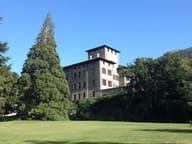 Gamba CastleIn the park, among 150 trees, grows a California giant sequoia
- Champlong Cross-Country TrailsOne variant passes a larch estimated to be 700 years old
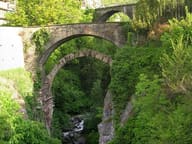 Châtillon Roman BridgeThe Roman abutments, with a 15-metre arch, still carry the bridge over the Marmore
- Ru de la PlaineIrrigation channel of 1325 bringing Valtournenche water to Châtillon and Saint-Vincent