 The Aosta Trip
Rifugio Quintino Sella al Felik
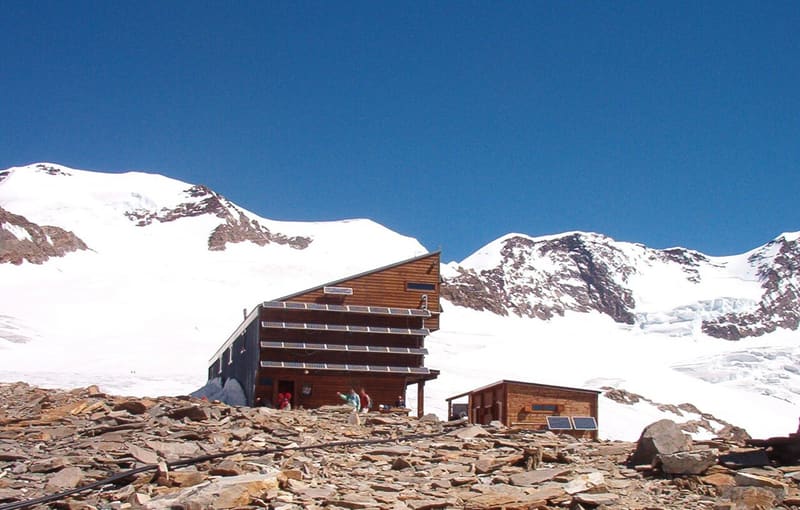
First hut from 1885, dedicated to Quintino Sella, founder of the CAI
It stands on the Felik plateau, at 3,585 m, below the pass of the same name. From the top floor you can see the Lyskamm range. It is the base for the Castore, one of the most accessible 4,000-metre peaks, and a stage of the Monte Rosa summits tour. The last section of the ascent is an exposed ridge equipped with a fixed rope. Next to it is the old hut, used as a winter room.

Visiting
From 06/06 to 12/09/2026; closed in spring 2026. 114 beds. From Staffal (Gressoney-La-Trinité): Stafal-Sant'Anna cable car and chairlift up to Colle Bettaforca (2,672 m), then on foot; last section on an exposed ridge with a fixed rope (3h (3–4h) from Colle Bettaforca, path 9, EE according to the official list, EEA according to the regional trail register). From Saint-Jacques (Ayas, 1,719 m): on foot via Resy and Colle Bettaforca (1,907 m height gain); alternatively the Frachey funicular and chairlifts, or a 4x4 taxi, up to Colle Bettaforca (5h48, path 9, EEA). From Staffal: on foot via the Vallone della Bettolina (about 1,700 m height gain) (5h30, path 1, then 9, EE). Phone: +39 0125 366113 / +39 348 8107793.
Trails
- from Colle Bettaforca (2,673 m) · ↑ 920 m · 2 h 44 min out, 1 h 40 min back · 4.4 km · EEA Equipped · path 9 · June, July, August, September
- from Saint-Jacques (1,719 m) · ↑ 1,907 m · 5 h 48 min out, 3 h 33 min back · 9.4 km · EEA Equipped · path 9 · June, July, August, September
Trails: data provided by the Struttura Forestazione e Sentieristica of the Aosta Valley Autonomous Region.
History
The first hut, built by the Gressoney carpenter Daniele Thedy for the Biella and Varallo CAI sections, was inaugurated on 15 August 1885 and named after Quintino Sella. It was rebuilt in 1907 by Floriano Lateltin and extended in 1924. After the landslide of 4 August 1936, over 200,000 cubic metres, it was moved back, and then again in 1945 onto the rock where it stands today. The present building was inaugurated on 29 August 1981 and renovated by the Biella CAI section in 2021.
Nearby
 Rifugio Ottorino MezzalamaOn the moraine of the Great Verra Glacier, at 3,036 m, facing Castore and Polluce
 Rifugio Guide Val d'Ayas al LambroneccaOn a rock spur between the Great and the Little Verra Glacier, at 3,425 m
- Laghi di RésySmall lakes between 2,523 and 2,572 m on a rock plateau at the foot of the Monte Rosso
 Colle BettaforcaStage of the Tour del Monte Rosa and starting point for the Quintino Sella al Felik hut
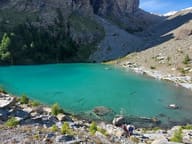 Lago BluTurquoise water in a basin on the moraine of the Verra glacier
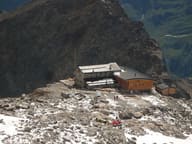 Rifugio Città di MantovaBuilt in 1984 with a gift from the families of 4 climbers from Mantova who died on the Lyskamm