 The Aosta Trip
Chamois
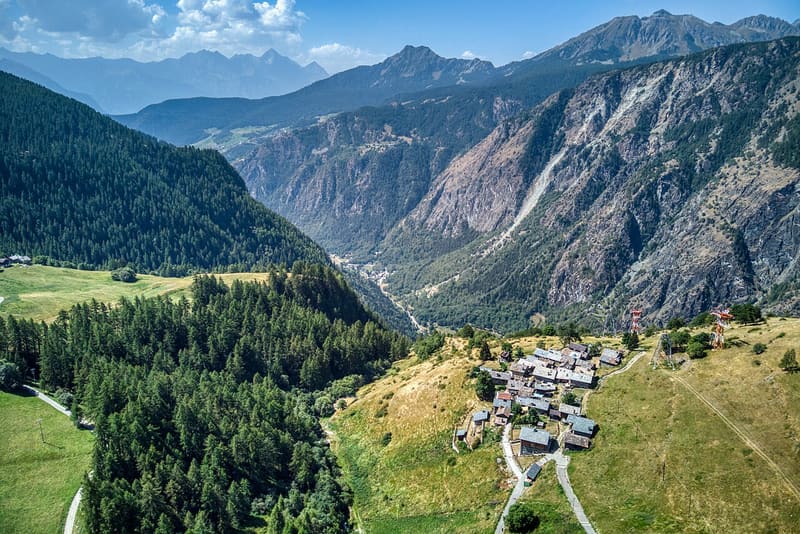
The only municipality in Italy with no road for cars: since 1955 you go up by cable car
The cable car from Buisson arrives at Corgnolaz, the main village, at about 1,815 metres: houses of stone and wood, narrow alleys and no cars. The church of San Pantaleone has its façade and bell tower facing east and, to the west, the presbytery with a vault and an octagonal dome. From here an almost level path leads to La Magdeleine, and by chairlift or in 40 minutes on foot you go up to the Lago di Lod.

Visiting
Car-free village, always accessible. Regional Buisson–Chamois cable car from Buisson (Antey-Saint-André): every day of the year except for short maintenance closures, from 7:00 to 22:30, departures every 30 minutes (every 15 at busy times); in summer the timetable is extended on Saturdays, Sundays, the 15 August holiday (Ferragosto) and during events. Non-residents: single €3.50, return €5.50; in July, August and the first week of September €4.50 and €7. Bicycles €3 per trip; dogs muzzled and on a lead, €2 single. Car park at Buisson free for the first two hours, then €3 until midnight; campervans and caravans not allowed. On foot: from Buisson by the Seingles mule track (700 m height gain, about 2 h 15 uphill, 1 h 30 downhill) or from La Magdeleine by a level path.
History
There is no record of the Chamois area being inhabited in pre-Roman or Roman times. The first settlers probably came in the centuries after the year 1000, when population growth led people to clear and live all year round on pastures previously used only for transhumance. In the fourteenth century Chamois was a fief of the lords of Challant-Montjovet, an exception in a Valtournenche held almost entirely by the Challant-Cly, and in church matters it depended on Antey-Saint-André. The charter of franchises that François, first count of Challant, granted on 21 May 1486 to the subjects of the lordship of Châtillon also covers Chamois.
On 21 July 1681 the bishop of Aosta, Albert-Philibert Bailly, made Chamois a parish, under the patronage of St Pantaleon, separating it from Antey. The inhabitants rebuilt and enlarged the chapel of Corgnolaz, already restored in 1632, and the new church was consecrated in 1707 by Bishop Amédée Milliet d'Avillars. With the church, Corgnolaz replaced La Ville as the main village. The present building dates from 1838: transformed and enlarged, it was then given its east-facing façade; inside it keeps a Baroque eighteenth-century high altar in carved, painted and partly gilded wood, which came from the parish of Torgnon, and from the old buildings there remain a fifteenth-century processional cross and a chalice of 1614.
In 1691, when the troops of Louis XIV invaded the Aosta Valley, Baroness Vittoria Solaro della Moretta, wife of the baron of Châtillon, left the castle and took refuge with her children among the subjects of Chamois, until the Marquis de La Hoguette, the French commander, found her and took her back to Châtillon as a hostage. In 1751 the Marquis Giacomo Bergera, baron of Cly, freed the community from the last feudal dues. The village had 320 inhabitants in 1707 and 386 in 1782; during the eighteenth century the first schools opened, among them the school for girls at La Ville established at the wish of Jean-Jacques Perruquet, parish priest from 1740 to 1750. The nineteenth century brought the cooperative dairy of Corgnolaz (1873, in operation until 1973), that of Crépin (1896, still in operation) and the town hall (1885).
From the second half of the nineteenth century the economic crisis in the Aosta Valley drove many to leave: the inhabitants, 373 in 1848, fell to 279 in 1921, to 194 in 1936 and to 141 in 1961. Until the mid-twentieth century the only way up was the Seingles mule track, which climbs from Buisson with some ninety hairpin bends, passing through La Ville. Instead of a road, the village chose the cable car, opened in 1955 and rebuilt in 1968; next to it runs a cableway for goods and animals. The Lago di Lod chairlift followed in 1960 and, in 1967, an altiport with a 350-metre runway, the first in Italy.
Chamois is the only municipality in Italy without roads for vehicles. Of the old village there remain many rural houses, the oldest dated 1654, the Crépin mill of 1834 with the chapel of the Transfiguration of 1856, the chapel of the Trinity at Moulins (1691) and the chapel of Notre-Dame de Pitié at Suis, from 1707 and rebuilt in 1931.
Nearby
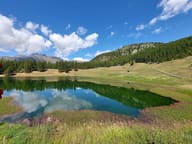 Lago LodAt 2,019 m above Chamois, the car-free municipality: by chairlift or in 35 minutes on foot
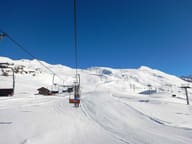 ChamoisThe village with no roads for cars: you go up to the lifts by cable car from Buisson
- Ru des NovallesIrrigation channel still in use, running level from Lago di Lod to Alpe Les Foressus
- Gilliarey Sanctuary1866 chapel on a rocky spur above Buisson, facing the Matterhorn
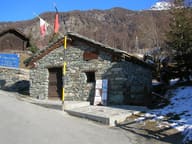 La Magdeleine MillsEight watermills in a chain along a stream, three of them grinding again
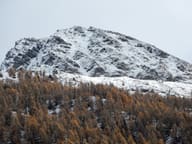 Mont TantanéBelow the summit, the walls of an Iron Age village of the Salassi at 2,440 m