 The Aosta Trip
Hangar 2173
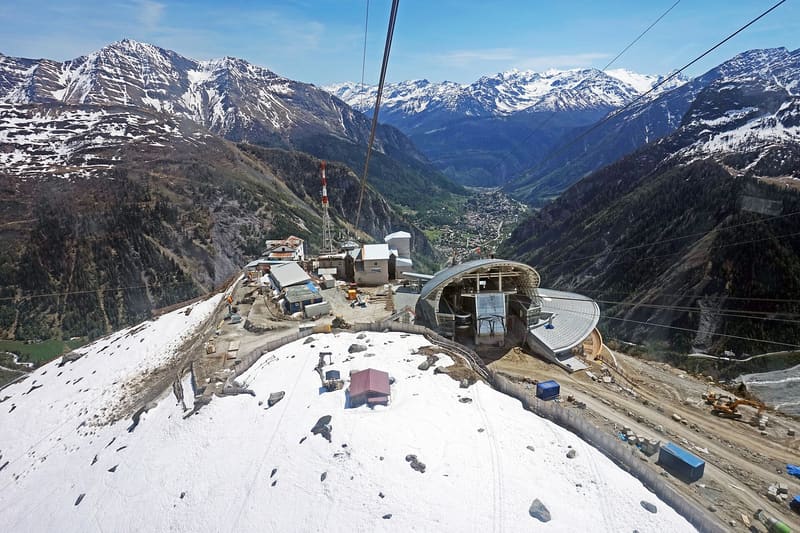
The steel cables of the old 1947 cable car become a work by Letizia Cariello
On the ground floor a video tells the story of building the new Skyway, with accounts from the actress Matilda Gioli, the mountaineer Hervé Barmasse and the astronaut Samantha Cristoforetti. On the lower floor, devoted to the old 1947–2015 cable car, the original steel cables are reused in the work ‘Una scala appesa al cielo’ by Letizia Cariello.

Visiting
It follows the opening hours of the Skyway Monte Bianco cable car, which is normally closed in November for maintenance. Admission is included in the cable car ticket (Pavillon station return: €24 online, €26 at the ticket office). Suitable for everyone, all year round except during the seasonal closures of the cable car.
Collections
Section — Today's construction site. The ground floor is devoted to the new Skyway Monte Bianco: a video tells the story of the construction ‘among the clouds’ of the cable car inaugurated in 2015, showing the work of the engineers and workers who built it, from the design by the architect Carlo Rossi to the assembly of the 80-person rotating cabins.
Section — The voices of the mountain. An installation with ‘sound showers’ gathers the accounts of three figures chosen as symbols of man, the cable car and the mountain: the actress Matilda Gioli, the mountaineer Hervé Barmasse and the astronaut Samantha Cristoforetti, each with their own story of the ascent towards Mont Blanc.
Section — The old cable car. On the lower floor, devoted to the 1947 cable car that remained in service until 2015, is the work ‘Una scala appesa al cielo’ by the artist Letizia Cariello: a sculpture built by reusing the original steel cables of the historic installation, the same cables along which for decades the cabins travelled between La Palud and Punta Helbronner.
Section — The evolution of the cabins. Near the exit, a painted silk scarf by the Aosta Valley artist Chicco Margaroli traces how the cabins of the Mont Blanc cable car have changed over time, from the first post-war ones, small and square, to today's rotating panoramic ones.
The exhibition has no temporary exhibitions of its own: it is part of the route through the Pavillon du Mont Fréty station, at 2,173 m, which also includes a high-altitude botanical garden, a 150-seat events room and the panoramic restaurant.
History
Dino Lora Totino, born in 1900, a count and heir to a family of textile industrialists from Biella, became passionate about cable car technology as a young man: by 1932 he had already built the link between Breuil and Plateau Rosà. In 1940 he signed the agreement with the military state property office to build a cable car on Mont Blanc, and in 1941 work began on the first section, from La Palud, a hamlet of Courmayeur (1,370 m), to Pavillon du Mont Fréty (2,173 m): a project interrupted by the war a few months after it began.
Work resumed after the war and the cable car opened to the public in 1947–48. In the 1950s the link continued with a far more difficult section, the one that crosses the glacier to Punta Helbronner: a construction project that cost four workers their lives and required the transport of about 300 km of cables. It fulfilled the dream of Lora Totino, who wanted to join Italy and France by cable car across the Mont Blanc massif.
The old Glaciers cable car remained in service, with upgrades over the years, until April 2012 for the summit section and until 2015 as a whole, when it was replaced by the new Skyway Monte Bianco, opened between May and June 2015 with 80-person rotating cabins; sources vary between 23 June and 30 May 2015 as the opening date.
On the two lower floors of the old Pavillon station, left standing while the rest of the historic installation was dismantled, Hangar 2173 then opened: a space that compares today's cable car with yesterday's, with a work of art made from the original 1947 cables.
Nearby
- Rifugio Chapy Mont BlancA Giovane Montagna house inaugurated in 1959, a Tour du Mont Blanc hut since 2025
 Skyway Monte BiancoCabins that rotate on their own axis up to Punta Helbronner, at 3,466 m
 Sanctuary of Notre-Dame-de-GuérisonA church of 1867, consecrated in 1868, its walls covered with crutches and ex-votos
 Passerin d'Entrèves Fortified HouseDated to 1351; since 1711 it has belonged to the Passerins, who live there in summer
 Rifugio TorinoFrom the Skyway at Punta Helbronner, a 150 m tunnel through the rock leads to the terrace
 Val Ferret Cross-Country TrailsFrom Planpincieux, 22 km of trails run up the Val Ferret as far as Lavachey