 The Aosta Trip
Gran Paradiso – ‘Bentornato gipeto’ Visitor Centre
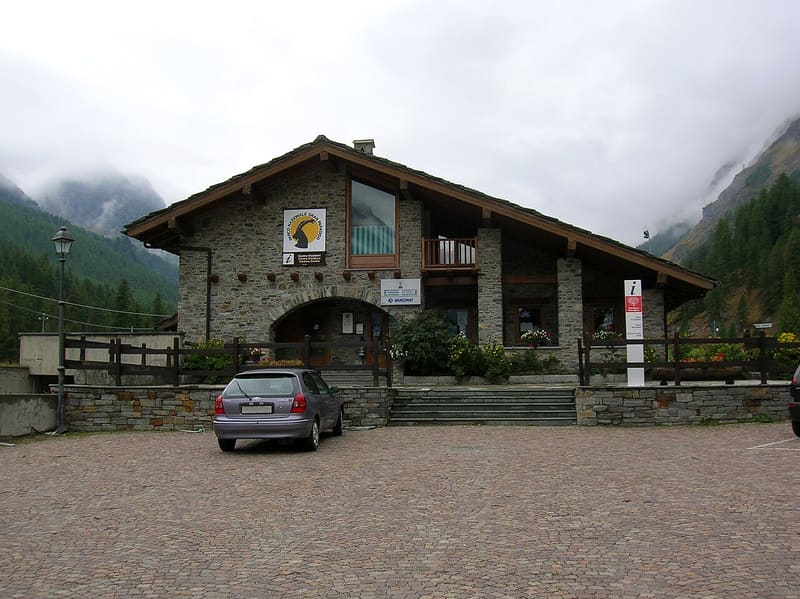
The return of the bearded vulture to the Park, with a reconstruction of its nest on a rock face
The centre is in Chanavey. A chronological route tells how the bearded vulture, which disappeared from the valley at the start of the twentieth century, returned to the Gran Paradiso National Park; in the hall there is a reconstruction of a nest on a rock face. Panels on the birds of the valley and a virtual reality station for the ascent of Gran Paradiso.

Visiting
Open in summer: from 20 July to 23 August every day 9:00–13:00 and 14:00–18:00; between late June and early September on weekdays 9:00–13:00, Saturdays and Sundays 9:00–13:00 and 14:00–18:00; in September at weekends. Then 5–8 December and 26 December–6 January 14:00–18:00. Full price €3, concession €1.50, free up to age 6.
History
The bearded vulture is the largest vulture in Europe: its wingspan reaches 2.85 metres and its weight 5–7 kilos. In the nineteenth century it was believed to carry off lambs, goats and even children, and its old name recalled this: in Italian it was ‘the vulture of the lambs’. In reality it does not attack live livestock. Because of rifles, bounties and poisoned baits left out for other predators, it disappeared from the whole of the Alps. The last Alpine specimen was shot in the Val di Rhêmes itself, in 1913 (some sources say 1912).
Its return began on paper in 1978, at Morges, in Switzerland, when experts from five Alpine countries decided to release young birds born in captivity instead of capturing wild birds elsewhere. The first were released in 1986 in the Hohe Tauern National Park, in Austria; France, Switzerland and, from 1994, Italy followed. In 1997 the first Alpine bearded vulture born in the wild in about eighty years hatched in Haute-Savoie, and the following year it was the turn of the Stelvio National Park, at Bormio. By 2015 the young birds released numbered over two hundred.
In the Gran Paradiso the first pair tried to breed in 2011 in Valsavarenche, but the chick, Siel, did not survive. In 2012 two young birds hatched and fledged: Iris in Valsavarenche and Champagne in the Val di Rhêmes, in a nest on the edge of the Park, almost a hundred years after the last one was shot in the same valley. The names were chosen by the schoolchildren of the two valleys. Today Cogne, Valsavarenche and Rhêmes each have one pair; the Valsavarenche nest is filmed by a park rangers' webcam, and one of the young birds born there was named Ilvo in memory of the mountain guide Ilvo Berthod.
There is no shortage of curiosities. The bearded vulture feeds almost only on bones: those that are too big it drops from a height onto the rocks to break them and swallow them. The rust-coloured breast of the adults is not a natural colour: it acquires it through ‘baths’ in soil in which the iron in the minerals stains the feathers. It lays two eggs, but as a rule only one chick survives, because the first to hatch prevails over its sibling. It matures slowly: the adult plumage comes after six or seven years. At the Chanavey centre, as well as the nest reconstructed on a rock face, there is an ‘ossuary’ that shows what it feeds on.
Nearby
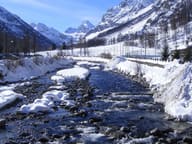 Rhêmes-Notre-Dame, ChanaveyA four-seater chairlift and a few runs on the edge of Gran Paradiso National Park
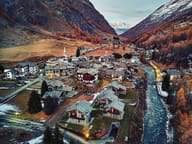 Rhêmes-Notre-Dame Cross-Country TrailsThe Pellaud loop runs along the Dora di Rhêmes and the Pellaud lake, for 13 km
- Bivacco Luigi RavelliA 10-place bivouac hut from 1982, at the foot of the Grande Rousse between two glaciers
- Col d'EntrelorPass at 3,002 m on the Alta Via 2, reached via Orvieille and the Djouan and Nero lakes
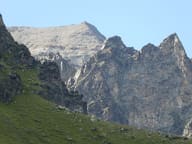 Punta BioulaOn the summit a statue of the Madonna; Victor Emmanuel II's hunting road climbed to it
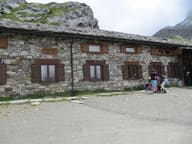 Rifugio Chalet de l'ÉpéeYou climb through the Arolla wood, among larches over five hundred years old