 The Aosta Trip
Mont Avic – Villa Biamonti Visitor Centre
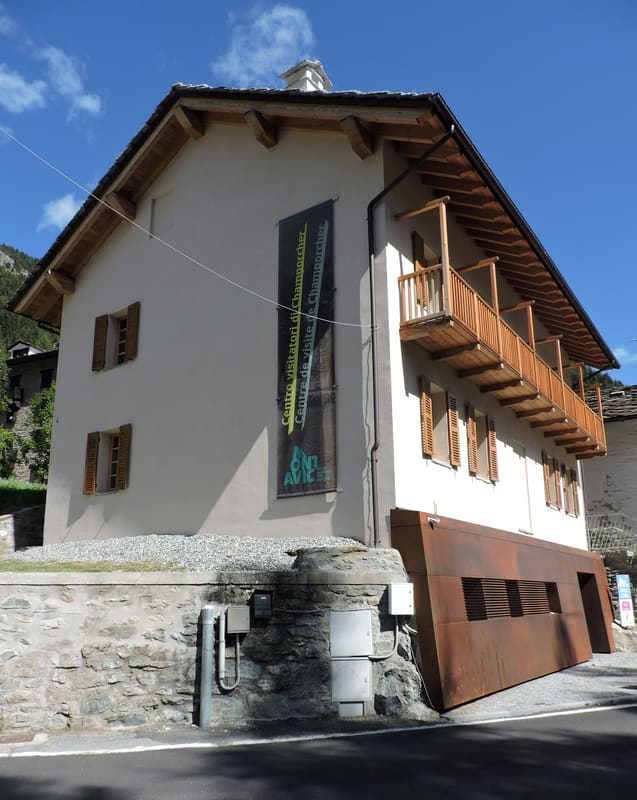
Restored early twentieth-century villa, with geological models of the Dondena valley
Villa Biamonti, a holiday residence from the early years of the twentieth century at Château, has been restored as a centre of Mont Avic Nature Park. On the first floor the geology and shape of the Dondena valley, with models onto which thematic maps are projected; on the second, flora, fauna and alpine pasture.

Visiting
Open every day from 27 June to 6 September, and at weekends in June and September, 9:00–13:00 and 14:00–18:00. Free admission.
History
Villa Biamonti was built in the early years of the twentieth century at Château, above the main village of Champorcher, as a holiday house. In 2006 Mont Avic Nature Park bought it from the municipality and renovated it, keeping the interior woodwork and the open layout of the rooms, and adding seismic-resistance standards, an insulated wood-fibre envelope and geothermal heating. The visitor centre was opened in 2014.
The park, created in 1989 on the Champdepraz side alone, arrived here in May 2003, at the request of Champorcher municipality: the Region included the upper Dondena valley in it, and since then Mont Avic has bordered Gran Paradiso National Park.
Before the park, Dondena was royal hunting ground. Victor Emmanuel II came to Champorcher for the ibex and had a road built towards Dondena, his favourite reserve. Between 1861 and 1864 about 300 km of hunting mule tracks were laid out, with a main route of 150 km from Champorcher to Ceresole and five hunting lodges along the way, the first at Dondena. From the Fenêtre de Champorcher the king went down towards Cogne without passing through Aosta. He used them until 1876.
This side too had its iron mines. On Mont Ros, between 2,050 and 2,200 m, magnetite was being dug as early as 1646: the floods between 1646 and 1655 destroyed the foundries near the village of Chardonney, and in 1669 the mines passed to the municipality. In 1697 Bernardo Mutta arrived, the same entrepreneur who four years earlier had taken the concession for the Lac Gelé on the other side of the park. Digging continued, with long breaks, until 1843, when a survey counted more than 300 m of tunnels; by the late nineteenth century landslides had almost wiped them out.
Nearby
- Champorcher Cross-Country TrailThe Moulin loop runs through the woods along the Ayasse stream, between Château and Chardonney
- ChamporcherFrench, Swedish and Spanish national teams train on the Del Bosco run
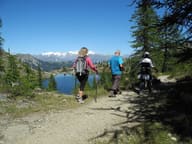 Colle del Lago BiancoGateway to the Mont Avic park, with views of the Matterhorn, Monte Rosa and Dent d'Hérens
- Lago di PanazSubalpine lake with a peat bog; the ascent crosses the Gorf bridge, suspended over a gorge
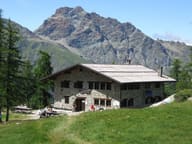 Rifugio BarbustelBuilt in 1994 on the ruins of an alpine pasture, above the Lago Bianco of Mont Avic
 Lago MufféMont Avic lake with a refreshment point, an hour from the Cort car park